Medically reviewed • Evidence-led under-eye filler education • Updated October 2026
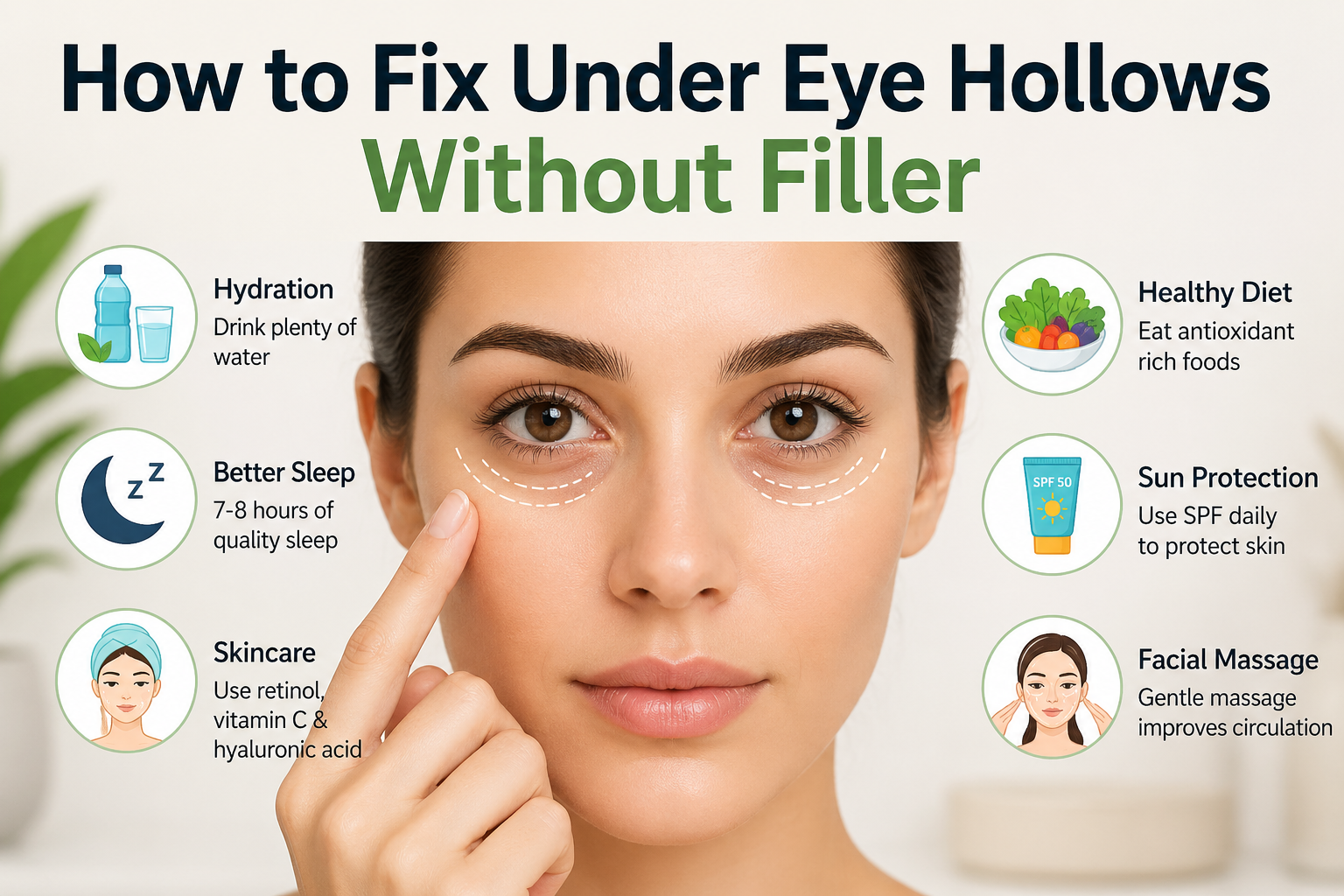
How to Fix Under Eye Hollows Without Filler: 7 Options That May Help23 min read
To fix under eye hollows without filler, identify the cause first. Makeup, skincare and lifestyle changes improve appearance and skin quality. PRP, PRF, polynucleotides, microneedling, radiofrequency and lasers target skin quality, texture or laxity, with variable evidence. Surgery is the main non-filler route that changes volume.
The seven categories at a glance:
- Makeup and light-reflecting concealers
- Skincare for thin or crepey skin
- Lifestyle factors
- PRP and PRF
- Polynucleotides and other regenerative treatments
- Microneedling, radiofrequency and selected lasers
- Surgery: fat grafting or lower blepharoplasty, when appropriate
You can make under-eye hollows less noticeable without filler, but you usually can’t replace substantial lost volume without adding or moving tissue. Makeup, skincare and selected professional treatments (PRP, PRF, polynucleotides, microneedling, radiofrequency or laser) may soften shadows or improve thin, crepey skin. Only surgery, such as fat grafting or fat repositioning, adds or moves volume, and surgery is not a non-surgical option. The best choice depends on whether your main problem is structural hollowing, thin skin, pigmentation, laxity or a mix, so working out the cause comes first.
Treatment-Selection Matrix
| Option | Main target | Does it add volume? |
|---|---|---|
| Makeup | Appearance of shadow | No |
| Skincare | Hydration, texture, pigmentation | No |
| Lifestyle changes | Contributing factors | No |
| PRP / PRF | Skin quality | Not reliably |
| Polynucleotides | Skin quality | No; hyaluronic acid is stronger for structure |
| Microneedling / RF / laser | Texture, laxity, pigmentation | No |
| Fat grafting / repositioning | Structural hollow | Yes (surgical) |
Can You Fix Under-Eye Hollows Without Filler?
Sometimes partly, and rarely completely. It depends on what is causing the hollow.
- What non-filler treatments can realistically improve: skin texture, fine lines, crepey skin, some pigmentation, and how visible the shadow looks.
- What they cannot correct: a hollow caused by significant volume loss in fat or bone support.
- Reducing a shadow vs restoring lost volume: concealer and brighter, firmer skin make a hollow less obvious. Only added or relocated tissue fills it.
- Why results vary: anatomy, age, skin quality, the cause of the hollow and the treatment all change the outcome.
Can deep under-eye hollows be fixed without adding volume? Usually not fully. Treatments that improve skin quality may help at the margins, but a deep groove caused by volume loss generally needs volume. That is why surgery, or filler, comes up for deeper hollows. Be wary of anyone who promises that skincare or a skin booster alone will remove one.
In simple words:
| Cause of Hollow Look | Can It Improve Without Filler? |
|---|---|
| Dehydration | Yes |
| Poor sleep | Yes |
| Allergies or puffiness | Yes |
| Pigmentation | Yes |
| Thin under-eye skin | Partly |
| Mild collagen loss | Partly |
| Skin laxity | Partly |
| True fat loss | Limited |
| Deep tear trough anatomy | Limited |
| Bone structure | Usually no |
What Causes Under-Eye Hollows?
he tear trough is a groove that runs from the inner corner of the eye down and outward toward the cheek. When the area sinks, it is called an infraorbital hollow (or tear trough hollowing), and the shadow it casts can look like tiredness or dark circles. A tear-trough review in the Journal of Cutaneous and Aesthetic Surgery describes how ligaments anchor the skin to bone at the lid-cheek junction, so the groove shows when the tissue around it changes.
Genetics and inherited facial structure
Genetic under-eye hollows are common. The shape of the cheekbone and orbital rim, and how much fat sits under the eye, are partly inherited, which is why some people have a groove in their twenties.
Age-related changes in fat, skin and bone support
Age-related fat loss under the eyes, thinning skin, loss of collagen and elastin and changes in the midface and cheek support all deepen the groove over time.
Thin skin and visible blood vessels
Thin under-eye skin is translucent. Muscle and vessels show through, which adds a blue or purple cast on top of any shadow.
Weight changes and other factors that affect facial appearance
Significant weight loss can reduce facial fat, and illness or marked dehydration can make eyes look sunken. A sudden or unexplained change deserves a medical assessment. Persistent structural hollows are not simply caused by poor sleep or low water intake, so don’t assume they are.
When hollows coexist with pigmentation, puffiness or bags
Many people have a mix: a hollow plus brown pigment, or a hollow beside a fat bag. Each part needs its own approach, which is why diagnosis matters.
Why do my eyes look sunken even when I sleep well? Because the cause is often structural (genetics, fat and bone support) rather than tiredness.
Reasons Why Under Eye Hollows Happen?
Under-eye hollows rarely happen for only one reason. Most people have a mix of skin, fat, bone, pigmentation, and lifestyle factors.
1. Natural Fat Loss
As the face ages, fat pads under the eyes and cheeks can shift, shrink, or descend. This can make the tear trough look deeper.
The area under the eye depends on support from the lower eyelid, cheek fat pads, and midface structure. When that support decreases, a hollow shadow becomes more visible.
2. Thin Under-Eye Skin
The skin under the eyes is naturally thin. When collagen and elastin decrease, blood vessels, pigmentation, and shadows can show more easily.
This is why some people look hollow even if they do not have major fat loss.
3. Tear Trough Anatomy
Some people are born with deeper tear troughs. In these cases, hollows may appear even at a young age.
This is often genetic and may be linked with facial bone structure, orbital rim shape, cheek projection, and lower eyelid anatomy.
4. Midface Volume Loss
Sometimes the hollow is not only under the eye. The real issue is the upper cheek losing support.
When the cheek becomes flatter, the under-eye area looks more sunken because there is less transition between the lower eyelid and cheek.
5. Pigmentation and Vascular Darkness
Dark circles can make hollows look worse. Brown pigmentation, blue-purple vascular darkness, or post-inflammatory pigmentation can create the illusion of depth.
This is called pseudo-hollowing because the shadow looks like a hollow, but the main problem may be skin color or blood vessel visibility.
6. Puffiness Above the Hollow
Under-eye bags can make hollows look deeper. When there is swelling or fluid retention above the tear trough, the groove below it becomes more obvious.
Salt intake, allergies, poor sleep, crying, alcohol, and water retention can all make this worse.
7. Dehydration and Poor Sleep
Dehydrated skin can look thinner and less plump. Poor sleep can make the under-eye area appear darker and more tired.
These factors usually do not cause permanent hollows, but they can make existing hollows look more noticeable.
First, Identify What Is Making Your Under-Eyes Look Hollow
Before choosing a treatment, use this simple self-check
Take one photo in overhead light and one with flash. A tear-trough review notes that circles caused by a hollow largely disappear under flash. Then match what you see:
| Main concern | What it may look like | What treatment should target |
|---|---|---|
| Structural hollow | A groove or depression casting a shadow | The underlying anatomy and volume deficit |
| Thin or crepey skin | Fine lines, translucency, visible vessels | Skin quality and texture |
| Pigmentation | Brown or uneven coloration | The cause of the pigmentation |
| Vascular discoloration | Blue or purple tones through thin skin | The underlying vascular and skin factors |
| Eye bags or puffiness | Bulging or swelling rather than a depression | Fat protrusion, fluid retention or another cause |
| Mixed concerns | Shadows, discoloration and texture changes together |
.
Type 1: Shadow Hollow
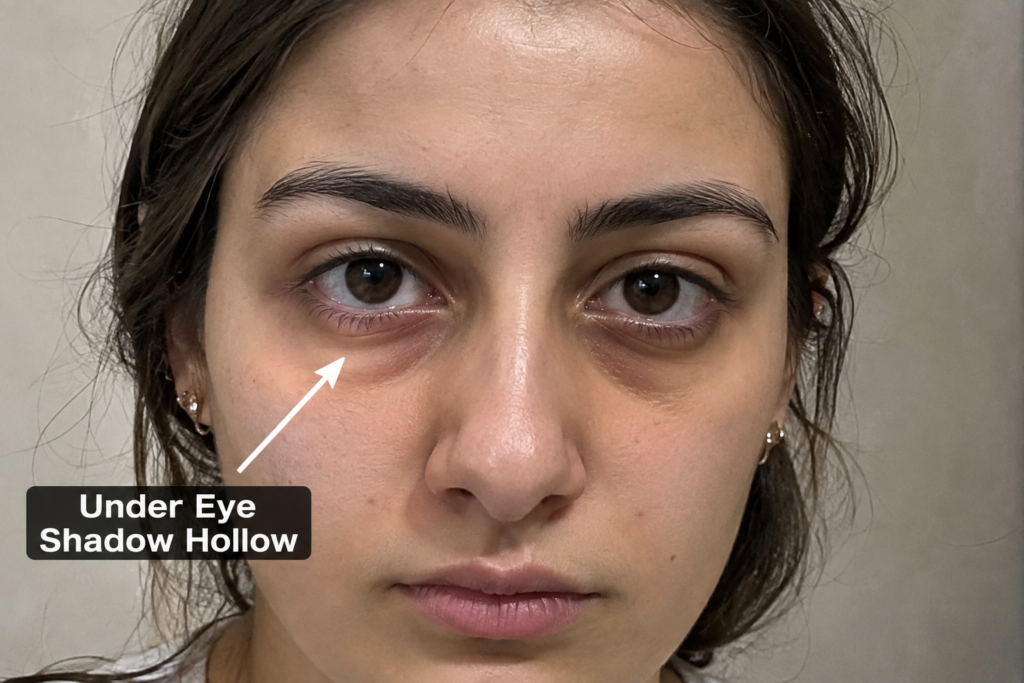
Your hollow looks worse in overhead lighting or photos. The skin may not be very dark, but the groove creates a shadow.
Best options: cheek support, collagen treatments, skincare, professional assessment.
Type 2: Pigmentation Hollow
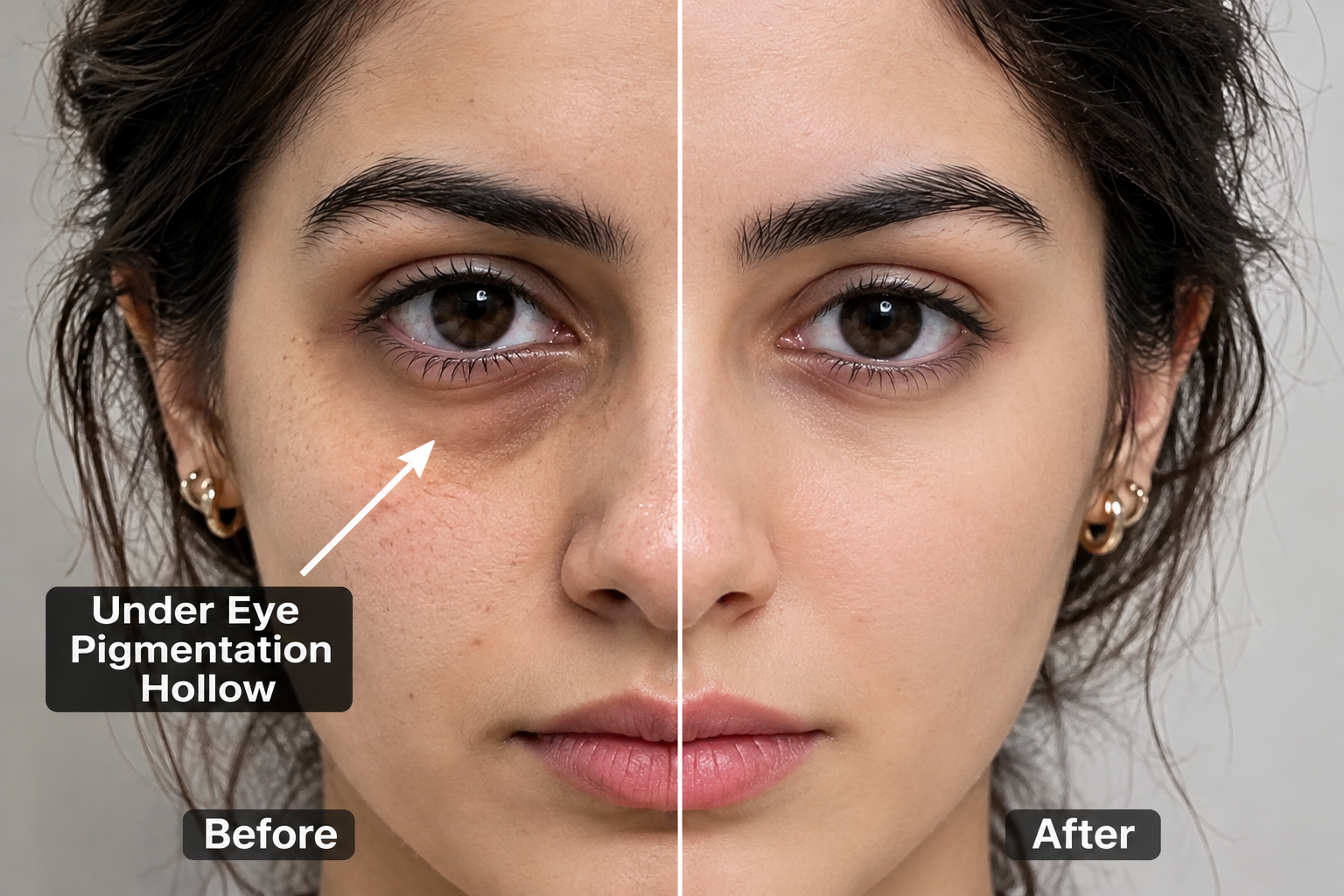
The area looks brown, grey, or dark even in soft lighting. The darkness may stay the same even when you pull the skin gently.
Best options: sunscreen, vitamin C, retinoids, pigment-safe skincare, dermatologist treatment.
Type 3: Thin-Skin Hollow
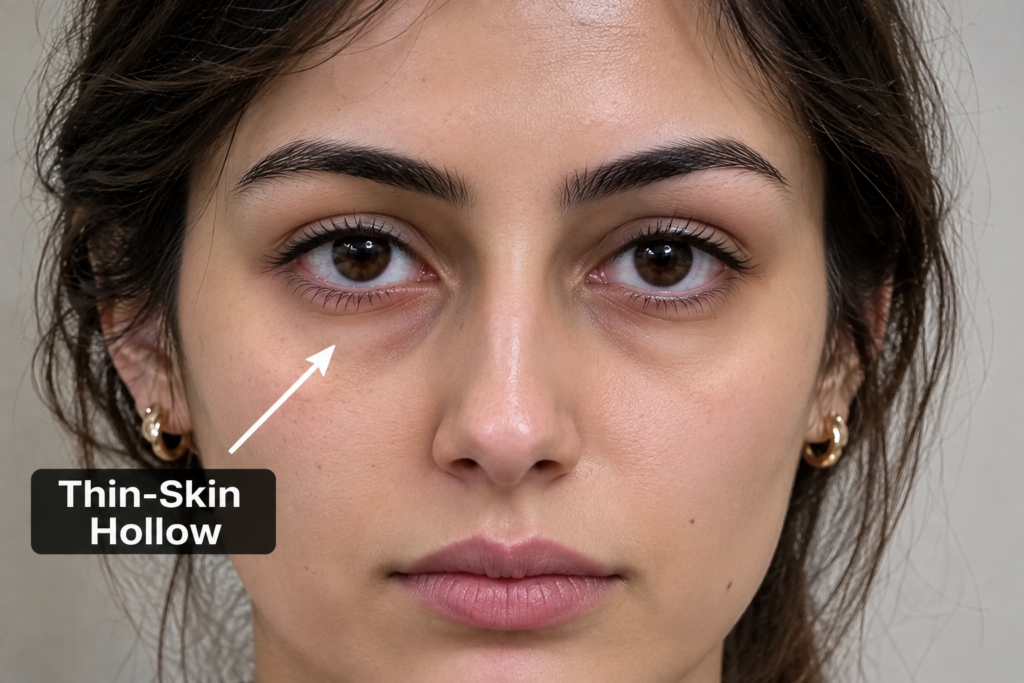
The area looks blue, purple, or transparent. Veins may show. Skin may look thin or crepey.
Best options: retinoids, peptides, PRP/PRF, polynucleotides, microneedling, laser under professional care.
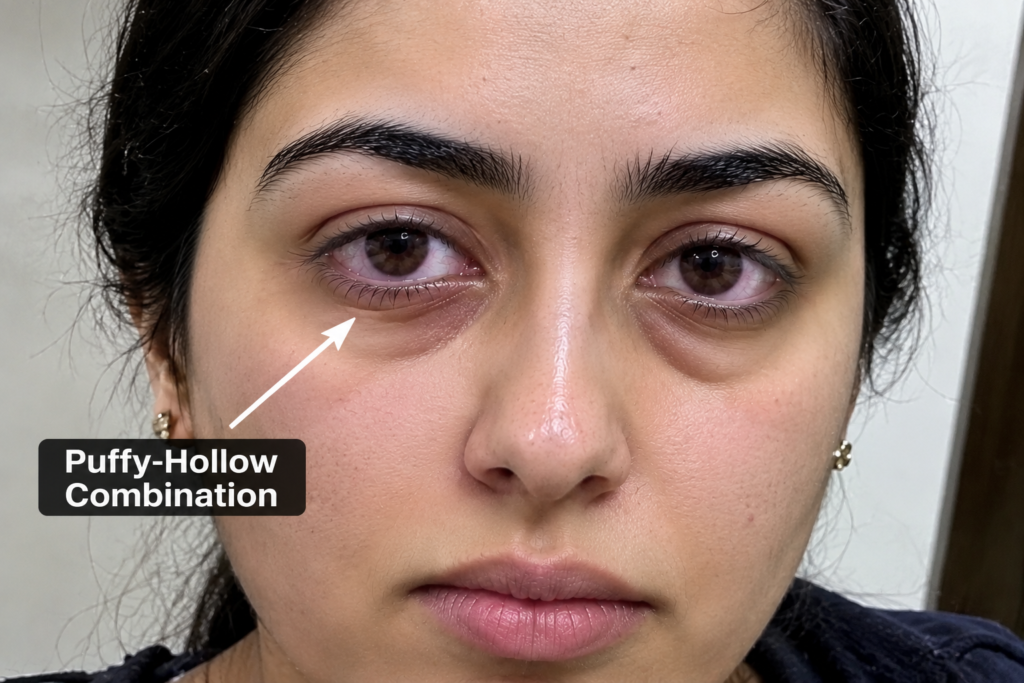
Type 4: Puffy-Hollow Combination
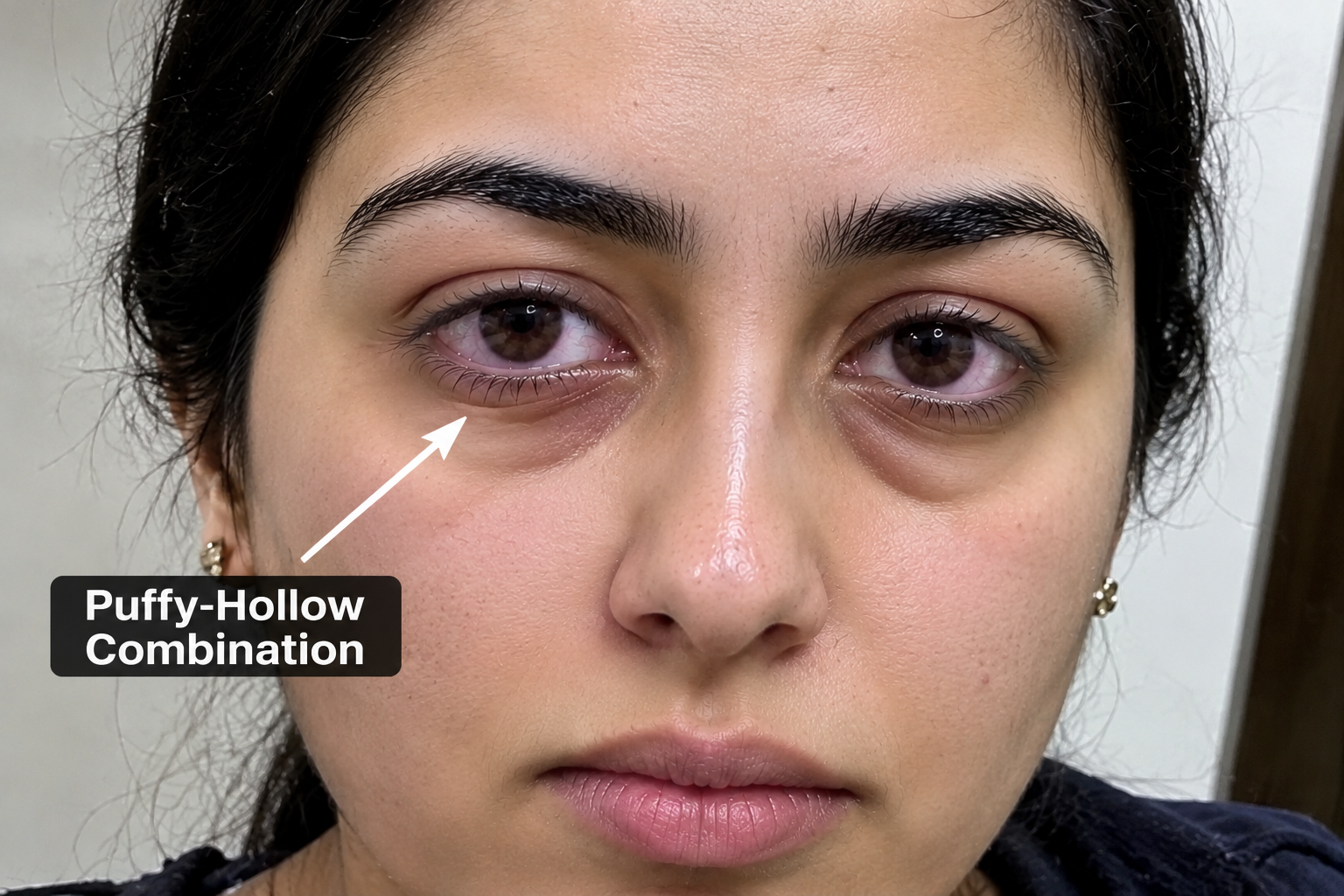
You have under-eye bags or swelling above a groove. The puffiness casts a shadow below.
Best options: allergy control, salt reduction, sleep improvement, cold compresses, medical evaluation if swelling is persistent.
Type 5: True Volume-Loss Hollow
The area looks physically sunken. It may be present in all lighting and may not improve much with sleep or skincare.
Best options: regenerative treatments for mild improvement, fat grafting or surgical correction for stronger correction.
7 Ways to Improve Under-Eye Hollows Without Filler
Each option below follows the same pattern: what it does, best fit, limits, pace, downtime, safety and cost factors.
1. Makeup and Light-Reflecting Concealers
- What it does: changes how light hits the area. Color-correcting products neutralize brown or blue tones, and a light-reflecting concealer placed in the shadow, then gently blended, makes the groove look shallower.
- Best fit: shadows and discoloration of any cause.
- Limits: it changes appearance, not anatomy. It wears off.
- Pace and downtime: immediate, none.
- Safety and cost: low risk; choose gentle formulas and remove them thoroughly. Cost is the product price.
This answers can makeup hide a tear trough? It can reduce the look of one in many lighting conditions, but not in every light.
2. Skincare for Thin or Crepey Under-Eye Skin
- What it does: retinoids, vitamin C, peptides, moisturizers and daily sun protection can improve hydration, texture and tone over time. Hyaluronic acid skincare plumps the surface temporarily.
- Best fit: thin, crepey skin and mild discoloration.
- Limits: benefits are usually gradual and modest, and skincare cannot replace missing fat or bone support. So can skincare fix deep under-eye hollows? No.
- Pace and downtime: weeks to months, no downtime.
- Safety: the eye area is delicate, so introduce one product at a time, start slowly and stop if you get irritation. Ask a clinician before using strong retinoids near the lids.
- Cost factors: product price and how many products you use.
3. Addressing Contributing Lifestyle Factors
- What it does: adequate sleep, sun protection, avoiding smoking and managing known allergies (including avoiding eye rubbing) address contributors to a tired look.
- Best fit: puffiness, pigment and dullness that worsen with these factors.
- Limits: these steps will not reverse a structural hollow. Can drinking more water fix hollow eyes? Staying hydrated supports skin health, but it will not rebuild a groove.
- Pace: gradual and variable. Downtime: none. Cost: minimal.
4. PRP and PRF Treatments
- What it does: platelet-rich plasma (PRP) and platelet-rich fibrin (PRF) are made from your own blood, concentrated for platelets and growth factors such as platelet-derived growth factor (PDGF), then injected. They are aimed at skin quality, not volume.
- Best fit: thin or crepey skin, mild discoloration and mild hollowness.
- What the research says: a 2025 systematic review found PRF was linked to improvement in skin texture, wrinkles and crepiness, while PRP had stronger evidence for hyperpigmentation, and that PRF has less research behind it. A randomized split-face trial of PRP vs PRF (three sessions, followed up to 7 months) reported improvement in periorbital pigmentation, fine wrinkles and mild hollowness. Trials are small and protocols differ. So do PRP or PRF treatments work for hollow eyes? They may modestly help mild cases, but the evidence does not show that they rebuild a deep hollow.
- Pace and downtime: gradual; multiple sessions may be proposed. Bruising or swelling is possible. Ask whether blood disorders or certain medications affect eligibility.
- Cost factors: per-session price, number of sessions and maintenance.
5. Polynucleotides and Other Regenerative Treatments
- What it does: polynucleotides (including PDRN) are proposed to improve dermal quality, hydration and elasticity. Skin boosters (non-crosslinked hyaluronic acid) hydrate the skin.
- Best fit: thin, crepey skin with fine lines.
- What the research says: a 2026 review concluded that hyaluronic acid remains superior for structural correction, while polynucleotides showed consistent gains in elasticity, hydration and fine lines, though study designs vary too much to be definitive. In a 27-person split-face trial against non-crosslinked hyaluronic acid, overall improvement scores did not differ significantly, and the polynucleotide side kept more elasticity and hydration gains. So do polynucleotides restore lost volume? No.
- Regulatory status: reports as of mid-2025 say no injectable polynucleotide product is FDA-approved for aesthetic use in the U.S., though products are CE-marked in Europe and approved in South Korea. Status varies by country and product, so check locally.
- Pace, downtime, cost: gradual, often a series of sessions; swelling or bruising may occur; costs vary.
6. Microneedling, Radiofrequency and Selected Laser Treatments
These are different procedures, not one:
- Microneedling: creates tiny channels to stimulate repair. It may help texture.
- Radiofrequency (RF) microneedling: adds heat to tighten and remodel skin. In October 2025 the FDA issued a safety communication reporting serious complications with RF microneedling, including burns, scarring, fat loss, disfigurement and nerve damage. It said these devices should be used by trained providers and not at home. Fat loss matters here because it could deepen a hollow.
- Fractional laser and IPL: may help texture, pigment or laxity. A 2025 expert consensus for periocular lasers lists corneal burns, ectropion, dry eye, infection and vision loss among serious risks, and calls for pre-treatment screening and eye shields.
- Chemical peels: clinician-applied peels may be used for under-eye discoloration, chosen for your skin type.
- Best fit: texture, mild laxity, pigment.
- Limits: none of these replaces volume, and they are not interchangeable.
- Pace and downtime: usually gradual; redness and swelling vary by device.
- Cost factors: device, number of sessions and the provider.
Brand-name devices such as Morpheus8 are examples of RF microneedling. The FDA’s concerns apply to the category.
7. Surgical Options: Fat Grafting or Lower Blepharoplasty, When Appropriate
Surgery is not a non-surgical alternative, but it is the main non-filler option that changes volume.
- Fat grafting: moves your own fat into the hollow. It may suit selected volume deficits.
- Lower blepharoplasty with fat repositioning: relocates bulging under-eye fat into the groove. In a 2017 comparison of 101 patients, fat repositioning gave greater improvement than fat grafting in grade II and III deformities, while both were acceptable for mild deformity without skin laxity. Reviews note that removing fat alone can deepen the tear trough, which is why lower blepharoplasty is not automatically right for every hollow.
- Implants: tear-trough implants are also described in the literature. They involve surgery and permanent material, so they need a specialist discussion.
- Safety: both approaches need specialist assessment and carry procedural risks, including complications of lower-lid surgery that can need correction.
- Pace, downtime, cost: the longest recovery of the group and the highest cost, depending on the procedure.
Compare the Best Non-Filler Treatments for Under-Eye Hollows
| Treatment | Main target | Speed of visible change | Main limitation | Evidence note |
|---|---|---|---|---|
| Makeup | Appearance of shadow | Immediate | Temporary; no structural change | Cosmetic camouflage |
| Skincare | Hydration, texture, pigmentation | Gradual | Does not replace lost volume | Modest, gradual effects |
| Lifestyle changes | Relevant contributing factors | Variable | Limited effect on structural hollowing | Supportive only |
| PRP / PRF | Selected skin-quality concerns | Gradual; varies | Response varies | Small trials; PRF has less research |
| Polynucleotides | Selected skin-quality concerns | Gradual; varies | Regulatory status varies; no volume | Mixed designs; reviews cautious |
| Microneedling / RF / laser | Texture, laxity or pigmentation | Usually gradual | Device-specific risks; not volume | FDA RF safety communication (2025) |
| Surgery | Selected structural issues | Depends on procedure and recovery | Invasive, with surgical risks | Clinical series; specialist-dependent |
How long do non-filler treatments take to work? Most skin-quality treatments are planned as a series and judged over months, not days. In the PRP vs PRF trial above, patients had three sessions and were assessed at 3, 4 and 7 months. Anyone who guarantees a timeline is overpromising. Be cautious with online forums too: advice on threads such as “how to fix under eye hollows without filler reddit” is anecdotal, not evidence.
What Will Not Truly Fix Under Eye Hollows?
Some methods can temporarily refresh the area, but they will not fix real volume loss.
Eye Cream Alone
Eye cream can hydrate, brighten, and smooth the skin. It cannot replace lost fat or change bone structure.
Cucumber Slices
Cucumber may cool the skin and reduce temporary puffiness, but it will not correct tear trough anatomy.
Ice or Cold Spoons
Cold compresses may reduce swelling for a short time. They do not build collagen or restore volume.
Face Massage
Gentle lymphatic massage may reduce fluid retention, but aggressive massage can irritate the under-eye area. It will not fill a true hollow.
Collagen Drinks
Collagen supplements may support general skin health for some people, but they should not be expected to directly fill under-eye hollows.
Random Home Remedies
Lemon juice, toothpaste, baking soda, and harsh DIY remedies should never be used near the eyes. They can irritate or damage the skin.
Which Treatment Is Best for Your Type of Under-Eye Hollow?
There is no universal best treatment, and combinations are not automatically better.
A simple decision path: (1) Take overhead and flash photos. (2) If a groove casts a shadow that fades under flash, you likely have a structural hollow. (3) If color stays, think pigment or vessels. (4) If a bulge sits above the groove, think bags. (5) Bring your photos to a qualified clinician.
Best options for mild hollows and thin skin
Skincare, makeup and, in some cases, PRP, PRF or polynucleotides may improve thin skin and soften mild shadows.
What may help when dark circles are the main concern
Pigment-directed skincare, chemical peels or selected lasers, chosen for your skin type, address color. PRP has some evidence for pigmentation, and filler is a different route if hollowness is the driver. See our guide to under-eye fillers for dark circles.
What to consider when hollows occur with skin laxity
RF microneedling or laser may tighten mildly loose skin, but weigh the risks near the eye. Significant laxity may need a surgical opinion.
Why significant structural hollowing may need a different approach
A clinical series of 78 patients grouped tear troughs by anatomy. It concluded that mild-to-moderate volume loss without severe fat bulging may suit filler or fat grafting alone, while more pronounced deformities with fat bulging and excess skin are often better served by fat repositioning with grafting. Skin-quality treatments do not replace that volume.
When eye bags or puffiness require a different evaluation
A fat bag casts its own shadow and can look worse with more volume. Persistent puffiness, cheek-side swelling or a recent change should be assessed first.
| Hollow Type | Best Non-Filler Options | Expected Improvement |
|---|---|---|
| Dehydration-related hollow | Hydration, sleep, moisturizer | Mild to moderate |
| Pigmentation hollow | Sunscreen, vitamin C, retinoid, dermatologist treatment | Mild to moderate |
| Thin-skin hollow | Retinoids, peptides, PRP/PRF, polynucleotides | Mild to moderate |
| Puffy-hollow look | Allergy control, cold compress, salt reduction, medical evaluation | Mild to strong if puffiness is the cause |
| Mild collagen loss | Retinoids, microneedling, laser, RF with expert care | Mild to moderate |
| Deep fat-loss hollow | Fat grafting, lower blepharoplasty, professional treatment plan | Moderate to strong |
| Bone-structure hollow | Usually needs structural correction | Limited without volume |
How Much Do Under-Eye Filler Alternatives Cost?
I don’t list dollar prices here because I couldn’t verify dated, sourced figures for each treatment. Cost depends on:
- Provider qualifications and location
- Treatment type (skincare is cheapest; surgery is the highest)
- Number of sessions, since a one-session price and a multi-session price are not directly comparable
- Maintenance: skin-quality results fade, so repeat sessions add to the total, while surgery is a larger upfront cost
Will the results last? Skincare and injectable skin-quality treatments need ongoing upkeep, and ageing continues, so hollows can progress. How can I prevent it? You can’t prevent genetic or age-related volume loss, but daily sun protection, not smoking and managing allergies protect skin quality.
Before you commit, ask for a written estimate covering every session and follow-up. To compare against filler pricing, see our under-eye filler cost guide.
Risks, Recovery and Choosing a Qualified Provider
The skin around the eye is among the thinnest on the body, so treatments here need anatomical knowledge. Risks differ by treatment:
- Common to injections and devices: bruising, swelling, redness, irritation, pigment changes.
- RF microneedling: burns, scarring, fat loss, nerve damage (FDA safety communication).
- Periocular lasers: corneal burns, ectropion, dry eye, infection, vision loss without proper safeguards.
- Surgery: procedure-specific complications, including lid malposition.
What to avoid: unverified at-home devices, DIY needles or injections, and aggressive scrubbing. The FDA says RF microneedling is a medical procedure and not for home use.
Choose the provider carefully: look for a board-certified dermatologist, plastic surgeon or oculoplastic surgeon with specific periocular experience and a clear plan for complications.
When should I contact a professional? Seek prompt medical attention for significant pain, vision changes, spreading redness, fever or any worrying symptom after a procedure. Also get an assessment before any treatment if you have persistent swelling or a sudden change.
Filler vs Non-Filler Options
| Option | Adds Volume? | Best For |
|---|---|---|
| Skincare | No | Texture, pigmentation, hydration |
| Sleep and hydration | No | Temporary tired look |
| Allergy control | No | Puffy, irritated under-eyes |
| PRP/PRF | Minimal | Skin quality, thin skin |
| Polynucleotides | No major volume | Crepey skin, elasticity |
| Microneedling | No | Texture and collagen support |
| Laser | No | Pigmentation, fine lines |
| RF treatments | No | Mild laxity |
| Fat grafting | Yes | True volume loss |
| Lower blepharoplasty | Structural correction | Bags, fat repositioning, deep troughs |
When Filler May Still Be the Right Option
Even if you prefer filler-free treatments, it is important to understand when filler may still be useful. Some people have true tear trough volume loss that cannot be corrected with skincare, sleep, or collagen treatments alone.
If you are comparing non-filler options with filler, it can help to look at realistic under eye filler before and after results so you understand what filler can and cannot change.
Filler may be considered when:
- The hollow is deep and structural
- The cheek has lost support
- The shadow is caused by volume loss
- Skin quality is good enough for safe treatment
- There is no major puffiness or fluid retention
- A qualified provider says you are a suitable candidate
However, filler is not ideal for everyone. People with very thin skin, under-eye bags, fluid retention, or previous filler complications may need other options first.
If you ever choose filler later, also understand the full under eye filler recovery time because swelling, bruising, and delayed settling can affect how results look in the first few weeks.
Questions to Ask at an Under-Eye Consultation
- What is causing my hollow: anatomy, skin quality, pigmentation or a combination?
- What improvement is realistic without adding volume?
- What evidence supports the recommended treatment?
- How many sessions might be recommended, and what maintenance may be needed?
- What are the alternatives, risks, recovery requirements and total estimated costs?
- What experience do you have with this specific treatment around the eyes?
Tell the clinician about your medical history, medications, previous procedures and any eye conditions such as dry eye.
How Long Do Non-Filler Results Take?
Non-filler options usually take time because they work by improving skin quality, collagen support, pigmentation, or swelling.
Response to non-filler options varies by diagnosis, treatment, and individual factors. Some approaches address pigmentation or puffiness rather than structural volume loss. A qualified clinician can discuss what outcome and follow-up period are realistic for your situation.
The deeper the hollow, the more likely you will need professional treatment rather than skincare alone.
Simple At-Home Routine for Mild Under Eye Hollows
Here is a realistic routine for mild hollows, thin skin, or dark shadows.
Morning
- Gentle cleanser
- Vitamin C or niacinamide serum
- Hydrating eye cream with peptides or caffeine
- Moisturizer
- Broad-spectrum sunscreen
- Sunglasses outdoors
Night
- Gentle cleanser
- Retinol eye product 2–3 times weekly
- Hydrating eye cream
- Moisturizer
- Avoid rubbing the eyes
Weekly
- Use cold compress if puffy
- Check sleep quality
- Reduce high-salt late meals
- Avoid harsh exfoliants near the eyes
- Track photos in the same lighting
This routine will not erase deep hollows, but it can make the under-eye area look smoother, brighter, and less tired.
FAQs About Fixing Under Eye Hollows Without Filler
Can you naturally get rid of under-eye hollows?
Not fully if the cause is structural. Sleep, sun protection and good skincare help skin quality, but they won’t restore lost fat or bone support.
Can drinking water fix hollow under-eyes?
Hydration supports your skin but won’t fill a structural groove. A sudden sunken look with illness needs medical advice.
Can eye cream fix deep under-eye hollows?
No. Eye creams can improve hydration and texture but can’t add volume.
Does PRP help under-eye hollows?
It may modestly help skin quality and mild hollowness, and has more evidence for pigmentation. Evidence is limited.
Is PRF better than PRP for under-eye hollows?
Results differ across small studies. A 2025 review linked PRF to texture and crepiness and PRP to pigmentation.
Do polynucleotides restore lost volume?
No. Reviews describe gains in skin quality, while hyaluronic acid remains stronger for structural correction.
Can microneedling improve hollow under-eyes?
It may help texture, not volume. RF microneedling carries FDA-reported risks including fat loss.
Can laser treatment help under-eye hollows?
Laser can address texture or pigment, not a hollow. Periocular lasers need strict eye-safety protocols.
How long do non-filler treatments take to show results?
Usually months, often across several sessions. Timelines vary.
What is the best treatment for deep under-eye hollows without filler?
For deep hollows, surgery such as fat repositioning or grafting is the main non-filler option that adds or moves volume. A specialist should assess you.
Can under-eye hollows be caused by genetics?
Yes. Bone structure and the distribution of fat are partly inherited.
When should I consider a surgical consultation?
When you have a deep hollow, a prominent fat bag, significant skin laxity, or when other options haven’t worked.
What the Research Says and Where to Find Reliable Sources
The evidence is strongest for hyaluronic acid as the structural option, and thinner for non-filler alternatives. Most PRP, PRF and polynucleotide studies are small and vary in design. Look for the FDA, peer-reviewed papers on PubMed and PMC, and professional societies, and treat provider marketing and forum posts as opinions.
Periocular laser safety consensus (Dermatology Times)
FDA safety communication on RF microneedling
Systematic review: PRP vs PRF for periorbital rejuvenation
Randomized split-face trial: PRP vs PRF on periorbital skin quality
Polynucleotide vs hyaluronic acid periocular split-face trial (PubMed)
Dermal fillers for tear trough deformity: anatomy review (PMC)
Fat removal and grafting for lower eye bags and tear trough (PMC)
Medically Reviewed
Reviewed by Dr. Guy G. Massry, MD, FACS- Oculoplastic & Reconstructive Surgeon Beverly Hills, California Source-linked educational guide
Medical review: [20th August -2024] | Last updated: [10th September-2026]
Bascom Palmer Eye Institute
This article was reviewed for medical accuracy, contraindications, patient-selection criteria and safety information.
Written in association with Dr. Emily R. Carter, MD, FACS, Consultant Ophthalmic and Oculoplastic Surgeon

Sarah Mitchell is the founder and research editor of Under Eyes Filler, an independent patient-education resource. She is a researcher and writer, not a licensed medical professional. Her work is to read clinical studies and official FDA and ASPS guidance, then translate them into clear, honest explanations of under-eye filler results, recovery, risks, and realistic costs, so readers can prepare better questions for their own qualified provider.