Medically reviewed • Evidence-led under-eye filler education • Updated October 2026

How Much Is Under Eye Filler? 2026 Cost by Country, 1ml, 2ml & Filler Brand29 min read
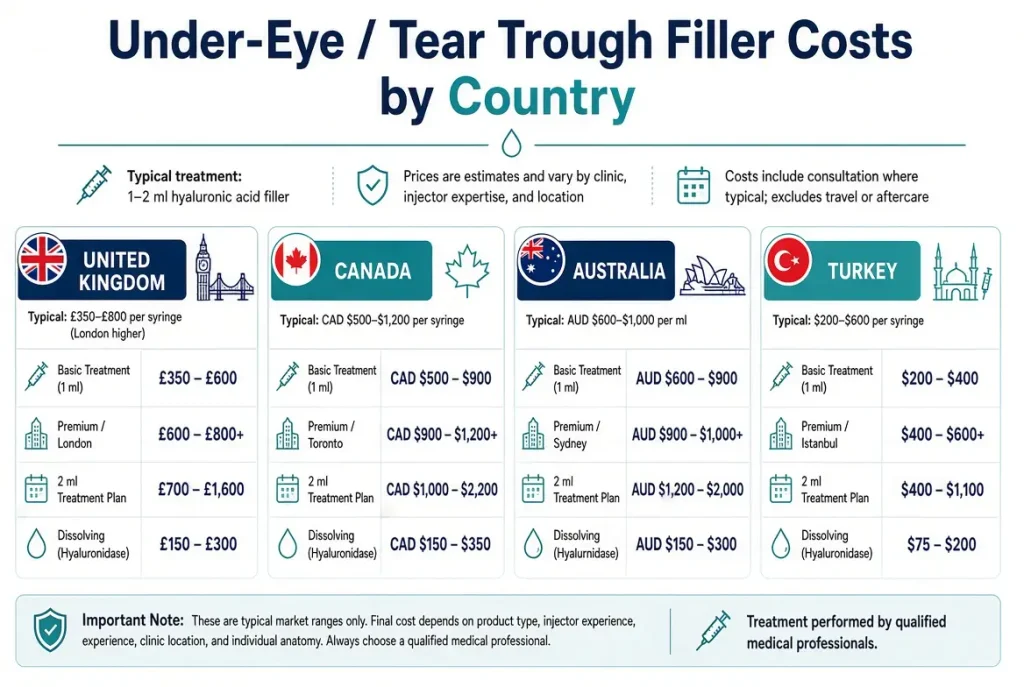
In 2026, under-eye filler usually costs $600–$1,500 in the US, £350–£800 in the UK, CAD $500–$1,200 in Canada, AUD $600–$1,000 in Australia, and $200–$600 in Turkey, per syringe or per 1ml session. Most patients need 0.5ml–1ml per side; deeper hollows or added cheek support can push the total toward $1,200–$3,000 (or the local equivalent) for 2ml. The final price depends on country, clinic location, injector experience, filler brand, how much product you need, and whether correction — dissolving, a touch-up, or cheek support — is involved.
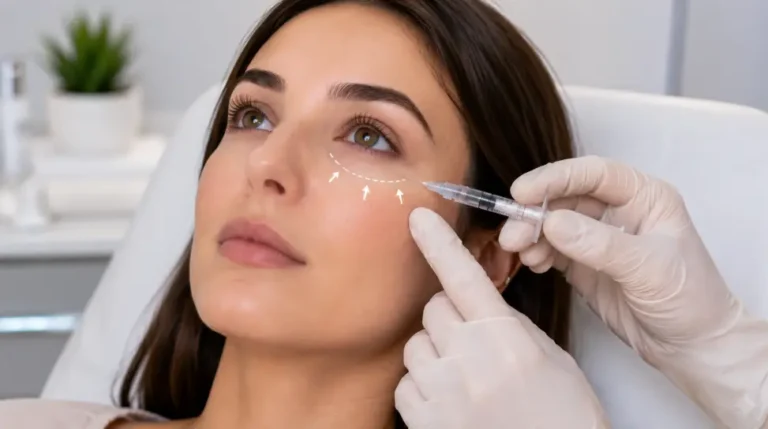
Under-eye filler is also called tear trough filler, infraorbital hollow filler, or under-eye hollow correction. Below: per-syringe breakdowns, brand-by-brand pricing, country deep-dives, what actually drives the price up, and real worked examples.
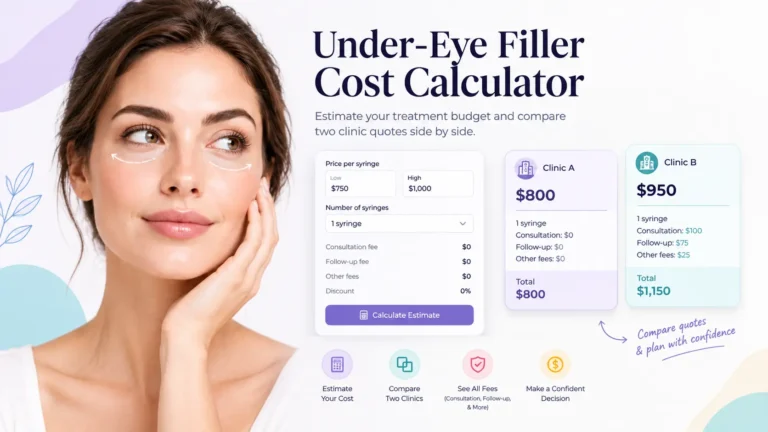
Before comparing prices, it helps to understand the full under eye filler cost breakdown because clinics may charge by syringe, by ml, by session, or by treatment area.
Average Under-Eye Filler Pricing (2026)
These are average estimates, not fixed medical prices. A simple under-eye treatment may need only 0.5ml to 1ml, while deeper hollows, asymmetry, or cheek support can need more product — see the per-syringe and treatment-plan breakdown next for how that changes your total.
Cost Per Syringe: How Much Is 1ml or 2ml Under-Eye Filler?
1ml under-eye filler
1ml usually costs the same as one syringe. In many mild-to-moderate cases, 1ml is enough for both under-eyes — though this depends on anatomy, hollow depth, cheek support, and injector technique.
| Country | 1ml Cost |
|---|---|
| United States | $600 – $1,500 |
| United Kingdom | £350 – £800 |
| Canada | CAD $500 – $1,200 |
| Australia | AUD $600 – $1,000 |
| Turkey | $200 – $600 |
2ml under-eye filler
2ml usually costs about double the 1ml price — but not every patient needs 2ml placed directly under the eyes. In many cases, “2ml” means tear trough filler plus cheek support, not two full syringes under the lower eyelids.
| Country | 2ml Cost |
|---|---|
| United States | $1,200 – $3,000 |
| United Kingdom | £650 – £1,500 |
| Canada | CAD $1,000 – $2,400 |
| Australia | AUD $1,200 – $2,000 |
| Turkey | $400 – $1,000 |
How much product do you actually need?
The real driver of cost isn’t the syringe size — it’s how much correction your anatomy needs:
| Treatment plan | Typical amount | Cost level |
|---|---|---|
| Very mild hollowing | 0.5ml | Lowest cost / clinic minimum |
| Mild to moderate hollows | 1ml | Standard under-eye filler price |
| Moderate hollows with asymmetry | 1ml – 1.5ml | Mid-range |
| Deep hollows | 1.5ml – 2ml | Higher |
| Under-eye + cheek support | 2ml – 4ml | Much higher total |
| Correction after old filler | Dissolving + refill | Higher, staged cost |
A careful injector often prefers a conservative first session, then reviews the result after swelling settles — overfilling the under-eye area can cause puffiness, lumps, or a bluish Tyndall effect, so more filler isn’t the same as better value.
Cost by Filler Brand: Juvéderm, Restylane & Others
Different filler brands can affect the final price. Some products are softer and better suited for delicate under-eye hollows, while firmer fillers are more often used for cheek or midface support.
| Filler Brand / Type | Common Use | 1ml Estimated Cost | 2ml Estimated Cost |
|---|---|---|---|
| Juvéderm Volbella XC | Under-eye hollows / infraorbital hollowing | $600 – $1,200 | $1,200 – $2,400 |
| Restylane Eyelight | Under-eye hollows / sunken eyes | $650 – $1,500 | $1,300 – $3,000 |
| Teosyal Redensity II | Tear trough / dark hollow under eyes | £350 – £800 / $400 – $1,000 | £650 – £1,500 / $800 – $2,000 |
| Belotero Balance | Fine lines / delicate correction | $500 – $1,000 | $1,000 – $2,000 |
| Restylane-L / Refyne | Soft correction / mild hollows | $500 – $1,200 | $1,000 – $2,400 |
| Juvéderm Voluma XC | Cheek support, not usually direct under-eye | $800 – $1,500 | $1,600 – $3,000 |
| Restylane Lyft | Cheek and midface support | $700 – $1,400 | $1,400 – $2,800 |
Juvéderm Volbella XC is FDA-approved in the U.S. for improvement of infraorbital hollowing in adults over 21. Restylane Eyelight is FDA-approved to improve depressed, sunken, or hollow under-eye areas in adults 21 and older.
FDA-approved for infraorbital use (U.S.)
Juvéderm Volbella XC is approved for improvement of infraorbital hollowing in adults over 21. Restylane Eyelight is approved to improve depressed, sunken, or hollow under-eye areas in adults 21 and older. Belotero Balance (+) and RHA Redensity Eye / Eye Lido also carry infraorbital-related indications for adults 21–22 and older, depending on the product. Ask your provider to confirm the exact product and its approved use for your treatment — see our FDA product guide for details.
This is also where “tear trough filler cost” and “under-eye filler cost” converge: tear trough filler is simply the term used for under-eye filler when it’s specifically treating the tear trough, or infraorbital hollow. Pricing follows the same per-ml and per-brand logic above — typically $600–$1,200 per syringe in the US, or £350–£700 in the UK — rising if cheek support is added to support the tear trough correction.
What Is Under Eye Filler?
Under eye filler is an injectable treatment used to improve tear trough hollows, sunken under eyes, and the shadow between the lower eyelid and upper cheek. The most common option is hyaluronic acid filler, often called HA filler.
Common under eye filler entities include:
| Entity | Meaning |
|---|---|
| Tear trough | The hollow groove between the lower eyelid and cheek |
| Infraorbital hollow | Medical term for under-eye hollowing |
| Hyaluronic acid filler | Temporary gel filler used to add volume |
| 1ml filler | Usually one syringe of filler |
| 2ml filler | Usually two syringes or a larger treatment plan |
| Cheek support | Midface filler used when cheek volume loss causes under-eye hollowing |
| Hyaluronidase | Enzyme used to dissolve HA filler |
| Tyndall effect | Bluish tint that can happen if filler is too superficial |
| Vascular occlusion | Rare but serious blood-vessel blockage risk |
Under eye filler is not the same as Botox. Botox relaxes muscles. Filler adds volume. If the issue is a true hollow or volume loss, filler may help. If the issue is pigmentation, loose skin, eye bags, allergies, or fluid retention, filler may not be the best solution.
Under Eye Filler Cost by Country & City
City and country both move the price — mainly through clinic operating costs, local demand, injector seniority, and whether consultation and follow-up are bundled in. Here’s the breakdown by market.
United Kingdom
Under-eye or tear trough filler usually costs £350–£800 per session, using around 0.5ml–1ml for most patients. London clinics charge more than the national average, especially at specialist or premium practices.
| UK Treatment Type | Average Cost |
|---|---|
| Basic tear trough filler | £350 – £500 |
| London under-eye filler | £450 – £950 |
| Premium UK clinic | £900 – £1,500 |
| 2ml treatment plan | £650 – £1,500 |
| Filler dissolving | £150 – £800, depending on complexity |
Canada
Canadian pricing runs CAD $500–$1,200 per syringe. Toronto and Vancouver sit toward the higher end of Canadian cosmetic pricing; other cities can run lower.
| Canada Treatment Type | Average Cost |
|---|---|
| Under-eye filler, 1 syringe | CAD $500 – $1,200 |
| Toronto / Vancouver clinics | CAD $600 – $1,200+ |
| 2ml treatment plan | CAD $1,000 – $2,400 |
| Under-eye + cheek support | CAD $1,500 – $3,500+ |
| Filler dissolving | CAD $150 – $300+ |
Australia
Australian pricing runs AUD $600–$1,000 per treatment or per ml, with Melbourne and Sydney generally pricier than smaller markets.
| Australia Treatment Type | Average Cost |
|---|---|
| Tear trough filler, 1ml | AUD $600 – $1,000 |
| 2ml filler plan | AUD $1,200 – $2,000 |
| Melbourne under-eye filler | AUD $650 – $1,000 |
| Cheek support filler | AUD $700 – $1,200+ |
| Rejuran Eye, 1ml | Around AUD $599+ |
Some Australian clinics also offer skin boosters, PRP, Rejuran Eye, and bio-remodelling injections for under-eye skin quality — these aren’t the same as volume filler (more on that distinction later).
Turkey
Turkish pricing runs $200–$600 per syringe, with Istanbul clinics typically advertising lower prices than the US, UK, Canada, or Australia — a major reason for medical-tourism demand.
| Turkey Treatment Type | Average Cost |
|---|---|
| Basic under-eye filler | $200 – $400 |
| Istanbul under-eye filler | $250 – $600 |
| 2ml treatment plan | $400 – $1,000 |
| Premium clinic / package | $600+ |
| Cheek support + under-eye filler | $600 – $1,200+ |
Turkey may be cheaper due to lower operating costs and strong medical-tourism competition — but price shouldn’t be the only factor in a treatment this close to the eye and its blood supply.
Why Does City Affect the Price?
Under-eye filler isn’t priced like a single flat product — the injector has to assess the lower eyelid, tear trough, cheek volume, skin thickness, pigmentation, fluid retention, and overall facial anatomy before quoting. These are the real levers:
| Price Factor | Why It Matters |
|---|---|
| Country | US, UK, Canada, and Australia typically cost more than Turkey |
| City | NYC, London, Toronto, Vancouver, Sydney, and Melbourne often charge above their national average |
| Injector experience | Board-certified surgeons and senior specialist injectors commonly charge noticeably more per syringe than general aesthetics providers — reflecting training and the area’s vascular risk, not just reputation |
| Filler brand | FDA-approved, infraorbital-indicated HA fillers (Volbella XC, Eyelight) tend to sit at or above the middle of the brand table above |
| Amount used | 2ml typically costs close to double 1ml, though rarely a clean 2x if cheek support is bundled in |
| Cheek support | Adding midface volume to support the tear trough adds its own per-syringe cost on top |
| Consultation fee | Some clinics bundle it into the treatment price; others bill it separately (see below) |
| Touch-up policy | Some clinics include a short review-window touch-up; others charge for any adjustment |
| Dissolving old filler | Needed if old product is puffy, lumpy, or migrated — adds a separate session cost |
| Ultrasound guidance | Some advanced clinics charge extra for ultrasound-assisted mapping, used for safer, more precise placement |
| Cannula vs. needle | Technique choice can carry its own fee at some clinics |
| Travel | Relevant mainly for medical tourism (e.g. Turkey) or out-of-city treatment |
| Aftercare | Cold packs, arnica, skincare, or medication, if advised |
The cheapest clinic isn’t automatically the best value. Because the under-eye area sits close to major blood vessels, provider skill plays a bigger role in outcome — and in avoiding costly correction later — than shaving a small amount off the sticker price.
City-level pricing can reflect:
- Clinic operating costs
- Local demand
- Injector experience
- Specialist expertise
- Filler brand
- Amount of filler required
- Clinic reputation
- Whether consultation and follow-up are included
Does Under-Eye Filler Cost Include the Consultation?
Not always — it depends on the clinic.
- Free consultations. Common at med-spas and larger clinics. No charge just to talk and get assessed.
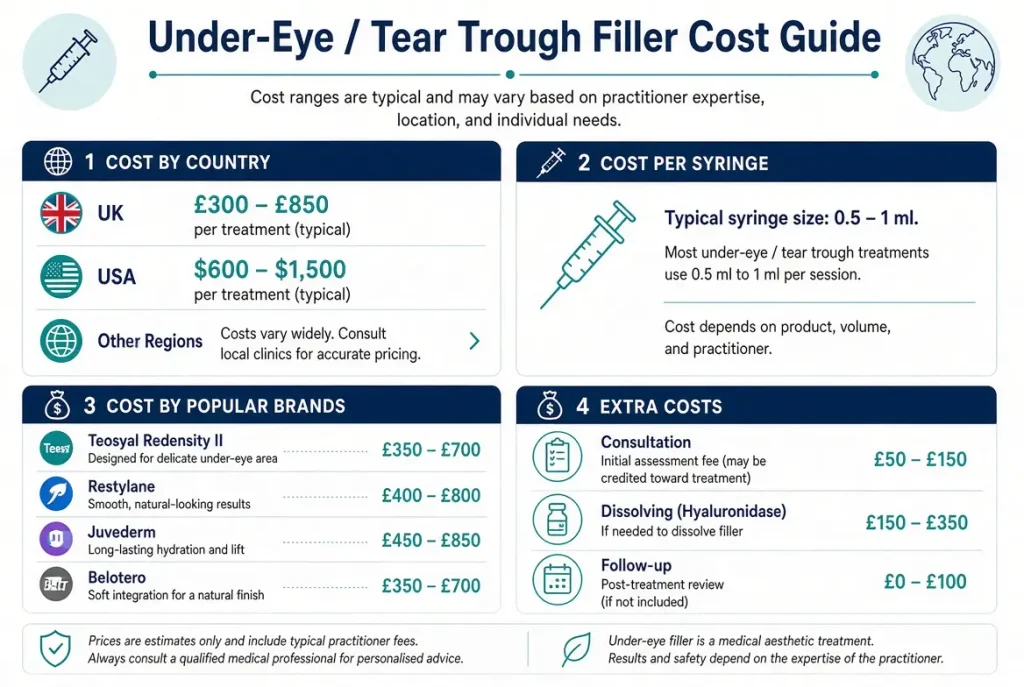
- Paid consultations. More common with specialist surgeons (oculoplastic, facial plastic). Usually $50–$250.
- Fee credited toward treatment. Many clinics apply the consultation fee to your final bill if you go ahead that day or within a set window.
- Medical assessment fees. Separate from a standard consult, these can apply if imaging, photos, or a more detailed workup is needed — common for complex or corrective cases.
- Same-visit treatment. Some clinics consult and inject in one appointment. Others require a separate visit, partly so you have time to decide without pressure.
- Follow-up. Not always included. Ask if a check-in visit is built into the price, or billed separately.
Before you book, ask directly: “Is the consultation fee included in the quoted treatment price, or is it separate?” One question, and most pricing confusion disappears.
Dissolving & Revision Costs
A follow-up and a touch-up aren’t the same thing, and mixing them up is the most common source of billing surprise:
- Follow-up = an assessment of the result (checking swelling, symmetry, healing).
- Touch-up = additional treatment or filler, charged on top if more product is used.
Here’s what each situation typically adds, in the US:
| Situation | Possible additional cost |
|---|---|
| Routine review visit | $0 – $150 |
| Minor touch-up (asymmetry, small top-up) | $0 – $300 |
| Additional syringe | $600 – $1,200 |
| Dissolving (hyaluronidase) | $150 – $600 per session |
| Dissolving + refill | $750 – $1,800 |
| Complex correction (imaging, specialist referral, surgery) | Provider-dependent |
Dissolving cost by country
Dissolving is usually done with hyaluronidase, an enzyme that breaks down HA filler — needed if filler causes puffiness, lumps, overfilling, migration, or an unnatural result. HA filler is considered reversible this way, though it should still be done by a qualified professional; the FDA has discussed hyaluronidase as a clinically used method for removing HA filler, though complication management can get complex.
| Country | Dissolving Cost |
|---|---|
| United States | $200 – $900+ |
| United Kingdom | £150 – £800 |
| Canada | CAD $150 – $300+ |
| Australia | AUD $180 – $600 |
| Turkey | Clinic-specific, often lower |
A clinic’s quoted “$X filler price” is usually the cost of one syringe, one visit — not your total lifetime cost. Over time, the real cost can include maintenance (most results fade in 6–18 months, prompting a repeat visit), touch-ups (free in a short window at some clinics, billed at others), correction (dissolving or re-treating, usually billed separately from the original price), and compounding syringes if more volume is needed over successive sessions.
When comparing quotes, ask directly: “If I need a touch-up or dissolving later, what would that cost on top of today’s price?”
A follow-up may involve:
- Checking swelling and healing
- Assessing symmetry
- Reviewing the final result
- Deciding whether additional filler is appropriate
- Discussing persistent puffiness or lumps
- Planning correction if necessary
Under Eye Filler Revision & Follow-Up Cost
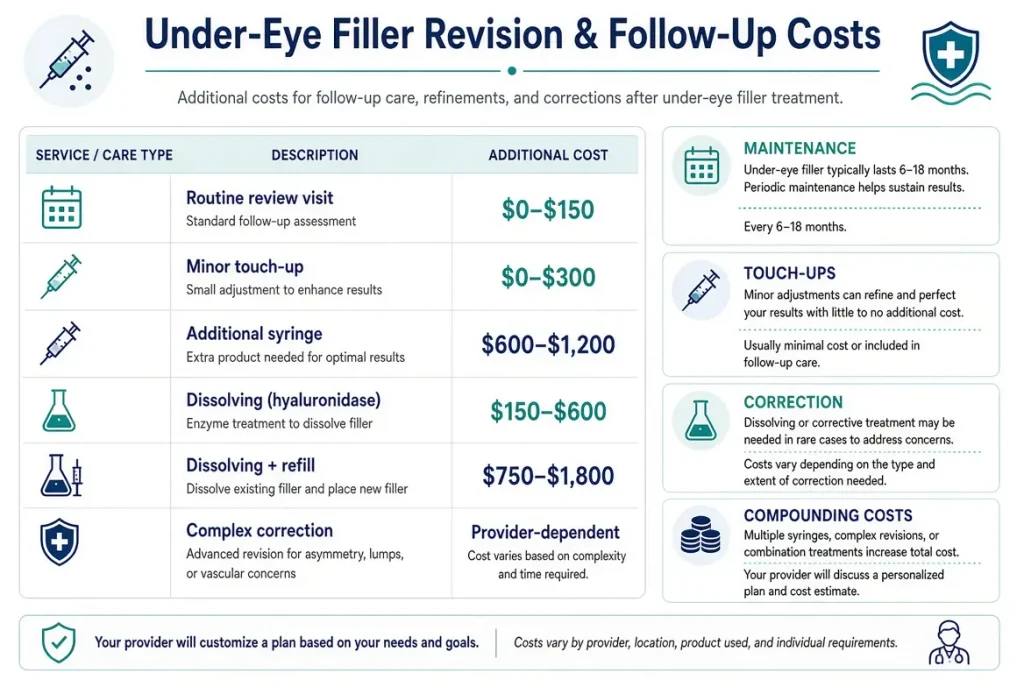
The price you’re quoted at booking usually covers the first treatment only — not what comes after, if anything needs adjusting.
| Situation | Possible additional cost |
|---|---|
| Routine review visit | $0–$150 |
| Minor touch-up (asymmetry, small top-up) | $0–$300 |
| Additional syringe | $600–$1,200 |
| Dissolving (hyaluronidase) | $150–$600 per session |
| Dissolving + refill | $750–$1,800 |
| Complex correction (imaging, specialist referral, surgery) | Provider-dependent |
Over time, the real cost can include:
- Maintenance. Results fade over months, so most patients return for more product — often every 6 to 18 months.
- Touch-ups. Some clinics include a short-window touch-up free; others charge for any adjustment, even minor ones.
- Correction. If the result needs fixing — dissolving, re-treating, or a referral — that’s usually billed separately from the original price.
- Compounding syringes. Needing more volume over successive visits adds up fast, especially if each syringe is priced the same as the first.
When comparing quotes, ask what’s covered beyond the injection itself, and ask this directly:
“If I need a touch-up or dissolving later, what would that cost on top of today’s price?”
What About Touch-Up Costs?
A touch-up is different from a routine follow-up.
Follow-up: assessment of the result.
Touch-up: additional treatment or filler.
If additional filler is needed, the clinic may charge for the extra product and procedure.
This distinction is worth making very clear because many patients confuse the two.
r the eyes because overfilling can cause puffiness, lumps, or a bluish Tyndall effect.
Does Insurance Cover Under-Eye Filler?
Under-eye filler is generally considered an elective cosmetic treatment, so health insurance typically does not cover the cost — and that applies across the board:
- Consultation — not covered, even if framed as a “medical assessment.”
- Injection — billed as cosmetic, regardless of provider type.
- Cosmetic correction — fixing an uneven or overfilled result is still cosmetic work.
- Maintenance — repeat or top-up treatments follow the same rule as the original.
- Dissolving after an aesthetic treatment — typically still classified as cosmetic, not medically necessary.
The exception is narrow: insurance can sometimes apply when there’s a genuine medical indication — for example, a true vascular complication requiring emergency treatment, or a separate, functional eyelid problem (like impaired vision) evaluated alongside cosmetic concerns.
Even then, only the medically necessary portion of care is typically covered; the cosmetic portion is usually billed separately. Coverage for a complication can also depend on the specific policy, provider, and country where treatment was performed — don’t assume a complication will automatically be covered.
Before treatment, ask your clinic:
- Is the consultation covered by insurance?
- Is the filler procedure considered cosmetic?
- Are follow-up visits included in the quoted price?
- What happens financially if a complication occurs?
- Is dissolving or corrective treatment charged separately?
Insurance policies vary — confirm coverage directly with your insurer if there’s any medical indication or complication involved.
Realistic Worked Examples
Numbers are easier to use when they’re attached to an actual patient scenario. These are illustrative, built from the ranges above — not quotes.
Example 1 — Mild hollowing, US, no cheek support. Patient needs 0.7ml total (both sides), treated with Restylane-L at a mid-market US clinic. Consultation is free and credited toward treatment. Estimated total: $500–$850 for product and injection, no separate consultation charge.
Example 2 — Moderate hollowing with cheek support, Toronto. Patient needs 1ml under the eyes plus 1.5ml of cheek support, treated by a senior injector. Consultation: CAD $100 (credited toward treatment if booked same-day). Product and injection: CAD $1,800–$2,600. Estimated total: around CAD $1,900–$2,700, plus a routine review visit typically included.
Example 3 — Correcting a previous overfilled result, London. Patient has puffy, slightly migrated filler from a treatment 18 months earlier and wants it corrected. Dissolving: £300–£500 across 2 sessions. Consultation for the correction: £100 (separate from the original provider). Refill after dissolving, 0.8ml: £400–£600. Estimated total: £800–£1,200 across two visits, spread over 6–8 weeks to let the area settle between dissolving and refill.
Example 4 — Budget-conscious patient comparing UK vs. Turkey. Patient in the UK is weighing a £650 London quote (1.2ml, premium clinic, consultation and 2-week review included) against a $350 Istanbul quote (roughly £275, similar volume, consultation included, but no dissolving plan disclosed and travel cost not factored in).
After adding flights and accommodation (~£300–£500) and accounting for the missing complication/dissolving plan at the Istanbul clinic, the two options land closer in real total cost than the headline price suggests — and the London option carries less logistical risk if a review or touch-up is needed.
How Much Does Tear Trough Filler Cost?
Tear trough filler” is essentially the term commonly used for under-eye filler when it’s treating the tear trough, or infraorbital hollow, specifically. Pricing varies by geography, provider experience, the product used, and whether the treatment plan also includes cheek support — since the tear trough and midcheek often need to be addressed together for a natural result.
| Factor | Typical range | Notes |
|---|---|---|
| Tear trough filler, 1 ml | $600–$1,200 per syringe | Many patients need less than a full syringe per side |
| Tear trough + cheek support | $1,200–$2,500+ | Priced per area/syringe; cheek volume often improves tear trough results |
| UK tear trough filler | £350–£700 per syringe | Clinic and injector seniority both move the price |
| Hyaluronidase correction | $150–$500 per session | Sometimes bundled into a correction package; may need more than one session |
| Consultation | Free–$150 | Some clinics credit this toward treatment |
These figures are general orientation, not a quote — ask your provider for a written estimate that separates the consultation, the product itself, and any follow-up correction visits, so you know exactly what a touch-up or a dissolving session would add later.
Is Under-Eye Filler Worth the Cost?
It can be worth it for the right candidate: true tear trough hollowing, realistic expectations, and suitable anatomy. It’s less likely to be worth it for heavy under-eye bags, strong fluid retention, very loose skin, or dark circles caused mainly by pigmentation — filler doesn’t fix any of those.
It tends to be worth the price when the hollow is caused by volume loss, the injector uses conservative placement, the filler type suits the under-eye area, cheek support is considered where needed, and the clinic has a clear plan for complications or dissolving.
Expect some swelling and bruising in the first few days — early results can look fuller or different than the settled outcome. A good before-and-after result should look refreshed, not overfilled: more filler is not the same as a better result, and the goal is softening the hollow, not erasing every shadow.
Who should avoid cheap under-eye filler?
Very low pricing can mean a clinic is skipping consultation, follow-up, correction planning, or emergency support. Be cautious if:
- The injector can’t name the filler brand, or won’t show the product box
- There’s no real medical assessment before treatment
- The price is far below the normal market range for that country
- The injector pushes more product than you asked for
- The clinic has no dissolving or complication plan
- Treatment is offered at home, in a salon, or by an unlicensed person
The Cleveland Clinic notes that accidental injection of hyaluronic acid into a blood vessel can potentially lead to vision problems — extreme pain or vision symptoms during treatment are warning signs that need immediate attention, not something to wait out.
Risks that can affect cost
| Risk / Side Effect | Cost Impact |
|---|---|
| Swelling or bruising | Usually no extra cost, but may need downtime |
| Lumps or unevenness | May need a review visit or massage guidance |
| Overfilling | May require dissolving |
| Tyndall effect | May require dissolving and retreatment |
| Filler migration | May require correction |
| Vascular occlusion | Medical emergency — requires immediate treatment |
| Poor candidate selection | Can mean wasted money or a worse result overall |
This is why under-eye filler should be chosen on experience and safety record first, price second.
Under-Eye Filler vs. PRP vs. Polynucleotides: Cost Comparison
Not every under-eye injection is a volume filler. Some treatments improve skin quality without adding volume the way HA filler does.
| Treatment | Adds Volume? | Average Cost | Best For |
|---|---|---|---|
| HA under-eye filler | Yes | $600 – $1,500 (US) | Hollow tear troughs |
| Juvéderm Volbella XC | Yes | $600 – $1,200 (US) | Under-eye hollowing |
| Restylane Eyelight | Yes | $650 – $1,500 (US) | Sunken under-eyes |
| Teosyal Redensity II | Yes | £350 – £800 (UK) | Tear trough / delicate eye area |
| PRP / PRF | No | $300 – $1,200 per session | Texture, fine lines, mild dark circles |
| Polynucleotides / Rejuran Eye | No | Varies by country | Skin quality and under-eye texture |
| Skin boosters | Not true volume filler | Varies | Hydration and skin quality |
| Hyaluronidase | No | Case-based | Dissolving HA filler |
If the main issue is hollowing, HA filler is usually the more relevant option. If the main issue is thin skin, crepey texture, or pigmentation, PRP, PRF, skin boosters, polynucleotides, laser, or skincare are more often the better fit.
How to Ask a Clinic for the Real Price
Before booking, ask:
- How much is under-eye filler for 1ml?
- How much is 2ml if cheek support is needed?
- Which filler brand will be used?
- Is it FDA-approved for under-eye use (if you’re in the US)?
- Is the consultation included?
- Is the 2-week review included?
- Is a touch-up included, or charged separately?
- How much does dissolving cost if it’s ever needed?
- Do you use cannula, needle, or both?
- What happens financially if there’s swelling, lumpiness, or an emergency?
The best quote isn’t always the lowest one — it’s the one that clearly explains product, amount, technique, safety, follow-up, and total cost before you commit.
Under Eye Filler Cost by Treatment Plan
The final cost is not only about the filler brand. The biggest cost difference often comes from how much correction is needed.
| Treatment Plan | Typical Amount | Estimated Cost Level |
|---|---|---|
| Very mild hollowing | 0.5ml | Lowest cost or clinic minimum |
| Mild to moderate hollows | 1ml | Standard under-eye filler price |
| Moderate hollows with asymmetry | 1ml – 1.5ml | Mid-range cost |
| Deep hollows | 1.5ml – 2ml | Higher cost |
| Under-eye + cheek support | 2ml – 4ml | Much higher total cost |
| Correction after old filler | Dissolving + refill | Higher and staged cost |
This is why two people can visit the same clinic but receive different quotes. One patient may need only subtle tear trough correction. Another may need cheek support before the under-eye area can be treated safely.
Why Under Eye Filler Prices Vary So Much
Under eye filler prices vary because the treatment is not just “one injection.” The injector has to evaluate the lower eyelid, tear trough, cheek volume, skin thickness, pigmentation, fluid retention, and facial anatomy.
Main price factors include:
| Price Factor | Why It Matters |
|---|---|
| Country | U.S., UK, Canada, and Australia usually cost more than Turkey |
| City | NYC, London, Toronto, Vancouver, Sydney, and Melbourne may charge more |
| Injector skill | Advanced injectors usually charge higher fees |
| Filler brand | FDA-approved or premium HA fillers may cost more |
| Amount used | 2ml costs more than 1ml |
| Cheek support | Midface filler increases the total cost |
| Consultation fee | Some clinics charge separately |
| Touch-up policy | Some include review visits, others charge extra |
| Dissolving old filler | Hyaluronidase correction can add cost |
| Ultrasound guidance | Some advanced clinics charge more for ultrasound-assisted assessment |
The cheapest clinic is not always the best value. Under-eye filler is close to important blood vessels and the eye area, so provider skill matters more than saving a small amount of money.
What about Complications?
Insurance coverage for treating a complication can depend on the circumstances, the insurance policy, the provider, and the country where treatment was performed. Patients should not assume that insurance will cover costs associated with correcting an aesthetic filler complication.
Before treatment, ask the clinic:
- Is the consultation covered by insurance?
- Is the filler procedure considered cosmetic?
- Are follow-up visits included in the quoted price?
- What happens financially if a complication occurs?
- Is dissolving or corrective treatment charged separately?
Hidden Costs Most People Miss
Many articles only mention the syringe price, but the real treatment cost may include extra fees.
| Hidden Cost | What It Means |
|---|---|
| Consultation fee | Paid before treatment in some clinics |
| Medical assessment | Required to check if filler is suitable |
| Review appointment | May be free or charged separately |
| Touch-up treatment | Small correction after swelling settles |
| Filler dissolving | Needed if old filler is puffy, lumpy, or misplaced |
| Cheek support filler | Sometimes needed before tear trough correction |
| Cannula or advanced technique fee | Some clinics charge extra |
| Ultrasound assessment | Used by some clinics for safer filler mapping |
| Travel cost | Important for Turkey or out-of-city treatment |
| Aftercare products | Cold packs, arnica, skincare, or medication if advised |
A smart patient should ask for the total treatment plan price, not only the price of one syringe.
How Much Does It Cost to Dissolve Under Eye Filler?
Under eye filler dissolving is usually done with hyaluronidase, an enzyme used to break down hyaluronic acid filler. It may be needed if filler causes puffiness, lumps, overfilling, migration, or an unnatural result.
| Country | Estimated Dissolving Cost |
|---|---|
| United States | $200 – $900+ |
| United Kingdom | £150 – £800 |
| Canada | CAD $150 – $300+ |
| Australia | AUD $180 – $600 |
| Turkey | Clinic-specific, often lower |
Hyaluronic acid filler is considered reversible because it can be broken down with hyaluronidase, although dissolving should still be performed carefully by a qualified professional. The FDA has also discussed hyaluronidase as a clinically used method for removing HA filler, though filler complication management can be complex.
Who Should Avoid Cheap Under Eye Filler?
Cheap under eye filler may be risky if the clinic is using unknown products, unqualified injectors, poor hygiene, or pressure-based sales. Very low pricing can also mean the clinic is not including consultation, follow-up, correction, or emergency support.
Avoid under eye filler deals if:
- The injector cannot name the filler brand.
- The product box is not shown.
- The clinic cannot explain risks.
- There is no medical assessment.
- The price is far below normal market range.
- The injector recommends too much filler too quickly.
- The clinic has no dissolving or complication plan.
- The treatment is done at home, in a salon, or by an unlicensed person.
The Cleveland Clinic notes that accidental injection of hyaluronic acid into a blood vessel can potentially lead to vision problems, and extreme pain or vision symptoms during treatment should be treated as warning signs.
Under Eye Filler Risks That Can Affect Cost
The under-eye area is delicate, so safety matters. Common side effects include swelling, bruising, tenderness, and temporary unevenness. Less common issues include lumps, puffiness, Tyndall effect, filler migration, infection, and vascular complications.
| Risk / Side Effect | Cost Impact |
|---|---|
| Swelling or bruising | Usually no extra cost, but may need downtime |
| Lumps or unevenness | May require review or massage advice |
| Overfilling | May require dissolving |
| Tyndall effect | May require dissolving and retreatment |
| Filler migration | May require correction |
| Vascular occlusion | Medical emergency; requires immediate treatment |
| Poor candidate selection | Can lead to wasted money or worse results |
Aesthetic filler complications can range from mild irregularities to rare but serious vascular events. This is why under-eye filler should be performed by an experienced medical injector, not chosen only by price.
Under Eye Filler Before and After: Does More Filler Mean Better Results?
More filler does not always mean better results. Under-eye filler usually looks best when the correction is conservative and natural. Overfilling can make the under eyes look puffy, swollen, or unnatural.
A good under eye filler before and after result should look refreshed, not overfilled. The goal is usually to soften the hollow, not completely erase every shadow.
Quick Glossary
| Term | Meaning |
|---|---|
| Tear trough | The hollow groove between the lower eyelid and cheek |
| Infraorbital hollow | Medical term for under-eye hollowing |
| Hyaluronic acid (HA) filler | Temporary gel filler used to add volume |
| 1ml filler | Usually one syringe of filler |
| 2ml filler | Usually two syringes, or a larger combined treatment plan |
| Cheek support | Midface filler used when cheek volume loss contributes to under-eye hollowing |
| Hyaluronidase | Enzyme used to dissolve HA filler |
| Tyndall effect | Bluish tint that can appear if filler sits too superficially |
| Vascular occlusion | Rare but serious blood-vessel blockage risk |
Under-eye filler isn’t the same as Botox: Botox relaxes muscle, filler adds volume. If the issue is a true hollow or volume loss, filler may help. If it’s pigmentation, loose skin, prominent eye bags, allergies, or fluid retention, filler may not be the right tool — see the comparison table above and the “who should avoid” section for alternatives.
FAQs
How much is under eye filler for both eyes?
Usually $600–$1,500 in the US, depending on how much filler is used. Many clinics treat both under-eyes with one syringe, but some patients need more product or cheek support.
Is 1ml enough for under eye filler?
Yes, 1ml is often enough for mild to moderate under-eye hollows. Some patients need only 0.5ml, while others need 1.5ml to 2ml if there is deeper hollowing or cheek volume loss.
Is 2ml too much for under eye filler?
2ml may be too much if placed directly under the eyes without proper assessment. In many cases, 2ml means under-eye filler plus cheek support, not two full syringes directly under the lower eyelids.
What is the cheapest country for under eye filler?
Among the countries compared in this guide, Turkey is usually the cheapest, with many clinics pricing under eye filler around $200 to $600. However, the cheapest option is not always the safest option.
Which filler is best for under eyes?
Common under-eye filler options include Juvéderm Volbella XC, Restylane Eyelight, Teosyal Redensity II, and soft HA fillers selected by experienced injectors. In the U.S., Juvéderm Volbella XC and Restylane Eyelight have FDA approvals for under-eye hollowing.
Why is under eye filler more expensive than lip filler?
Under eye filler can be more expensive because the tear trough area is more delicate, more technically demanding, and closer to important blood vessels. The injector must use careful product selection and conservative placement.
Does under eye filler include consultation?
Some clinics include consultation in the treatment price, while others charge separately. Always ask whether consultation, review, and touch-up are included before booking.
How long does under eye filler last?
Under eye filler commonly lasts around 9 to 18 months, depending on filler type, metabolism, anatomy, and how the product is placed. UK tear trough guidance commonly lists results around 9 to 18 months.
Can under eye filler be dissolved?
Yes, hyaluronic acid under eye filler can usually be dissolved with hyaluronidase. Dissolving may be needed for puffiness, lumps, migration, overfilling, or poor results.
Is under eye filler safe?
Under eye filler can be safe when performed by a qualified, experienced medical injector using appropriate product and technique. However, it still carries risks such as swelling, bruising, lumps, Tyndall effect, infection, and rare vascular complications.
References
We used these official sources to support the safety and product-approval information in this article.
- FDA Dermal Fillers Guide
Used for general dermal filler safety information, possible risks, and patient guidance. - FDA Juvéderm Volbella XC Approval
Used to verify that Juvéderm Volbella XC is approved for improving under-eye / infraorbital hollowing in adults over 21. - NHS Cosmetic Procedure Guidance
Used for guidance on choosing a qualified provider and asking the right safety questions before cosmetic treatment.
Disclaimer
This article is for educational purposes only and should not be taken as medical advice. Under eye filler results, risks, and costs can vary from person to person. Always consult a qualified medical professional before choosing any cosmetic treatment.
Medically Reviewed
Medically reviewed by Dr. J. Harper, MD, FAAD Board-certified Dermatologist with 12 years of experience in facial aesthetics and injectable treatments, including specialist focus on complication risks, warning signs, diagnosis and treatment considerations.
This educational content was prepared in association with Bascom Palmer Eye Institute and with clinical input from Dr. Emily R. Carter, MD, FACS, Consultant Ophthalmic and Oculoplastic Surgeon.
Medical review: [20th August -2024] | Last updated: [10th September-2026]
Bascom Palmer Eye Institute
Written in association with Dr. Emily R. Carter, MD, FACS, Consultant Ophthalmic and Oculoplastic Surgeon

Sarah Mitchell is the founder and research editor of Under Eyes Filler, an independent patient-education resource. She is a researcher and writer, not a licensed medical professional. Her work is to read clinical studies and official FDA and ASPS guidance, then translate them into clear, honest explanations of under-eye filler results, recovery, risks, and realistic costs, so readers can prepare better questions for their own qualified provider.