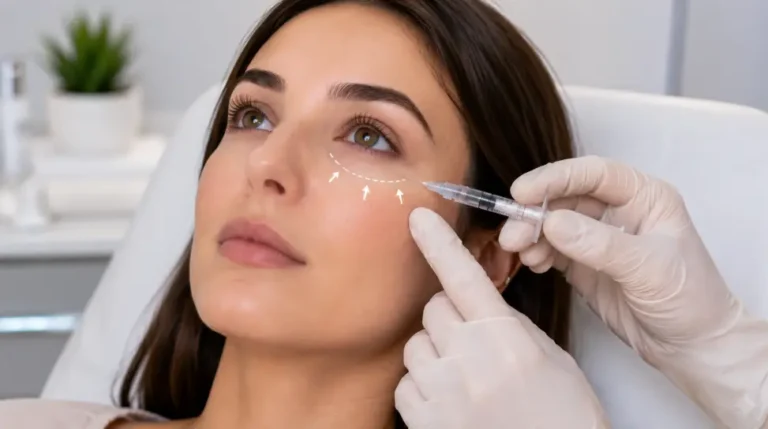

For 2026, a practical U.S. planning range for under-eye filler is approximately $600 to $1,500+ per syringe or treatment, with many patients encountering prices around $700 to $1,200. Highly experienced specialists and premium practices in major metropolitan markets may charge $1,500 to $2,500 or more.
If you are researching under-eye filler cost in the U.S., the price you see online can vary substantially from one provider to another. A typical quote may depend on the filler used, amount required, injector experience, city, clinic setting, and whether consultation or follow-up care is included.
How Much Does Under-Eye Filler Cost in the U.S.?
For most patients, the easiest way to budget for under-eye filler is to think in terms of the total treatment quote, rather than simply the price of one syringe.
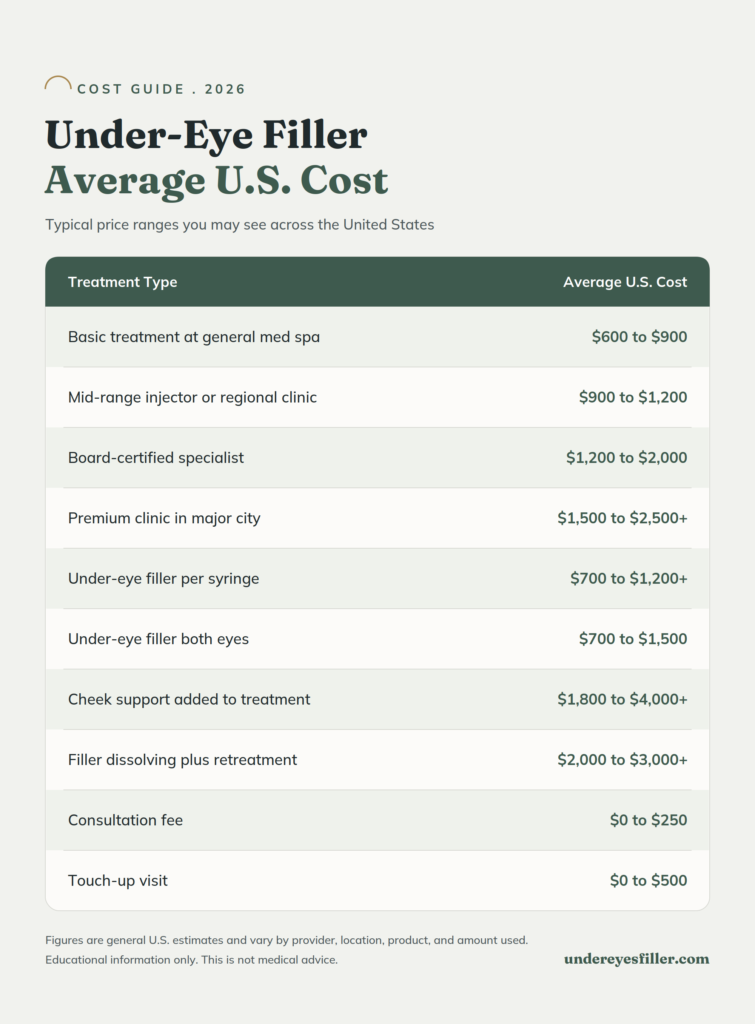
| Treatment Type | Average U.S. Cost |
|---|---|
| Basic treatment at general med spa | $600 to $900 |
| Mid-range injector or regional clinic | $900 to $1,200 |
| Board-certified specialist | $1,200 to $2,000 |
| Premium clinic in major city | $1,500 to $2,500+ |
| Under eye filler per syringe | $700 to $1,200+ |
| Under eye filler both eyes | $700 to $1,500 |
| Cheek support added to treatment | $1,800 to $4,000+ |
| Filler dissolving plus retreatment | $2,000 to $3,000+ |
| Consultation fee | $0 to $250 |
| Touch-up visit | $0 to $500 |
The American Society of Plastic Surgeons reports an average cost of $715 for hyaluronic acid dermal fillers overall. That figure is useful as a general benchmark, but it is not an under-eye-specific average. ASPS notes that filler prices vary according to the provider’s qualifications and expertise, the procedure, time and effort required, and geographic location.
The under-eye area can command a higher price than a general filler treatment because it requires careful assessment of the lower eyelid, tear trough, orbital anatomy, skin thickness and surrounding midface.
The short answer
If you are comparing quotes, a reasonable starting expectation is:
- $600–$900: lower-cost markets or providers
- $900–$1,200: common mid-market range
- $1,200–$2,000: experienced or specialist providers
- $1,500–$2,500+: premium specialists and major metropolitan practices
A higher price does not automatically mean a better result. Conversely, the lowest quote should not automatically be considered the best value.
For an elective medical procedure around the eyes, injector qualifications, anatomical expertise, product selection, treatment planning and complication management matter alongside price.
Under-Eye Filler Cost by U.S. City in 2026
Location can have a noticeable effect on cosmetic procedure pricing. Major metropolitan areas often have higher operating costs, greater demand and more specialist practices.
The table below provides typical planning ranges rather than official citywide averages. Prices can vary significantly between practices within the same city.
| U.S. City / Market | Typical Planning Range |
|---|---|
| New York City | $1,200–$2,500+ |
| Los Angeles / Beverly Hills | $1,200–$2,500+ |
| San Francisco | $1,100–$2,200+ |
| Miami | $1,000–$2,000+ |
| Chicago | $900–$1,800+ |
| Boston | $850–$1,600+ |
| Dallas | $800–$1,500+ |
| Houston | $800–$1,500+ |
| Other large regional cities | $900–$1,400+ |
| Small to mid-size U.S. markets | $600–$1,000+ |
Why does under-eye filler cost more in some cities?
Several factors can influence local pricing:
- Cost of operating the medical practice
- Local demand for aesthetic treatments
- Injector experience and qualifications
- Type and brand of filler used
- Specialist versus general aesthetic practice
- Amount of product required
- Whether consultation and follow-up are included
- Clinic location and overhead
- Availability of highly experienced injectors
- Whether adjacent areas such as the cheeks are treated
For example, two providers in New York City could quote very different prices for the same general treatment because one may be a specialist physician with extensive periocular experience while another may operate a lower-overhead aesthetic practice.
Therefore, city alone should never be used to judge whether a quote is reasonable.
Under Eye Filler Cost Per Syringe
One of the most common questions is:
How much is one syringe of under-eye filler?
A typical U.S. planning range is approximately $700–$1,200+ per syringe, although some providers charge less and premium specialists may charge substantially more.
However, the price per syringe can be misleading because the amount used is individualized.
Example pricing by amount
| Amount Purchased | Approximate Planning Range |
|---|---|
| 0.5 mL | $350–$700+ |
| 1 mL | $700–$1,200+ |
| 1.5 mL | $1,000–$1,800+ |
| 2 mL | $1,400–$2,500+ |
These figures should be treated as budgeting examples rather than fixed national prices.
A provider may not charge a simple proportional amount for a half syringe, and some clinics have minimum treatment prices.
Does one syringe mean both eyes?
Not necessarily.
A syringe is a quantity of product, not a guarantee of how much will be injected into each eye.
The amount required depends on:
- depth and severity of the hollow
- facial anatomy
- asymmetry
- skin thickness
- existing volume
- product characteristics
- treatment goals
- injector technique
- whether adjacent areas are being treated
Clinical information for FDA-approved Restylane Eyelight demonstrates that treatment volumes can vary considerably rather than fitting a universal 0.5–1 mL rule.
That is why a provider should assess your anatomy before telling you exactly how much filler you need.
Under-Eye Filler Cost by Brand
The filler product itself is another important part of the price.
Two providers may quote different prices even when they use the same amount of filler because they use different products, have different wholesale costs, or price their services differently.
Restylane Eyelight
Restylane Eyelight is a hyaluronic acid dermal filler specifically approved by the FDA for improving infraorbital hollowing in adults aged 21 and older.
The FDA approved this indication in 2023. In the clinical study used for the approval, patients received one or two treatment sessions, and results were reported to last up to 12 months.
The price you pay for Restylane Eyelight will still depend on the provider, location, amount used and treatment plan.
JUVÉDERM Volbella XC
JUVÉDERM Volbella XC is another hyaluronic acid filler with an FDA-approved indication for the infraorbital hollow in adults over age 21.
The FDA’s approval information states that patients in the clinical study required one or two treatments and that results may last up to 12 months.
Again, FDA approval of a product does not establish one universal retail price.
What about Belotero or other fillers?
Some providers may use other hyaluronic acid fillers in or around the under-eye area depending on their clinical judgment, product characteristics and the specific indication.
However, patients should not assume that every filler marketed for the face has the same FDA indication for the infraorbital area.
When comparing providers, ask:
- What exact product will you use?
- Is that product FDA-approved for the intended treatment area?
- How much product is included?
- Is the price per syringe or per treatment?
- What happens if I need a touch-up?
- Is follow-up included?
This is more useful than comparing brand names based solely on price.
How Much Does Under-Eye Filler Cost by Provider Type?
The provider performing the treatment can have a major influence on the price.
| Provider / Practice Type | Typical Pricing Position |
|---|---|
| Lower-cost aesthetic clinic | Lower end of market |
| General medical aesthetics practice | Lower to middle range |
| Experienced cosmetic injector | Middle to upper range |
| Dermatology or plastic-surgery practice | Middle to premium range |
| Oculoplastic/periocular specialist | Often premium |
| Highly sought-after specialist in major metro | Premium to $2,500+ |
This does not mean that every dermatologist, plastic surgeon or oculoplastic surgeon charges more than every aesthetic clinic.
The important point is that under-eye filler is a technically sensitive treatment, and provider expertise should be considered alongside price.
The American Society of Plastic Surgeons emphasizes the importance of choosing a qualified physician with appropriate training and knowledge of facial anatomy for dermal filler injections.
Why might a specialist charge more?
A specialist’s price may reflect:
- advanced training
- years of injection experience
- knowledge of periocular anatomy
- consultation time
- individualized treatment planning
- higher practice overhead
- complication-management capability
- medical staff and infrastructure
- follow-up care
For under-eye treatment, paying more for appropriate expertise can be more valuable than simply choosing the lowest available quote.
What Determines the Cost of Under-Eye Filler?
There is no single national price because several variables are combined into the final quote.
1. Injector experience
Experience with the under-eye area can affect pricing.
The tear trough and infraorbital region contain important anatomical structures and are not equivalent to simpler filler areas such as some superficial facial lines.
2. Amount of filler needed
More product can increase the treatment cost, but more filler is not necessarily better.
A conservative approach may be appropriate for some patients because overcorrection can create unwanted fullness or other aesthetic problems.
3. Filler product
Different fillers have different product costs and characteristics.
The product should be selected based on the treatment goal and anatomy rather than simply choosing the cheapest syringe.
4. Geographic location
Major metropolitan areas frequently have higher practice costs and a greater concentration of premium providers.
5. Provider credentials and specialization
A physician specializing in dermatology, plastic surgery or oculoplastic/periocular procedures may structure pricing differently from a general aesthetic clinic.
6. Clinic setting
A physician-led medical practice, specialist center and med spa may have very different overhead and pricing models.
7. Consultation and follow-up
Some practices bundle consultation and follow-up into the treatment price. Others charge separately.
Always ask what is included.
8. Additional treatment areas
A provider may recommend treating the cheek or midface if volume loss contributes to the appearance of the tear trough.
That can substantially increase the total cost
Under-Eye Filler Cost: Published Provider Prices
Published clinic prices can be useful because they show what actual practices charge, but they should not be treated as nationwide averages.
For example, some U.S. dermatology practices publicly list under-eye filler starting prices around the mid-hundreds per syringe, while specialist practices in major metropolitan markets may publish substantially higher prices.
A published price is most useful when you also know:
- the product used
- amount included
- provider qualifications
- whether consultation is included
- whether follow-up is included
- whether the price applies to one or both eyes
- whether additional product is charged separately
This is why a $750 syringe at one practice cannot automatically be compared with a $1,500 treatment quote at another practice.
The services included may be completely different.
What Are the Hidden Costs of Under-Eye Filler?
The advertised syringe price is not always the final amount you will pay.
Potential additional costs include:
| Possible Cost | Typical Planning Range |
|---|---|
| Consultation | $0–$250+ |
| Medical assessment | $0–$150+ |
| Follow-up appointment | $0–$300+ |
| Touch-up treatment | $0–$500+ |
| Additional syringe | $700–$1,200+ |
| Cheek/midface filler | $700–$1,500+ per syringe |
| Filler dissolving | $200–$900+ |
| Additional aftercare | $20–$100+ |
These are budgeting ranges, not universal fees.
Before booking, ask the clinic:
“What is the total estimated cost for my treatment, including consultation, product, injections, follow-up and any expected touch-up?”
That question can prevent an apparently inexpensive treatment from becoming substantially more expensive later.
Does Under-Eye Filler Cost More Than Regular Facial Filler?
The general cost of a dermal filler procedure depends on the product, provider, location and treatment complexity.
Under-eye treatment can require particularly careful assessment because the lower eyelid and infraorbital region have delicate anatomy and because aesthetic problems in this area can have several different causes.
A patient with a true structural hollow may be a reasonable candidate for filler.
A patient whose main concern is:
- prominent fat pads
- significant eye bags
- skin laxity
- pigmentation
- vascular dark circles
- edema
- malar bags or festoons
may need a different treatment strategy.
This distinction matters because the cheapest treatment is not necessarily the least expensive solution if it is treating the wrong problem.
How Much Does Under-Eye Filler Cost for Both Eyes?
Patients often search for a “both eyes” price, but clinics do not all structure their pricing the same way.
A rough U.S. planning range may be around $700–$1,500+ for a straightforward treatment, but specialist pricing can be considerably higher.
The final price depends on:
- how much filler is needed
- whether one or more syringes are opened
- whether the clinic charges by syringe or treatment
- product choice
- injector experience
- location
- whether the cheeks also require treatment
Ask whether the quoted price covers both sides and exactly how much product is included.
How Long Does Under-Eye Filler Last?
Under-eye filler is generally considered a temporary treatment, but longevity varies.
For specific FDA-approved products, clinical data provide product-specific expectations. For example, FDA information for Restylane Eyelight and JUVÉDERM Volbella XC states that results may last up to approximately 12 months.
Individual results can differ based on:
- filler product
- metabolism
- anatomy
- injection technique
- amount used
- treatment area
- whether additional treatments are performed
Do not assume that paying more automatically makes filler last longer.
A higher-priced provider may offer a more specialized treatment, but longevity is not determined by price alone.
How Much Does It Cost to Dissolve Under-Eye Filler?
If a hyaluronic acid filler needs to be reduced or dissolved, the cost can add another $200–$900+ depending on the provider, amount of product, complexity and number of appointments.
The actual price can vary substantially.
Dissolving should also not be viewed as a simple “undo button.” Treatment may require clinical assessment, and additional interventions may sometimes be necessary.
The FDA notes that removal of dermal fillers may require injections, surgery or other interventions, and removal can be difficult or impossible for some filler materials.
For this reason, provider selection is an important part of controlling the overall financial risk of treatment.
Is Under-Eye Filler Covered by Insurance?
Usually, no.
Under-eye filler performed for cosmetic purposes is generally considered an elective aesthetic treatment rather than a medically necessary procedure.
The American Society of Plastic Surgeons states that health insurance does not cover dermal fillers.
Some practices may offer:
- financing
- payment plans
- membership pricing
- promotional pricing
but these options vary by provider.
Do not choose a provider solely because financing makes a treatment affordable. Evaluate the medical qualifications and treatment plan first.
Is Under Eye Filler a One-Time Cost?
No. Under eye filler is usually temporary. Hyaluronic acid fillers are gradually absorbed by the body, which means maintenance may be needed.
The FDA explains that many dermal fillers are temporary because the body absorbs them over time, and repeat treatments may be needed to maintain results.
Most under-eye filler results last around 9 to 18 months, depending on the filler brand, metabolism, injection technique, and individual anatomy.
Under-Eye Filler vs Other Treatments: Cost Comparison

Under-eye hollows are not the only cause of an aged or tired-looking eye area.
Depending on the diagnosis, other treatments may be considered.
| Treatment | Approximate U.S. Planning Range | May Be Better Suited For |
|---|---|---|
| Under-eye HA filler | $600–$1,500+ | Structural hollowing/shadowing |
| PRP/PRF | $500–$1,500+ | Selected skin-quality/volume goals |
| Laser treatments | $500–$2,000+ | Selected pigmentation/skin-quality concerns |
| Lower blepharoplasty | $3,000–$8,000+ | Significant bags, fat or skin changes |
| Eye creams/topicals | $20–$200+ | Selected superficial skin concerns |
These are broad planning ranges and can vary considerably.
The appropriate treatment depends on the underlying cause.
When Is Under-Eye Filler Worth the Cost?
Under-eye filler may be worth considering when the primary concern is a structural hollow or tear-trough depression that creates a shadow.
It is less likely to solve the primary problem when the main issue is:
- true pigmentation
- visible blood vessels
- prominent orbital fat
- significant skin laxity
- pronounced eye bags
- malar edema
- festoons
- certain forms of swelling
This is why diagnosis should come before price comparison.
A $700 treatment that does not address your actual concern may ultimately cost more than a $1,500 treatment that is appropriately matched to your anatomy.
Who Is a Good Candidate for Under Eye Filler?
Potential candidates may have:
- visible infraorbital hollowing
- tear-trough depression
- structural shadowing beneath the eyes
- mild to moderate volume loss
- relatively good skin quality
- realistic expectations
However, not every person with dark circles or under-eye bags is a good filler candidate.
A qualified provider should determine whether the appearance comes primarily from hollowing, pigmentation, vascular visibility, fat prominence, edema, skin laxity or a combination of factors.
Who may not benefit from filler?
Filler may be less appropriate when the dominant problem is:
- prominent lower-eyelid fat
- significant skin excess
- substantial puffiness
- persistent edema
- malar bags or festoons
- predominantly pigmented dark circles
In these situations, another treatment—or no procedure—may make more sense.
How to Compare Under-Eye Filler Quotes
Do not compare clinics based only on the headline price.
Instead, ask each provider the same questions.
1. What product will you use?
Ask for the exact brand and product name.
2. How much product is included?
A “syringe” does not tell you the final treatment plan.
3. Is the price for one or both eyes?
Make sure the quote clearly defines the treatment area.
4. Is consultation included?
Some practices charge separately.
5. Is follow-up included?
Ask whether a routine post-treatment assessment is included.
6. Are touch-ups included?
Some clinics include a limited touch-up; others charge separately.
7. What happens if I develop a complication?
Ask whether the practice has an established emergency protocol and who manages complications.
8. Does the provider regularly treat the under-eye area?
General injection experience is not necessarily the same as extensive periocular experience.
9. Can I see representative before-and-after results?
Look for results involving patients with similar anatomy and concerns.
10. What is the total estimated cost?
Ask for an itemized estimate rather than only a syringe price.
Why the Cheapest Under-Eye Filler May Not Be the Best Value
It can be tempting to choose a clinic advertising the lowest price.
But the true cost of treatment includes more than the filler itself.
A very low quote may reflect:
- a lower-cost product
- less experienced provider
- promotional pricing
- limited follow-up
- separate consultation fees
- different amounts of filler
- a different treatment approach
At the same time, an expensive clinic is not automatically superior.
The best value is usually a combination of:
appropriate diagnosis + qualified injector + suitable product + conservative treatment plan + transparent pricing + appropriate follow-up.
What Should You Expect to Pay for Under-Eye Filler Near You?
If you are searching for “under-eye filler cost near me,” start with the local market range rather than a single advertised price.
Compare at least three qualified providers and ask each for an itemized estimate.
Your comparison should include:
- provider credentials
- under-eye experience
- product
- amount of filler
- total treatment price
- consultation
- follow-up
- touch-up policy
- complication-management plan
Do not travel to another city simply to save a small amount if doing so means compromising on provider experience or follow-up.
Conversely, traveling to an experienced specialist may make sense when your anatomy is complex or previous filler has caused problems.
How Much Does Under Eye Filler Cost?
Under eye filler usually costs $600 to $1,500 in the United States. Most people pay around $700 to $1,200 per syringe or treatment session, while premium providers in major cities may charge $1,500 to $2,500 or more. The final price depends on the injector’s experience, clinic location, filler brand, number of syringes, treatment complexity, and whether correction or cheek support is needed.
Bottom Line: What Should You Budget for Under-Eye Filler?
For a typical U.S. patient in 2026, a reasonable starting budget is approximately:
$600–$1,500+ for under-eye filler, with many treatments falling around $700–$1,200 and premium specialist treatment potentially reaching $1,500–$2,500+.
Your final price depends on:
- where you live
- who injects you
- which filler is used
- how much product is required
- whether both eyes are treated
- whether the cheeks or midface are also treated
- whether consultation and follow-up are included
- whether additional treatment is required
The most important question is therefore not simply:
“How cheap is the filler?”
It is:
“What exactly am I paying for, who is performing the treatment, and is the treatment appropriate for my under-eye anatomy?”
For an area as delicate as the under-eye, choosing an appropriately qualified and experienced provider should be part of the cost calculation—not an afterthought.
Sources & References
The following authoritative sources were used to support the medical, safety, FDA-approval, and pricing information in this guide.
- U.S. Food & Drug Administration — FDA-Approved Dermal Fillers
Provides information about FDA-approved dermal fillers, approved materials, indications, and the FDA approval process.
FDA-Approved Dermal Fillers - U.S. Food & Drug Administration — Dermal Fillers (Soft Tissue Fillers)
Provides FDA guidance for patients and healthcare providers, including approved uses, unapproved uses, safety considerations, provider qualifications, and potential complications associated with dermal fillers.
FDA Dermal Fillers (Soft Tissue Fillers) - U.S. Food & Drug Administration — Restylane Eyelight
FDA approval information for Restylane Eyelight, including its indication for improving infraorbital hollowing in adults aged 21 and older, clinical study information, and product-specific safety information.
FDA Restylane Eyelight Approval Information - U.S. Food & Drug Administration — JUVÉDERM VOLBELLA XC
FDA approval record documenting the expanded indication for JUVÉDERM VOLBELLA XC to include improvement of infraorbital hollowing in adults over 21.
FDA JUVÉDERM VOLBELLA XC Approval Record - American Society of Plastic Surgeons — Dermal Fillers Cost
Provides the ASPS national cost benchmark for dermal fillers and explains factors that can affect pricing, including provider qualifications, procedure type, time and effort, and geographic location.
ASPS Dermal Fillers Cost - FDA Product-Specific Labeling & Clinical Documentation
FDA product labeling and Summary of Safety and Effectiveness Data (SSED) provide more detailed information about indications, clinical studies, treatment parameters, contraindications, warnings, precautions, and adverse events for individual dermal filler products.
FDA Devices@FDA — PMA Database
Important note about FDA approval
FDA approval applies to a specific product, indication, and treatment area. A filler being FDA-approved does not mean that every use of that filler in every facial area has been approved.
For example, Restylane Eyelight and JUVÉDERM VOLBELLA XC have specific FDA indications relating to infraorbital hollowing, while other fillers may have different approved indications. Patients should discuss the specific product, treatment area, and risks with a qualified healthcare professional.
Pricing disclaimer: Prices presented in this article are general U.S. planning ranges compiled from available market and provider information. They are not official FDA or ASPS under-eye filler prices, and actual costs vary by provider, product, location, treatment volume, and services included.
Medically Reviewed
Medically reviewed by Dr. Guy G. Massry, MD, FACS
Oculoplastic & Reconstructive Surgeon
Beverly Hills, California · Last updated October 2026 ·
Frequently Asked Questions About Under-Eye Filler Cost
How much does under-eye filler cost in the U.S.?
A practical 2026 planning range is approximately $600–$1,500+, with many quotes falling around $700–$1,200. Experienced specialists and premium practices in major metropolitan markets may charge $1,500–$2,500 or more.
How much does one syringe of under-eye filler cost?
A typical planning range is around $700–$1,200+ per syringe, although prices vary by product, provider, location and clinic.
How much does under-eye filler cost in New York?
A reasonable planning range for New York City is approximately $1,200–$2,500+, although individual provider prices can fall outside this range.
How much does under-eye filler cost in Los Angeles?
Los Angeles and Beverly Hills practices may commonly fall around $1,200–$2,500+, particularly for experienced or specialist providers.
How much does under-eye filler cost in Miami?
A practical planning range is approximately $1,000–$2,000+, although actual quotes vary.
How much does under-eye filler cost in Chicago?
A broad planning range is approximately $900–$1,800+.
How much does Restylane under-eye filler cost?
There is no single national retail price for Restylane under-eye filler. The final price depends on the specific Restylane product, amount used, provider, location and clinic pricing structure.
Restylane Eyelight is FDA-approved for improving infraorbital hollowing in adults aged 21 and older.
How much does JUVÉDERM Volbella under-eye filler cost?
There is no fixed national price. Provider, location, amount used and clinic pricing determine the final cost.
JUVÉDERM Volbella XC has an FDA-approved indication for the infraorbital hollow in adults over age 21.
Does under-eye filler cost more than cheek filler?
Not necessarily. Pricing depends on the provider, product, amount and treatment complexity. However, under-eye treatment may be priced at a premium because of the technical considerations involved.
How many syringes do I need under my eyes?
There is no universal number. The amount depends on your anatomy, degree of hollowing, product and treatment plan. A qualified provider should determine the appropriate amount rather than using a fixed syringe rule.
Is $500 too cheap for under-eye filler?
Not necessarily, but an unusually low quote deserves careful investigation.
Ask what product is being used, who performs the treatment, how much product is included and whether consultation and follow-up are included.
Is $2,000 expensive for under-eye filler?
It can be at the upper end of the general market, but it is not necessarily unreasonable for a highly experienced specialist in a major metropolitan area or when the quoted treatment includes additional product or services.
Does insurance pay for under-eye filler?
Cosmetic dermal filler is generally not covered by health insurance.
Is under-eye filler permanent?
No. Hyaluronic acid under-eye fillers are temporary treatments. Product-specific clinical data should be used when discussing expected longevity.
Can under-eye filler be removed?
Some hyaluronic acid fillers can be treated with hyaluronidase, but removal is not necessarily simple or guaranteed. The FDA notes that filler removal may sometimes require additional injections, surgery or other interventions.

Sarah Mitchell is the founder and research editor of Under Eyes Filler, an independent patient-education resource. She is a researcher and writer, not a licensed medical professional. Her work is to read clinical studies and official FDA and ASPS guidance, then translate them into clear, honest explanations of under-eye filler results, recovery, risks, and realistic costs, so readers can prepare better questions for their own qualified provider.