Medically reviewed • Evidence-led under-eye filler education • Updated October 2026
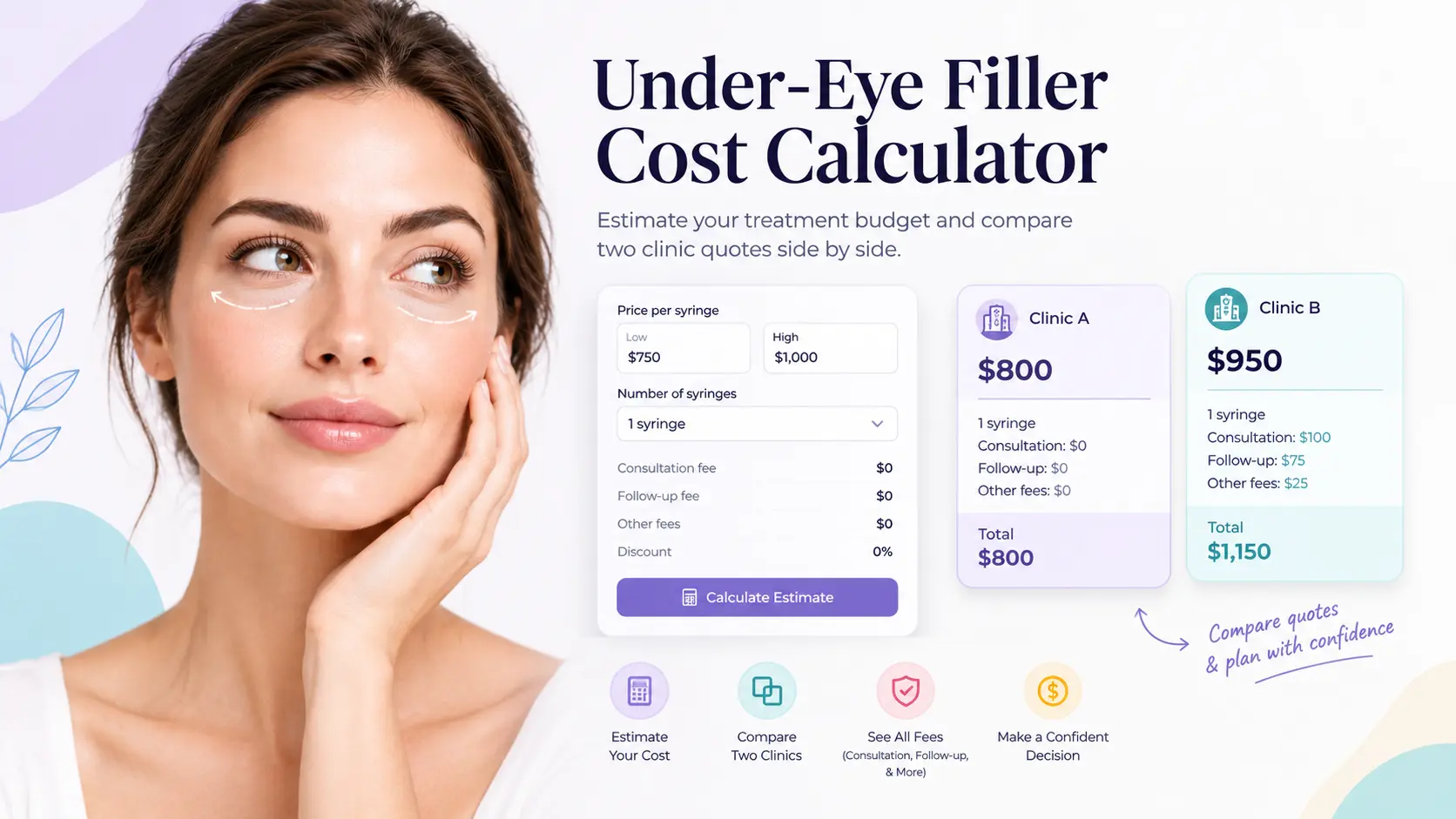
Best Under Eye Filler Cost Calculator (2026): Price per Syringe4 min read
Under Eye Filler Cost Calculator
Estimate tear trough filler cost by syringes, brand and market, then compare two clinic quotes side by side.
Your details
Tip: type your clinic’s actual per-syringe price above to personalise the estimate.
Treatment areas & syringes
Your estimate
$0
Select at least one area.
0 syringes
Total volume
Total volume
$0 / year
Estimated upkeep once results fade
Estimated upkeep once results fade
$0 / month
Cost spread over longevity
Cost spread over longevity
Estimates only, based on commonly quoted U.S. ranges (roughly $600–$1,500 per syringe for under-eye; most patients need 0.5–1 syringe). Final pricing depends on your consultation, product and provider. Fillers are cosmetic and generally not covered by insurance.
Book a consultationUnder Eye Filler Cost Calculator – Estimate Treatment Budget
Under eye filler usually costs about $600 to $1,500 per syringe in the U.S. Most people need only 0.5 to 1 syringe for the tear trough area, so a typical treatment lands between roughly $350 and $1,200, before consultation, touch-up or other fees. Prices are higher in major metros and with physician injectors.
This free calculator estimates your cost by area, product, market and injector. The second tab lets you compare two clinic quotes side by side, so you see the true total, not just the headline price per syringe
How to use Dermal Filler Cost Calculator
Under eye filler costs vary a lot, and a single price range rarely tells you what you will pay. Our free under eye filler cost calculator turns typical U.S. ranges into a personal estimate in about a minute. This guide shows you how to use it, how to read the results, and how to avoid common budgeting mistakes. When you have a real quote in hand, our quote comparison tool shows you the true total cost.
Quick answer: Choose your market, product and injector, set your clinic’s price per syringe if you have it, pick your treatment areas and syringe amounts, and read your price range plus yearly and monthly cost. Then book a consultation for an exact quote.
Before you start: what you need
- Your city or the type of market you live in (average, lower-cost or major metro)
- A rough idea of the area you want treated, such as tear troughs or dark circles from hollowing
- Optional: a price per syringe from a clinic you are considering
- Optional: the product name, such as Restylane Eyelight, Juvéderm Volbella or Belotero Balance
Step-by-step instructions
Step 1: Choose your market. Pick average U.S., lower-cost or major metro (NYC, LA, Miami and similar). Metro clinics usually charge more per syringe.
Step 2: Choose the filler type. For under-eye hollows, soft hyaluronic acid (HA) gels are typically used. Volumizers such as Juvéderm Voluma are usually for cheek support. Sculptra works gradually and is also used for the midface.
Step 3: Choose the injector. Physician injectors (board-certified dermatologists and plastic surgeons) often charge more per syringe than nurse or PA injectors. Experience in the under-eye area matters more than the title, so ask how many under-eye treatments they do.
Step 4: Enter your base price per syringe. The default is $750. If a clinic has quoted you a price, type it in. This is the most accurate way to personalise the estimate.
Step 5: Select your treatment areas and syringes. Each area shows a typical syringe amount and how long results often last. Tear trough and dark circles are commonly 0.5 to 1 syringe. Cheek support is often 1 to 2. Do not enter double just because there are two eyes. Many injectors treat both eyes with about 1 syringe in total, but some quote per eye, so confirm this.
Step 6: Read your estimate. You will see a likely range, a per-area breakdown, total syringes, and your estimated yearly and monthly upkeep.
Step 7: Compare real quotes. Take your estimate to the quote comparison tool and enter two clinic quotes to see the true total, including consultation and follow-up fees.
Step 8: Book a consultation. An in-person assessment decides the actual amount and whether filler is right for you.
How to Read Your Results
| Result | What it means | How to use it |
|---|---|---|
| Estimated total | Typical cost for the treatment you selected | Your planning figure |
| Likely range | About 12% below to 18% above the estimate, reflecting normal pricing variation | Use it as a quote sanity check |
| Total syringes | The volume the estimate assumes | Ask clinics if they agree |
| Yearly upkeep | Cost to repeat treatment when results fade | Your ongoing budget |
| Monthly cost | Yearly upkeep divided by 12 | Compare with other beauty spending |
Most Three Worked Examples
These use the calculator’s default base price of $750 per syringe.
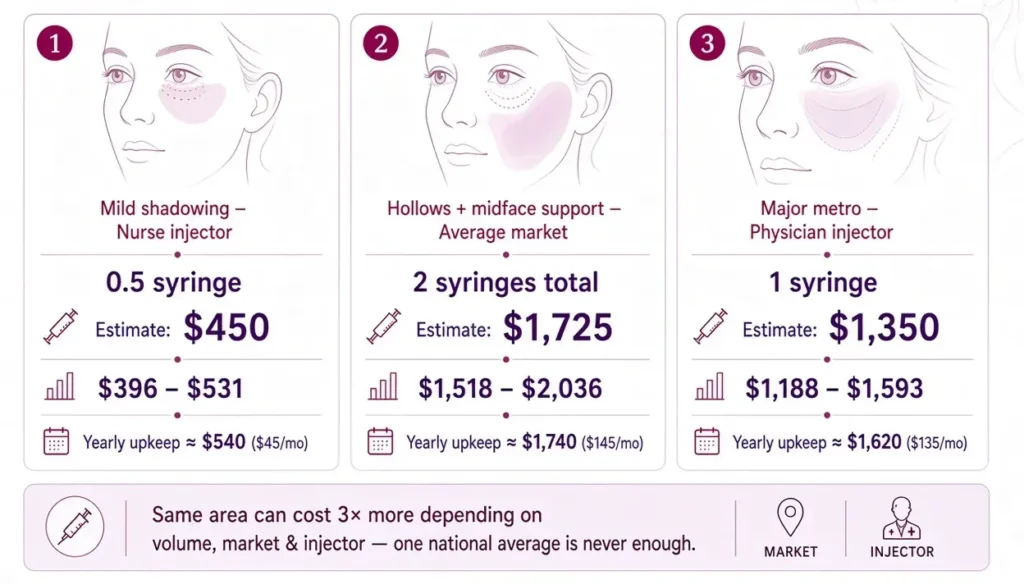
Example 1: Mild shadowing, average market, nurse injector. Tear trough, 0.5 syringe. Estimate: $450, range about $396 to $531. Estimated yearly upkeep about $540, or about $45 per month.
Example 2: Hollows plus midface support, average market. Tear trough 1 syringe plus cheek support 1 syringe. Estimate: $1,725 (about $900 plus $825), range about $1,518 to $2,036. Yearly upkeep about $1,740, or about $145 per month.
Example 3: Major metro, physician injector, tear trough only. Tear trough, 1 syringe. Estimate: $1,350, range about $1,188 to $1,593. Yearly upkeep about $1,620, or about $135 per month.
The point of the examples: the same area can cost three times as much depending on volume, market and injector, which is why one national average is not enough.
Common Budgeting Mistakes
- Comparing price per syringe only. Consultation, follow-up and other fees change the real total.
- Assuming two eyes means two syringes (or one). Ask the clinic how they quote.
- Choosing the lowest price. An unusually low price per syringe can point to a less-experienced injector or questionable product. Ask which product will be used and who will inject.
- Ignoring upkeep. HA filler is temporary. Plan for repeat treatments.
- Expecting filler to fix everything. Filler helps dark circles caused by hollowing and shadow. It does not correct pigment-based dark circles, and it can make true fat-pad bags look more prominent.
Using Your Results at a Consultation: Checklist
- Bring your calculator estimate and quote comparison
- Ask which product will be used and why
- Ask how many syringes or mL are recommended and whether the price is per eye, per syringe or per session
- Ask whether the consultation fee is credited and whether touch-ups are included
- Ask who will inject and how many under-eye treatments they perform
- Ask what happens if the result needs correcting, including access to hyaluronidase
Understanding the Key Terms
- Syringe / mL: Filler is sold in syringes, most often 1 mL. Half-syringe pricing varies by clinic.
- Tear trough: The groove between the lower eyelid and cheek.
- Infraorbital hollows: The medical term for under-eye hollowing.
- Hyaluronic acid (HA): The reversible gel used in most under-eye fillers.
- Hyaluronidase: An enzyme that dissolves HA filler.
- Tyndall effect: A bluish tint that can appear when filler sits too superficially.
- Consultation credit: When a consultation fee is deducted from your treatment price.
Tear Through Filler Cost by Area
| Area | Typical syringes | Cost factor | Results last (approx.) |
| Tear trough (under-eye hollows) | 0.5 – 1 | Higher, delicate area | 9 – 12 months |
| Dark circles caused by hollowing | 0.5 – 1 | Higher | 9 – 12 months |
| Lid-cheek junction | 0.5 | Higher | 9 – 12 months |
| Cheek / midface support | 1 – 2 | Standard to higher | 12 – 18 months |
| Nasolabial folds | 1 – 2 | Standard | 9 – 12 months |
| Temples | 1 – 2 | Standard to higher | 9 – 12 months |
Many people pair under eye filler with cheek filler. Supporting the midface can lift the area below the eye and sometimes reduces how much tear trough product is needed. This is also why a plan with “facial balancing” can cost more than a single under eye treatment.
What affects the Cost of Under Eye Filler?
- Number of syringes or mL. Most clinics price per syringe, and a few price per mL. Confirm which, because a half syringe is not always half the price.
- Product choice. Premium or purpose-built gels cost more than general-purpose HA.
- Injector credentials. Board-certified dermatologists and plastic surgeons often charge $100 to $300 more per syringe than nurse injectors, and some people prefer that experience level for a high-risk area.
- Your market. Prices in NYC, Los Angeles, Miami and San Francisco sit at the top of the range, while smaller cities are lower.
- Technique. Cannula or needle technique, and the time a careful under-eye treatment takes.
- Fees around the treatment. Consultation, numbing, deposits, tax and follow-up visits can add 10 to 30% to a quote.
- Memberships and offers. Loyalty programs, first-time patient offers and manufacturer rewards can cut cost per syringe.
How Many Syringes Do You Need for Under Eye Filler? (Per Eye vs Both Eyes)
Many people are treated with roughly one syringe (1 mL) in total for both eyes, which is about half a syringe per eye. Some injectors quote one syringe per eye, and significant hollowing can need more. Mild shadowing may need less. Your injector decides after examining you.
Why quotes confuse people
Prices online range from about $600 to $1,500 per syringe, while totals “for both eyes” can range from around $1,000 to $3,000. The gap exists because clinics describe pricing differently:
- Per syringe: Most common. The total depends on how much you use.
- Per eye: Some clinics quote each eye separately.
- Per session: A flat price for the visit, regardless of exact volume.
How much does half a syringe cost?
Often close to half the price of a full syringe, but some clinics set a minimum. If a full syringe is $900, half may be $450 to $600. Always ask.
Example syringe amounts
| Situation | Typical syringes (both eyes) |
|---|---|
| Mild shadowing | 0.5 to 1 |
| Moderate tear trough hollowing | About 1 |
| Pronounced hollowing | 1 to 2 |
| Hollows plus cheek support | 2 or more across areas |
These are general ranges, not recommendations. Use the calculator to see what each scenario costs.
Does using more filler make it better?
No. Under-eye skin is thin, and overfilling can cause puffiness, lumps or a bluish tint. A conservative, experienced approach, with a touch-up if needed, is often safer than a large amount at once.
Questions to ask
- Is your price per eye, per syringe, per mL or per session?
- How many syringes do you expect to use for me?
- What is the cost of a small touch-up?
Ready to compare? Enter two quotes into our quote comparison tool.
Frequently asked questions
Is the calculator a quote? No. It is an estimate based on typical U.S. ranges. Only a clinic can give you a quote after examining you.
How accurate is the under eye filler cost calculator? It is as accurate as the numbers you enter. For the best result, type your clinic’s real price per syringe.
Does it include consultation and follow-up fees? The estimator covers treatment cost. Use the quote comparison tool to add consultation, touch-up and other fees.
How is yearly cost calculated? It multiplies the treatment cost by how often each area typically needs repeating, based on how long results last.
Can I use it for cheek or temple filler? Yes, those areas are included because they are often treated together with the under-eye area.
Does insurance cover under eye filler? No. It is a cosmetic treatment paid out of pocket.
Is my data saved? The tool runs in your browser, and nothing you enter is sent to or stored on our servers. [Confirm this matches your final setup.]
Medically Reviewed:
Medically reviewed by Dr. J. Harper, MD, FAAD, a board-certified dermatologist with 12 years of experience in facial aesthetics and injectable treatments. Clinical input from Dr. Emily R. Carter, MD, FACS, consultant ophthalmic and oculoplastic surgeon.
Medical review date: [October 20, 2026] · Last updated: [September 23, 2026]
Reference Source
| Page section | Recommended Source |
|---|---|
| Average filler pricing | ASPS cost guide |
| FDA approval and product safety | FDA approved fillers |
| Filler risks and safety warnings | FDA dermal-filler guidance |
| Explaining additional treatment and aftercare costs | NHS cosmetic procedure advice |

Sarah Mitchell is the founder and research editor of Under Eyes Filler, an independent patient-education resource. She is a researcher and writer, not a licensed medical professional. Her work is to read clinical studies and official FDA and ASPS guidance, then translate them into clear, honest explanations of under-eye filler results, recovery, risks, and realistic costs, so readers can prepare better questions for their own qualified provider.