Medically reviewed • Evidence-led under-eye filler education • Updated October 2026
Who Should Not Get Under-Eye Filler? 15 Warning Signs & Alternatives32 min read
Under-eye fillers must be avoid by peoples with prominent eye bags, significant skin laxity, or specific underlying medical and anatomical conditions. In these cases, tear trough filler may worsen puffiness, increase the risk of complications, or deliver limited cosmetic improvement. A qualified medical professional should assess the underlying cause of the under-eye concern to determine whether filler is appropriate or an alternative treatment would be more effective.
Under-eye filler may not be right for you if your main problem is a fat bag, festoons, loose skin, pigment, visible vessels, very thin skin or flat cheeks, or if you have an active infection, a relevant allergy, a bleeding or immune-related condition, or you are pregnant. Some situations mean wait. Some mean get a medical review first. Some mean filler is the wrong tool. Because under-eye concerns have different causes, diagnosis should come before injection.
Under-eye filler is not suitable for everyone. Some people should postpone treatment, some need individualized medical assessment, and some are poor anatomical candidates because filler does not address the main cause of their appearance. The key is to identify the underlying problem before deciding whether to inject.
The 15 warning signs at a glance
| # | Situation | Group | What it usually means |
|---|---|---|---|
| 1 | Active infection, inflammation or a recent laser or peel | Postpone | Resolve first, then reschedule |
| 2 | Allergy to the product, lidocaine or past HA filler | Product-specific | Check the exact label |
| 3 | Prominent eye bags or fat herniation | Poor fit | Filler adds volume; it does not remove fat |
| 4 | Festoons, malar mounds, allergy or fluid-related swelling | Review first | Find the cause before adding volume |
| 5 | Significant skin laxity | Poor fit | Filler does not remove excess skin |
| 6 | Pigment- or vessel-dominant dark circles | Poor fit | Treat the real cause |
| 7 | Very thin or crepey skin | Review first | Higher risk of visible filler or a blue tint |
| 8 | Flat cheeks or midface volume loss | Review first | The cheek may need support first |
| 9 | Bleeding, immune, scarring or pigment-related history; blood thinners | Review first | Disclose everything; never stop medicines alone |
| 10 | Pregnancy or breastfeeding | Postpone | Safety has not been studied |
| 11 | Previous filler, unknown product or past complications | Review first | Identify what is there before adding more |
| 12 | Previous or planned eyelid surgery | Review first | Share your surgical history |
| 13 | Expectations filler cannot meet, or body-image distress | Reassess | Reset goals with a clinician |
| 14 | Late teens or early twenties | Review first | Check labeling and whether it is true volume loss |
| 15 | DIY, online or unlicensed filler | Never | Use a licensed, experienced clinician only |
The phrase who should not get under-eye filler can mislead, because not every risk factor is an absolute contraindication. A more useful way to judge under-eye filler candidacy is to sort people into four groups:
- Do not proceed right now: treatment should be postponed.
- Medical review required: history, medicines or a previous reaction need individual assessment.
- Poor anatomical candidate: filler does not address the main cause and could make fullness or contour problems more noticeable.
- Potentially suitable: structural hollowing, appropriate anatomy, realistic expectations and no major contraindication.
A person can be a bad candidate for under-eye filler without being medically unable to receive dermal filler.
1. Active Infection, Inflammation or Recent Skin Treatments
Elective filler should wait while the skin near the injection area is infected or inflamed. Juvéderm’s safety information says treatment should be postponed where skin sores, pimples, rashes, hives, cysts or infections are present, because filler may delay healing or worsen the problem. The FDA’s dermal filler guidance gives similar advice.
This includes inflamed cysts or pimples near the lids, rash or hives, open wounds, active inflammatory skin conditions and unresolved irritation around the lower eyelid.
Timing matters too. Juvéderm warns of possible inflammation if a laser treatment or chemical peel happens closely before or after filler. Tell your injector about recent or planned skin procedures.
What to do: get the problem assessed and treated, then reschedule.
2. Allergy to the Filler or Its Ingredients
The exact product matters. Each FDA-approved under-eye filler has its own labeling, and all of them list severe-allergy contraindications (see the product-by-product table below). Common ones include a history of anaphylaxis or multiple severe allergies, allergy to gram-positive bacterial proteins used in manufacturing and, for lidocaine-containing products, allergy to lidocaine. Juvéderm also lists previous allergic reactions to hyaluronic acid fillers.
Do not assume every HA filler has the same ingredients or contraindications. Before treatment, ask:
- What exact product will be injected?
- Does it contain lidocaine?
- What are its contraindications?
- Is it approved for under-eye use and for my age in my country?
3. Prominent Under-Eye Bags or Fat Herniation
Filler adds volume. If the problem is already excess volume, such as protruding orbital fat or lower-eyelid fat prolapse, more volume usually does not fix it. Surgeons interviewed by AEDIT describe bags that create a bulge followed by a hollow, where filler can exaggerate the bulge.
What looks like a tear trough may actually be:
- Orbital fat herniation
- An eye bag
- Lower-eyelid contour change
- Midface anatomy
- Shadowing from a combination of structures
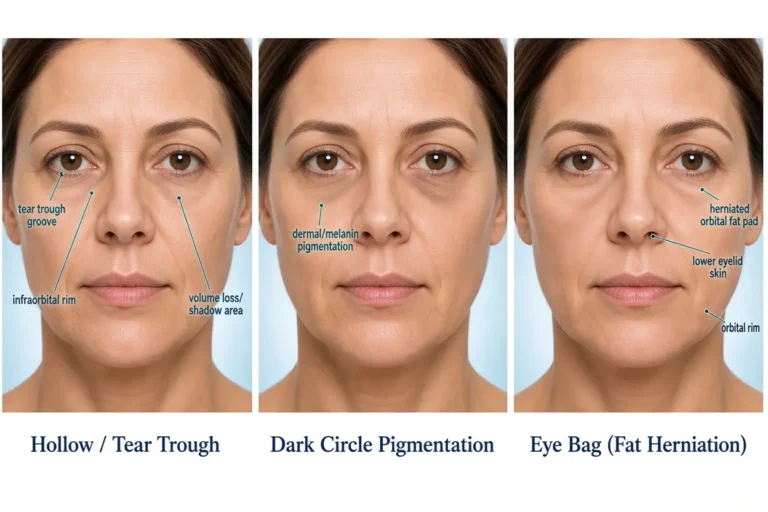
For selected people with a moderate or severe structural deformity, lower blepharoplasty with fat repositioning may be considered instead of simply adding filler. Our guide to hollows vs dark circles vs eye bags shows how to tell them apart.
4. Festoons, Malar Mounds or Recurring Under-Eye Swelling
- What they are: fullness at the junction of the lower eyelid and upper cheek, sitting over the cheekbone rather than directly under the eye.
- How they differ from eye bags: bags usually come from orbital fat bulging. Festoons and malar mounds involve the lid-cheek tissues and can include fluid retention.
- Why they matter for filler: added volume can make existing fullness more noticeable.
Allergies and fluid. A surgeon quoted by AEDIT names chronic or seasonal allergies, morning puffiness and swelling that changes with food as signs that filler can make things look worse. If your fullness changes during the day, with allergies, with salt or alcohol, or with illness, find the cause before adding volume.
See a doctor first if swelling is new, one-sided, painful or comes with other symptoms. Some causes of eyelid swelling are medical, not cosmetic.
Who to consult: an oculoplastic surgeon, ophthalmologist, dermatologist or experienced injector. Options depend on the cause and can include observation, skin-focused treatment, lower blepharoplasty or midface procedures.
5. Significant Skin Laxity or Excess Lower-Eyelid Skin
Filler restores volume but does not remove excess skin. It may have a limited role if your main concern is loose lower-eyelid skin, significant wrinkles, severe crepey skin, lower-eyelid laxity or excess skin folds. Reviews of infraorbital hyaluronic acid filler describe carefully selected candidates as having relatively good skin quality and limited laxity or fat herniation. Many people with significant laxity are better served by a surgical or skin-focused assessment.
6. Pigment- or Vessel-Dominant Dark Circles
Not every dark circle is a hollow. Darkness can come from pigment, visible vessels, structural shadowing, a tear trough hollow, thin translucent skin, or several of these.
- If the darkness changes a lot with lighting or head position, structural shadowing may be involved.
- If the color stays the same, pigment or vessels matter more.
Injecting filler beneath pigment does not remove the pigment. The practical question is whether the darkness comes from a depression, a color change or both. Read our guides on under-eye fillers for dark circles and hollows vs dark circles.
7. Very Thin or Highly Crepey Under-Eye Skin
Thin skin is a candidate-selection factor, not an automatic “no.” It makes results less forgiving, because irregularities become visible or palpable more easily. Concerns include visible or palpable filler, contour irregularity, blue-gray discoloration (the Tyndall effect), lumps and bruising. A clinical series cited in the infraorbital filler literature found that very thin skin, pre-existing color problems and pre-existing eyelid fluid made people less suitable.
8. Flat Cheeks or Significant Midface Volume Loss
The tear trough does not exist on its own. If the cheek below it has lost support, filling only the groove can leave the lower lid looking fuller or puffier. Surgeons interviewed by AEDIT describe this as the “chipmunk” look and say filler will not help when the real problem is cheek volume.
A good assessment looks at the cheek as well as the groove. In some people the first step is midface support, with the under-eye groove reassessed afterward. Ask your clinician whether your cheeks should be treated first.
9. Medical Conditions, Medicines and Supplements
Tell your clinician about all of the following before treatment. None of these automatically means “never,” but each needs individual assessment.
- Bleeding disorders (the FDA advises disclosing them).
- Prescribed blood thinners (anticoagulants or antiplatelet medicines). Do not stop a prescribed medicine on your own just to have filler. Discuss it with the treating clinician and the clinician who prescribed it.
- Over-the-counter products that raise bruising risk. Juvéderm lists aspirin, ibuprofen and other blood thinners. Many clinics also ask patients to avoid aspirin, NSAIDs, vitamin E and ginkgo for about five days beforehand. Follow your injector’s instructions, and only pause medicines your doctor says are safe to pause.
- Immune-suppressing treatment, such as steroids, chemotherapy or medicines for autoimmune disease or HIV. Juvéderm notes these may raise infection risk.
- A history of excessive scarring or pigmentation disorders. Juvéderm says treatment in these patients has not been studied and may cause additional scars or pigment changes.
- Autoimmune or inflammatory disease. This is not a universal “no filler” rule. A review of HA fillers in autoimmune inflammatory diseases describes the issue as controversial, with evidence that differs between conditions.
- A history of severe reactions to fillers.
10. Pregnancy and Breastfeeding
Elective filler is generally deferred during pregnancy because safety data are limited. The FDA states that the safety of dermal fillers during pregnancy and breastfeeding is unknown, and Juvéderm says it has not been studied. A 2026 review of cosmetic dermatology in pregnancy and lactation treats the two situations as different and recommends deferring elective procedures during pregnancy. Breastfeeding should not simply be treated as identical to pregnancy, so decide with your treating clinician.
11. Previous Filler, an Unknown Product or Past Complications
Do not automatically add more filler if you have had:
- Persistent swelling or malar edema
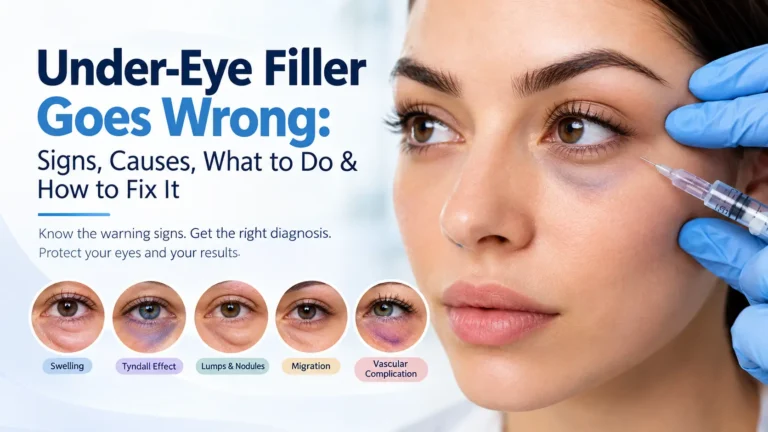
- Migration or the Tyndall effect
- Nodules, asymmetry or contour irregularities
- A vascular complication or an inflammatory reaction
- A problem that needed hyaluronidase
The first question is what caused the problem, and is any filler still present? Old HA filler can persist longer than people expect. Before another injection, your clinician may need to know the product, when and how much was injected, where it was placed, whether complications occurred and whether the current look is actually caused by filler. Juvéderm asks patients to tell their doctor about earlier fillers in the same area.
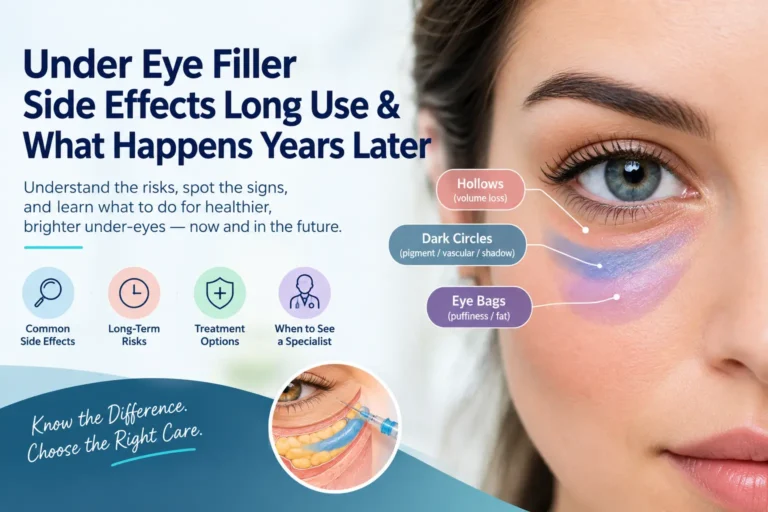
If the product is unknown, try to contact the previous injector for records. See our guide on when under-eye filler goes wrong and the page on long-term side effects.
12. Previous or Planned Eyelid Surgery
Lower blepharoplasty, transconjunctival surgery, fat removal, fat repositioning, fat grafting and other eyelid or periocular surgery can change contour, tissue planes, scarring and swelling patterns. Previous surgery does not automatically rule out filler, but it makes assessment more complex. It can also be hard to tell whether a hollow is true volume loss, post-surgical contour change, residual swelling or laxity.
Bring your surgical records, or at least the procedure name and date.
If you may have surgery later: tell your surgeon about any filler first. One oculoplastic surgeon quoted by AEDIT says existing filler must be completely dissolved before blepharoplasty, and that some patients come to remove filler and choose surgery for a longer-term result.
13. Expectations Filler Cannot Meet, Including Body-Image Distress
You may be a poor candidate if you want something filler is not designed to do. It is not a direct treatment for pigment, prominent orbital fat, excess skin, every form of puffiness, significant festoons, severe laxity or every type of dark circle.
Warning signs include expecting:
- Perfect symmetry
- A permanent result
- Complete elimination of dark circles or eye bags
- A dramatic change from a small amount of filler
- No swelling or bruising
Body dysmorphic disorder (BDD) deserves care. A pathway for BDD in facial aesthetics notes that cosmetic procedures may not address the underlying problem and can be followed by persistent dissatisfaction. Ordinary concern about appearance is not BDD. The right approach is respectful clinical assessment, not labeling.
14. Late Teens and Early Twenties (and the Age Rules)
Age alone does not decide candidacy, but the labeling sets limits:
- Restylane Eyelight, JUVÉDERM VOLBELLA XC and Belotero Balance (+) are FDA-approved for under-eye hollows in adults over 21. Juvéderm notes that VOLBELLA XC has not been studied in patients under 22.
- The FDA says dermal fillers are generally approved for people aged 22 and older.
In the late teens and early twenties, a practitioner writing for Livara Aesthetics notes that tear trough shadows usually come from natural anatomy, such as bone structure, skin thickness and fat-pad position, rather than lost volume. In that case filler may look unnatural, and it is not restoring anything.
At the other end, a surgeon quoted by AEDIT describes older patients with larger bags, lots of excess skin or very thin skin as poorer candidates.
15. Anyone Planning DIY, Online or Unlicensed Filler
The FDA says not to inject yourself with dermal fillers or with needle-free injection “pens.” Products bought online may be fake, contaminated or not approved for use in the U.S. Filler is for prescription use only and should be injected by a licensed provider who is experienced with fillers, facial anatomy and managing complications.
The under-eye area is high-risk because of its delicate skin and blood vessels, so this is the one group where the answer is always no. See the FDA’s dermal filler do’s and don’ts.
Quick answer: who may need to avoid or postpone treatment?
| Situation | What it usually means |
| Active infection or significant inflammation | Postpone elective filler until the problem has been assessed and managed. |
| Relevant severe allergy | Check the exact product and its ingredients; product-specific contraindications matter. |
| Prominent eye bags / fat herniation | Filler adds volume and does not remove protruding orbital fat; another approach may be more appropriate. |
| Festoons, malar mounds or recurrent edema | Persistent fullness should be assessed before adding volume. |
| Very thin or crepey skin | Not an automatic contraindication, but visible filler, contour irregularities and bluish discoloration may be more noticeable. |
| Significant skin laxity | Filler does not remove excess skin and may have a limited role. |
| Pigment- or vascular-dominant dark circles | Filler does not directly treat pigment or visible vessels; the diagnosis may point to another treatment. |
| Previous unresolved filler complication | Do not automatically add more filler; establish what product remains and what caused the problem. |
| Previous blepharoplasty or periocular surgery | Not an automatic “no,” but altered anatomy makes individualized assessment important. |
| Pregnancy | Elective cosmetic filler is generally deferred because safety data are limited. |
| Anticoagulant/antiplatelet therapy or bleeding disorder | Requires disclosure and individualized risk assessment; prescribed medication should not be stopped independently. |
| Autoimmune/inflammatory disease | Not a universal contraindication; some conditions require additional medical assessment. |
| Unrealistic expectations | Treatment should be reconsidered if the desired result is outside what filler can realistically achieve. |
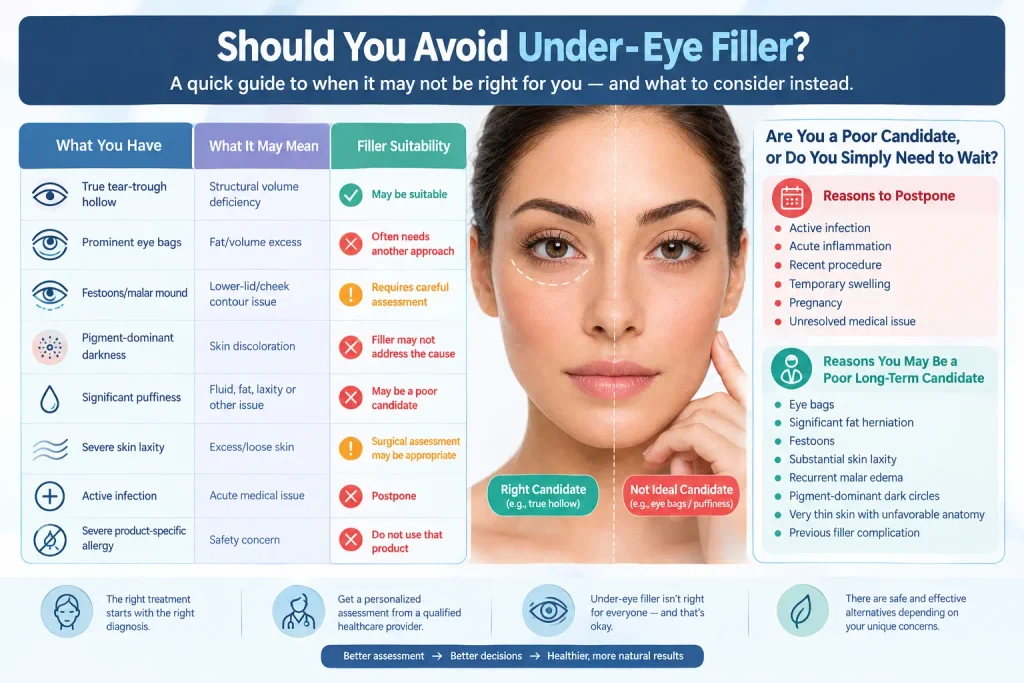
The phrase “who should not get under-eye filler” can be misleading because not every risk factor is an absolute contraindication.
A more useful way to assess under-eye filler candidacy is to place potential patients into four groups:
- Do not proceed right now — treatment should generally be postponed.
- Medical review required — the person’s medical history, medication, or previous reaction needs individual assessment.
- Poor anatomical candidate — filler may not address the underlying structure and could make fullness or contour problems more noticeable.
- Potentially suitable candidate — the person has structural hollowing, appropriate anatomy, realistic expectations, and no major contraindication.
That distinction is important because a person can be a bad candidate for under-eye filler without being medically unable to receive dermal filler.
Under-Eye Filler Contraindications by Product
Labels differ, so check the current instructions for use for the exact product. This table summarizes what the FDA and manufacturers publish.
| Product | FDA under-eye approval | Age | Label says not for people with | Also note |
|---|---|---|---|---|
| Restylane Eyelight | May 2023 | Over 21 | History of anaphylaxis or multiple severe allergies; allergy to certain bacterial proteins used in the product; allergy to lidocaine or other amide anesthetics | Contains lidocaine; labeling cautions that people prone to edema may swell more |
| JUVÉDERM VOLBELLA XC | May 28, 2021 | Over 21 (not studied under 22) | History of anaphylaxis or severe allergies; multiple severe allergies; allergy to gram-positive bacterial proteins; allergy to lidocaine; previous allergic reactions to HA fillers | 0.3% lidocaine; injectors should complete training for the under-eye area |
| Belotero Balance (+) | Sept 27, 2023 | Over 21 | History or presence of multiple or severe allergies, including anaphylaxis; allergy to gram-positive bacterial proteins | Lidocaine formulation; Merz advises delaying treatment until a reaction at the site resolves |
| RHA Redensity Eye | 2026 | Adults 22 and older | Check the current labeling | Newest approval; confirm details with the manufacturer or FDA |
Sources: the FDA pages for Restylane Eyelight, VOLBELLA XC and Belotero Balance (+), plus Juvéderm and Merz safety information.
| Category | Example | What to do |
|---|
| Do not proceed until resolved | Active infection | Postpone |
| Product-specific contraindication | Severe allergy to relevant component | Avoid that product |
| Requires medical assessment | Certain inflammatory/autoimmune conditions | Individual assessment |
| Bleeding consideration | Anticoagulant/antiplatelet use | Discuss with clinician |
| Anatomical mismatch | Large fat pads | Consider alternative |
| Poor skin quality | Very thin/crepey skin | Specialist assessment |
| Concern mismatch | Pigmentation | Treat the cause |
| Existing filler | Unknown/previous filler | Assess before adding |
| Previous surgery | Lower blepharoplasty | Assess altered anatomy |
| Temporary timing issue | Active swelling/inflammation | Wait |
| Expectation issue | Wants complete elimination | Reassess goals |
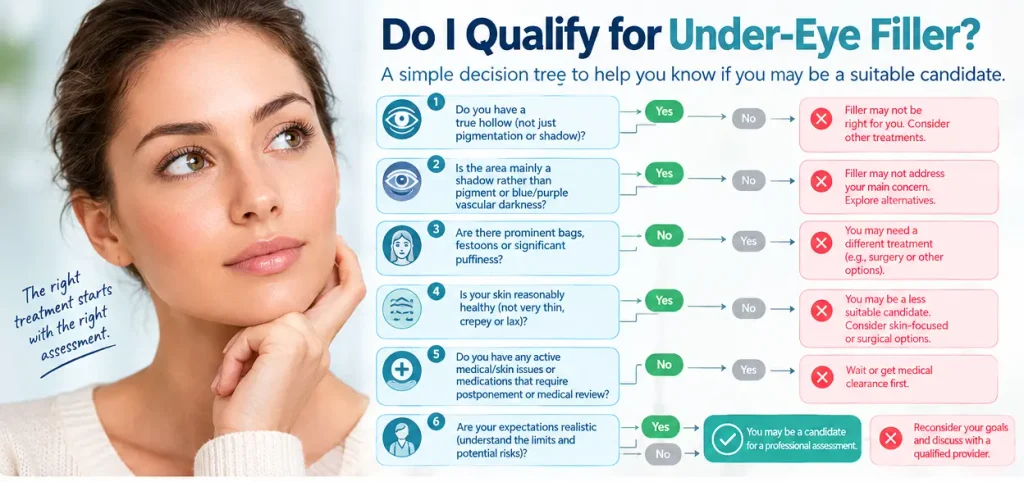
Under-Eye Filler Candidacy Map: 8 Questions to Ask Yourself
Use this as an educational framework, not a diagnosis or a substitute for an in-person exam.
| Do you see a groove or indentation? | A structural hollow may be contributing |
| Is the color brown, blue or purple, and does it stay the same in every light? | Pigment or vessels may be involved |
| Does the shadow change a lot with lighting? | A structural component is likely |
| Is there a visible bulge, or fullness that reaches the cheek? | Think bags, festoons or malar mounds first |
| Does the swelling fluctuate with time of day, allergies, food or illness? | Find the cause before adding volume |
| Are your cheeks flat or deflated? | The cheek may need support first |
| Do you have previous filler or eyelid surgery? | Record the product, date and procedure; get an assessment first |
| Any allergy, bleeding, immune, scarring, pigment, pregnancy or medicine issue? | Review with the treating clinician |
Possible outcomes
- Potential filler candidate: the main problem appears to be structural hollowing, with appropriate anatomy and realistic expectations.
- Needs specialist assessment: anatomy, swelling, previous treatment, surgery or medical history makes the decision less straightforward.
- Filler may not address the primary problem: the dominant issue appears to be pigmentation, vascular darkness, prominent fat, significant laxity, festoons or another cause.
Who may still be a good candidate?
Who May Still Be a Good Candidate for Under-Eye Filler?
Being cautious about poor candidates does not mean under-eye filler is inappropriate for everyone.
A carefully selected candidate may have:
Mild-to-moderate structural infraorbital hollowing
Reasonably good skin quality
Minimal significant lower-eyelid laxity
Little or no prominent fat herniation
Limited persistent edema
Realistic expectations
No relevant untreated medical contraindication
An appropriate filler product
A qualified, experienced injector
Recent literature on tear-trough deformity emphasizes individualized patient selection and identifies good skin quality, limited lower-eyelid laxity and limited fat herniation as characteristics of patients who may be suitable for nonsurgical treatment.
Who May Still Be a Good Candidate for Under-Eye Filler?
Being cautious about poor candidates does not mean filler is wrong for everyone. A carefully selected candidate may have:
- Mild-to-moderate structural infraorbital hollowing
- Reasonably good skin quality
- Minimal lower-eyelid laxity
- Little or no fat herniation
- Limited persistent edema
- Adequate cheek support
- Realistic expectations
- No untreated medical contraindication
- An appropriate, approved product and a qualified, experienced injector
In one clinical series of tear trough patients, those with mild-to-moderate volume loss and no severe fat bulging were considered suited to filler or fat grafting alone.
What does under-eye filler actually treat?
- Structural tear-trough or infraorbital hollowing — often the main indication when anatomy is appropriate.
- Shadowing caused by a hollow — may improve when the shadow is primarily structural.
- Mild volume loss — may improve in selected patients.
- Pigmentation — filler does not directly remove pigment.
- Visible vessels/vascular darkness — filler does not directly treat the vessels.
- Prominent orbital fat or significant eye bags — filler does not remove protruding fat.
- Festoons/malar mounds — usually require a different assessment and treatment strategy.
- Excess skin or significant laxity — filler does not remove excess skin.
- Dynamic crow’s feet — filler is not a direct treatment.
Diagnosis should come before injection. If the visible problem is not primarily a hollow, adding volume may not produce the expected result.
If Filler Isn’t Right: Options by Concern
The goal is not to choose the most aggressive treatment. It is to match the treatment to the anatomy. See our guide to fixing hollows without filler for non-filler options.
| Primary concern | Filler may help? | Consider discussing |
|---|---|---|
| Structural hollow or tear trough | Often, in selected patients | HA filler assessment; fat grafting or surgery for larger deformities |
| Pigmentation | No direct treatment | Sun protection, pigment-focused skincare, selected light or laser options |
| Visible vascular darkness | No direct treatment | Assessment of vascular and skin contribution |
| Prominent bags or fat herniation | Usually limited | Lower-eyelid or oculoplastic assessment |
| Festoons or malar mounds | Usually limited | Specialist assessment of swelling and midface anatomy |
| Flat cheeks | Partly | Midface volume assessment first |
| Significant skin laxity | No direct correction | Skin-focused or surgical assessment |
| Mixed hollow, bag and pigment | Depends on the dominant cause | Diagnosis first, then a combined plan |
Previous blepharoplasty and existing filler: two situations that need extra care
After blepharoplasty or periocular surgery
Previous surgery does not automatically prohibit filler. However, lower blepharoplasty, transconjunctival surgery, fat removal, fat repositioning or fat grafting can change tissue planes and contour. The clinician should understand the prior procedure and assess the current anatomy before deciding whether additional filler is appropriate.
If you already have under-eye filler
Do not assume that adding more filler will improve an unsatisfactory result. First establish what product was used, when and where it was injected, how much was used, whether it may still be present, and whether the current appearance is actually caused by filler. Persistent edema, nodules, migration, Tyndall effect, asymmetry or contour irregularity should be assessed before additional treatment.
Age, pregnancy, breastfeeding and medication considerations
Age alone does not determine candidacy. Appropriate age also depends on the specific product’s labeling and the clinical indication.
Elective cosmetic filler is generally deferred during pregnancy because safety data are limited. Breastfeeding is not identical to pregnancy; evidence remains limited, so the decision should be individualized with the treating healthcare professional.
Anticoagulant or antiplatelet medicines can increase bruising and bleeding considerations. Do not stop prescribed medication independently just to undergo filler; discuss the risks and benefits with the treating clinician and, when appropriate, the prescribing clinician.
Autoimmune or inflammatory disease is not a universal evidence-based “no filler” rule. Evidence differs between conditions, so some patients may require additional medical assessment before treatment.
What the Research Says About Patient Selection (and What Is Still Uncertain)
Research supports careful, individualized selection rather than a one-size-fits-all list of contraindications. Some points come from product labeling and peer-reviewed reviews. Others are clinician opinion, and we label them that way.
Well established
- Under-eye filler is not appropriate for everyone.
- Active infection or inflammation should be managed before injection.
- Product-specific allergies matter, and labels differ by product.
- Bleeding disorders need to be disclosed.
- Swelling, bruising and contour irregularities are recognized effects, and accidental injection into a blood vessel can cause severe complications.
- Prominent fat herniation and significant laxity make filler less suitable.
- Approved indications and age limits differ by product.
Supported, but individualized
- Very thin skin raises the chance of visible irregularities.
- Existing or recurrent edema can make infraorbital filler less suitable.
- Previous filler or eyelid surgery changes treatment planning.
- Autoimmune or inflammatory disease may need extra assessment.
- Blood-thinning medicines affect bruising and bleeding considerations.
- Cheek support can matter for the groove (mainly surgeon opinion, with limited controlled data).
Still uncertain or not universal
- How long filler persists in every patient
- How often clinically significant migration occurs
- The mechanism behind every case of delayed edema
- The long-term effects of repeated filler
- Whether every autoimmune condition is a contraindication
- Whether every person with thin skin should avoid filler
Good medical content should not present uncertain claims as settled facts.
Well Established
- Under-eye filler is not appropriate for everyone.
- Active infection or inflammation should generally be managed before injection.
- Product-specific allergies matter.
- Bleeding disorders need to be disclosed.
- Filler can cause swelling, bruising and contour irregularities.
- Accidental intravascular injection can cause severe complications.
- Prominent fat herniation and significant laxity can make filler less suitable.
- Patient selection is important.
- Different fillers have different approved indications and labeling.
Supported but individualized
- Very thin skin can increase the visibility of irregularities.
- Existing edema can make infraorbital filler less suitable.
- Previous filler can affect treatment planning.
- Previous eyelid surgery can change anatomy.
- Autoimmune or inflammatory disease may require additional assessment.
- Anticoagulant or antiplatelet medication can affect bleeding and bruising considerations.
Still uncertain or not universal
- Exactly how long filler remains in every patient
- How frequently clinically significant migration occurs
- The precise mechanism behind every case of delayed edema
- The long-term effects of repeated filler in every patient
- Whether every autoimmune condition should be considered a contraindication
- Whether every patient with thin skin should avoid filler
- This distinction matters because good medical content should not present uncertain claims as settled facts.
Important risks — keep this section brief on this page
Even an appropriate candidate can experience bruising, redness, swelling, tenderness, contour irregularity, lumps, persistent edema or blue-gray discoloration. Rare but serious complications can include vascular compromise, tissue necrosis, vision abnormalities including blindness, and stroke. The FDA warns that accidental injection into a blood vessel can cause severe complications.
Seek immediate medical attention for unusual severe pain, vision changes, or white, gray or blue skin near the injection site during or shortly after treatment. For the complete complication guide, link to your dedicated Under Eye Filler Risks & Complications page.
Risks, Longevity and Cost in Brief
Risks. Even a good candidate can have bruising, redness, swelling, tenderness, lumps, persistent edema or a blue-gray tint. Rare but serious complications can follow unintentional injection into a blood vessel, including vision abnormalities, blindness, stroke, scabs or permanent scarring, according to Juvéderm’s safety information. Seek immediate care for vision changes, signs of a stroke, white-looking skin or unusual pain during or shortly after treatment. For the full picture, see our risks and complications guides.
Longevity. No single duration fits every patient. The FDA says results for Restylane Eyelight and JUVÉDERM VOLBELLA XC may last up to 12 months. Duration varies by product, amount, placement and anatomy.
Cost. Prices depend on the product, injector, location and amount used. See our under-eye filler cost guide rather than relying on a single figure.
Questions to ask before getting under-eye filler
- What is causing my concern: a hollow, pigment, vessels, fat, swelling, laxity or a mix?
- Is filler actually addressing the main cause?
- Which exact product do you recommend, and is it approved for under-eye use at my age?
- Have you completed the manufacturer’s training for this product and this area?
- Do my cheeks need support first?
- How much filler do you expect to use, and why?
- Where will you place it, and will you use a needle or a cannula?
- What are the main risks in my anatomy, and what is your plan for a vascular emergency or vision change?
- If I have previous filler, surgery or a medical condition, how does that change the plan?
- What alternatives could address my concern, and when would you recommend surgery instead?
Red flags when choosing an injector
- They cannot explain why filler suits your specific anatomy.
- They do not ask about previous filler, surgery, allergies, medicines or pregnancy.
- They cannot name the exact product they will inject.
- They dismiss serious risks or have no emergency plan.
- They promise perfect symmetry, a permanent result or the end of every dark circle.
- They place filler too low, over the orbital rim, instead of high in the tear trough. A surgeon quoted by AEDIT says this is a common mistake.
- They offer filler for bags or festoons without discussing alternatives.
- Their credentials are unclear. The FDA recommends a licensed health care professional who is experienced with dermal fillers, facial anatomy and managing complications.
The FDA recommends using a licensed healthcare professional who is experienced with dermal fillers, facial anatomy and complication management.
Filler vs. alternative treatment: simple decision guide
| Primary concern | Filler may help? | Consider discussing |
| Structural hollow / tear trough | Often, in selected patients | HA filler assessment; surgical options when deformity is more significant |
| Pigmentation | No direct treatment | Pigment-focused skincare or selected light/laser options |
| Visible vascular darkness | No direct treatment | Assessment of vascular/skin contribution |
| Prominent eye bags / fat herniation | Usually limited | Lower-eyelid/oculoplastic assessment |
| Festoons / malar mounds | Usually limited | Specialist assessment of swelling and midface anatomy |
| Significant skin laxity / excess skin | No direct correction | Skin-focused or surgical assessment |
| Mixed hollow + bag + pigment | Depends on dominant cause | Diagnosis-first, potentially combined treatment |
Frequently Asked Questions
Who should absolutely not get tear trough filler?
There is no single list for every product and patient. Active infection or inflammation, product-specific severe allergies, pregnancy and DIY or unlicensed filler are the clearest reasons to stop.
Can I get under-eye filler at 18, 20 or 25?
The approved products are labeled for adults over 21, and Juvéderm says VOLBELLA XC has not been studied under 22. In the late teens and early twenties, shadows are often anatomical rather than volume loss, so a clinician should assess whether filler is appropriate at all.
Can I get under-eye filler if I have eye bags?
Possibly, but filler is not usually the main treatment for prominent bags caused by orbital fat, because it adds volume rather than removing fat.
Can I get tear trough filler if I have festoons?
Festoons or malar mounds can make filler less suitable because they involve fullness and sometimes fluid. Find the cause before adding volume.
Can I get filler with very thin under-eye skin?
Possibly. Thin skin makes visible filler, contour irregularities and a bluish tint more likely, so patient selection and technique matter.
Can I get under-eye filler if I have dark circles?
It depends on the cause. Filler may help darkness from a hollow and its shadow, but it does not treat pigment or visible vessels.
Can I get filler if my cheeks are flat?
Possibly, but the cheek may need support first. Filling only the groove can leave the lower lid looking fuller.
Can I get filler if I have seasonal allergies or morning puffiness?
Fluctuating swelling should be assessed first, because the cause may be allergy, fluid or inflammation rather than simple volume loss. See a doctor if swelling is new, one-sided or painful.
Can I get filler if I am pregnant?
Elective filler is generally deferred during pregnancy because safety data are limited.
Can I get filler while breastfeeding?
Evidence is limited, and breastfeeding is not identical to pregnancy. Decide with your treating clinician.
Can I get filler if I take blood thinners or aspirin?
Tell your clinician about every medicine and supplement. Do not stop a prescribed medicine on your own. Many clinics ask patients to avoid aspirin, NSAIDs, vitamin E and ginkgo for about five days beforehand, but follow your injector’s and doctor’s advice.
Can I get filler if I have an autoimmune condition?
Possibly. It is not a universal rule, and evidence differs between conditions, so you may need extra medical assessment.
Can I get filler after blepharoplasty?
Possibly. Previous eyelid surgery changes anatomy and tissue planes, so your surgical history and current anatomy should be assessed.
I might have eyelid surgery later. Should I avoid filler now?
Tell your surgeon. One oculoplastic surgeon quoted by AEDIT says existing filler must be fully dissolved before blepharoplasty.
Can I get more filler if I already have filler?
Not automatically. Residual product, edema, migration, nodules or a Tyndall effect should be assessed before adding volume.
What if I do not know what filler I have?
Try to identify the product, date, amount and injector. If it is unknown, additional filler should not be added automatically.
Can I get filler after a laser treatment or chemical peel?
Juvéderm warns of possible inflammation if these procedures happen close to filler treatment. Tell your injector about recent or planned procedures.
Can I get filler if I scar easily or have a pigmentation disorder?
Juvéderm says treatment in these patients has not been studied and may lead to additional scars or pigment changes. Discuss it with your clinician first.
Can I buy filler online or inject it myself?
No. The FDA says not to inject yourself or use needle-free “pens,” and warns that online products may be fake, contaminated or not approved.
What is the difference between an eye bag and a tear trough?
A tear trough is a depression that can create a shadow. An eye bag is fullness or bulging, often related to orbital fat. They can coexist but are different problems.
Who is the ideal candidate for under-eye filler?
Typically someone with a true structural hollow, good skin quality, limited edema, laxity and fat herniation, adequate cheek support, realistic expectations and no major contraindication.
What should I do instead if I am not a candidate?
It depends on the cause. Options can include pigment-focused treatment, skincare, midface support, energy-based procedures or lower-eyelid surgery when bags or laxity dominate.
Publication Evidence Notes
Primary sources
- FDA: Dermal Fillers (Soft Tissue Fillers)
- FDA: Dermal Filler Do’s and Don’ts
- FDA: Restylane Eyelight (P040024/S135)
- FDA: JUVÉDERM VOLBELLA XC (P110033/S053)
- FDA: Belotero Balance (+) (P090016/S050)
- Juvéderm under-eye information and Important Safety Information
- Merz Aesthetics: Belotero Balance (+) consumer safety information
Peer-reviewed literature
- Infraorbital hyaluronic acid filler (PubMed)
- Complications associated with infraorbital filler injection (PubMed)
- HA fillers in autoimmune inflammatory diseases (PubMed)
- Cosmetic dermatology in pregnancy and lactation, 2026 (PubMed)
- Evidence-based pathway for BDD in facial aesthetics (PubMed)
Clinician commentary (opinion, not trial data)
- AEDIT: Are You a Candidate for Under Eye Filler? (2023)
- Livara Aesthetics: Who Shouldn’t Get Under-Eye Tear Trough Filler? (2024)
Medically Reviewed
Medically reviewed by Dr. J. Harper, MD, FAAD, a board-certified dermatologist with 12 years of experience in facial aesthetics and injectable treatments. Clinical input from Dr. Emily R. Carter, MD, FACS, consultant ophthalmic and oculoplastic surgeon.
Medical review date: [October 20, 2026] · Last updated: [September 23, 2026]

Sarah Mitchell is the founder and research editor of Under Eyes Filler, an independent patient-education resource. She is a researcher and writer, not a licensed medical professional. Her work is to read clinical studies and official FDA and ASPS guidance, then translate them into clear, honest explanations of under-eye filler results, recovery, risks, and realistic costs, so readers can prepare better questions for their own qualified provider.