Medically reviewed • Evidence-led under-eye filler education • Updated October 2026
Under-Eyes Filler Goes Wrong: Signs, Causes, What to Do & How to Fix It30 min read
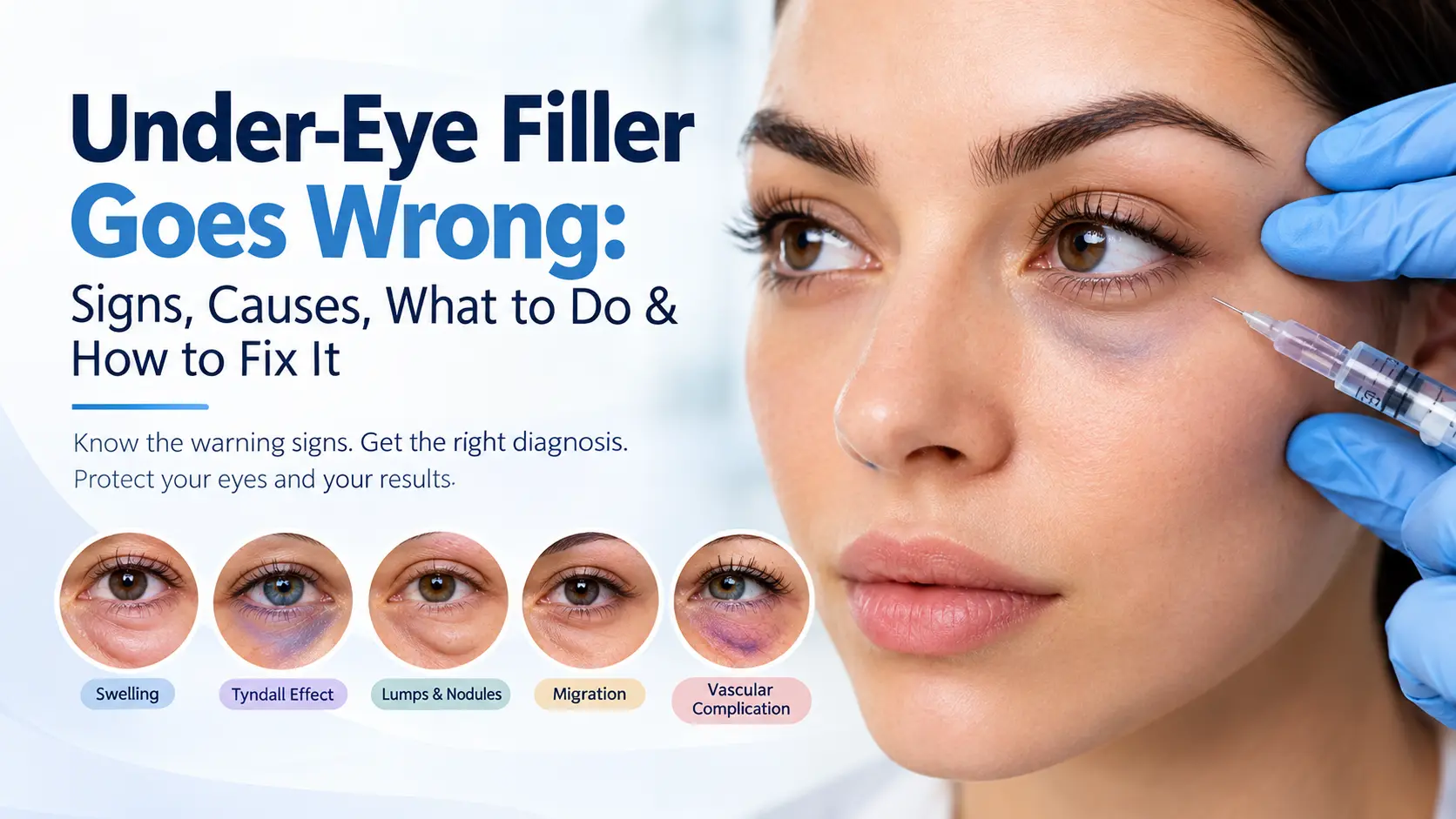
When under-eyes filler goes wrong, the result may look puffy, uneven, blue-gray, lumpy, overly full or different from the original treatment plan. Some changes are temporary and part of normal healing. Others may need assessment and correction. A much smaller group of symptoms—including sudden vision changes, severe or unusual pain, or pale, gray or mottled skin—can indicate a medical emergency.
The most important point is this:
Do not assume the problem is filler migration or automatically decide to dissolve it. The first step is to determine what is actually causing the appearance.
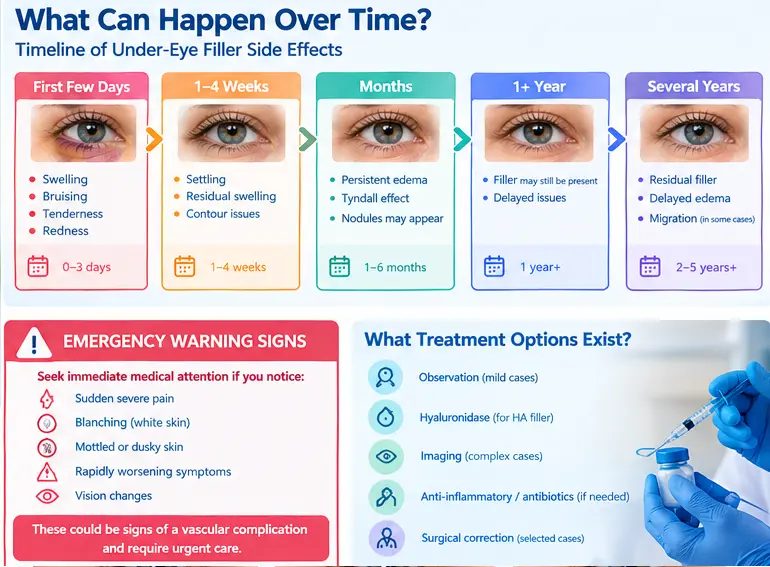
The U.S. Food and Drug Administration (FDA) notes that common filler reactions include swelling, bruising, redness, pain and tenderness, while some complications can occur weeks, months or even years after injection. Unintended injection into a blood vessel is the most serious filler risk because it can result in tissue necrosis, vision abnormalities including blindness, or stroke.
Important: This article provides educational information, not a diagnosis. If you have new vision changes, severe or unusual pain, skin blanching, mottled or dusky discoloration, or rapidly worsening symptoms after filler, seek urgent medical evaluation.
Key Takeaways
- Mild swelling, bruising, redness and tenderness are common after dermal filler and often improve during the early recovery period.
- Puffiness that persists, worsens or fails to improve as expected deserves professional assessment rather than an automatic decision to dissolve the filler.
- A blue-gray discoloration may indicate the Tyndall effect, particularly when hyaluronic acid filler has been placed too superficially.
- Firm lumps, nodules, asymmetry, overfilling and persistent edema can have different causes and should not automatically be treated in the same way.
- Fullness that appears away from the original injection site may represent migration, edema, fat prominence or another structural issue. Appearance alone cannot reliably establish the cause.
- Hyaluronidase can break down hyaluronic acid (HA) filler, but not every complication is caused by HA filler and not every HA-related problem should automatically be dissolved.
- Sudden vision changes, severe or unusual pain, pale/white skin, or mottled or dusky discoloration require urgent medical assessment.
- Some filler-related problems can appear or become noticeable months or years after treatment, although late complications are generally reported less often than early reactions.
How Do You Know If Your Under-Eyes Filler Goes Wrong?
Not every unexpected appearance after filler means something has gone wrong.
The first question is:
Is this normal healing, a complication that needs assessment, or a symptom requiring urgent medical attention?
Changes that can occur during normal recovery
Shortly after treatment, it is common to experience:
- Mild swelling
- Bruising
- Redness
- Tenderness
- Mild firmness around the injection area
- Temporary asymmetry caused by swelling
The FDA lists bruising, redness, swelling, pain, tenderness, itching and rash among recognized filler-related side effects. Many common swelling and bruising reactions occur shortly after injection and improve within days to weeks.
A typical recovery pattern
| Time after treatment | What may occur |
|---|---|
| Days 1–3 | Swelling, bruising, redness and tenderness may be most noticeable |
| Days 4–7 | Bruising often begins fading and swelling should generally start improving |
| Around week 2 | Much of the obvious bruising and early swelling may have settled, although individual recovery varies |
| Weeks 3–4 | The appearance may continue to settle and minor irregularities may become less noticeable |
| Later | Persistent, worsening or newly appearing symptoms deserve assessment rather than being assumed to be normal healing |
This is a general recovery pattern, not a diagnostic rule. Individual healing varies.
Symptoms that deserve professional assessment
Arrange an assessment if you develop:
- Puffiness that is persistent or not improving
- Increasing rather than decreasing swelling
- Noticeable new asymmetry
- Firm or persistent lumps
- Blue-gray discoloration
- Persistent redness or unusual firmness
- Fullness that appears away from the original injection area
- A result that becomes increasingly unnatural over time
- New symptoms developing weeks or months after treatment
The cause may be filler-related, but it may also involve edema, anatomy, pigmentation, orbital fat, inflammation or another condition.
Symptoms that require urgent medical attention
Seek urgent medical evaluation after filler if you develop:
- Sudden vision changes
- Severe or unusual pain
- White or markedly pale skin around the injection area
- Gray, blue or mottled skin discoloration
- Rapidly worsening symptoms
- Symptoms suggestive of stroke, such as sudden weakness, facial drooping, difficulty speaking or severe neurological symptoms
The FDA specifically advises immediate medical attention for unusual pain, vision changes, or white, gray or blue skin near the injection site.
What Does Bad Under-Eye Filler Look Like?
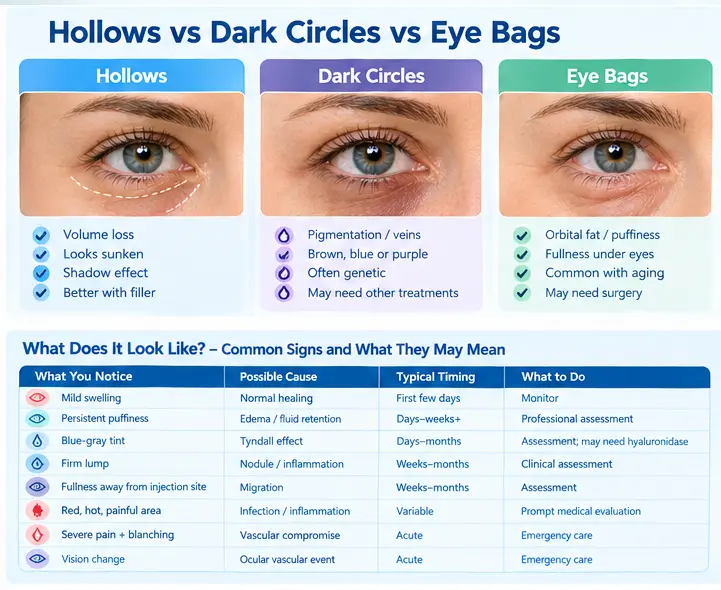
People searching for “under-eye filler gone wrong pictures” or “botched tear trough filler pictures” are often trying to match their appearance with a possible complication.
Photos can help you recognize patterns, but they cannot establish a diagnosis.
1. Normal early swelling
The area may look temporarily fuller or uneven during the first days after treatment.
Typical clue: the appearance gradually improves rather than becoming progressively worse.
2. Tyndall effect
A blue-gray or bluish appearance beneath the skin may occur when HA filler is placed too superficially.
Typical clue: the discoloration is blue-gray rather than the purple, green or yellow progression often associated with a resolving bruise.
3. Overfilling
The under-eye may appear excessively full, rounded or “pillowy.”
Typical clue: the fullness appears to be related to added volume rather than temporary generalized swelling.
4. Persistent edema
The lower eyelid or upper cheek may remain puffy after the expected early recovery period.
Typical clue: swelling remains or fluctuates instead of steadily resolving.
5. Possible migration
Filler may appear to create fullness outside the intended treatment area.
Typical clue: a visible or palpable fullness develops away from the original injection site.
However, fullness away from the injection site does not prove migration. Edema and changes in underlying fat or soft tissue can create a similar appearance.
6. Lump or nodule
A localized bump may be visible or palpable.
Possible explanations include uneven product placement, a persistent filler deposit, an inflammatory nodule or a delayed granulomatous reaction.
7. Possible vascular complication
Skin that becomes unusually pale, white, gray, blue or mottled—especially with significant pain—requires urgent assessment.
The appearance of a complication can overlap with normal healing. That is why timing + symptoms + examination are more useful than appearance alone.
What Might Be Causing the Problem?
Use the following table as a starting point—not as a way to diagnose yourself.
| What you notice | Possible explanation | Typical timing | Urgency | What to do |
|---|---|---|---|---|
| Mild swelling | Expected post-treatment edema | Early | Usually low | Monitor improvement |
| Persistent puffiness | Persistent edema or filler-related swelling | Days to weeks or later | Assessment | Arrange clinical evaluation |
| Blue-gray tint | Possible Tyndall effect | Variable | Assessment | Have the area examined |
| Purple/blue bruising | Bruising | Early | Usually low | Monitor unless worsening |
| Firm lump | Filler irregularity, nodule or inflammation | Weeks to months | Assessment | Clinical assessment |
| Fullness away from injection site | Possible migration, edema or structural fullness | Variable | Assessment | Do not assume migration |
| Red, warm, increasingly painful area | Possible infection or inflammatory reaction | Variable | Prompt assessment | Contact a qualified clinician |
| Severe pain + pale/mottled skin | Possible vascular compromise | Acute | Emergency | Seek immediate medical care |
| Vision change | Possible ocular vascular complication | Acute | Emergency | Seek immediate medical care |
Why diagnosis matters
A puffy under-eye could represent:
- Normal early swelling
- Persistent edema
- Malar edema
- Overfilling
- Orbital fat prominence
- Filler migration
- Another inflammatory process
Likewise, a lump could represent uneven filler, a nodule, inflammation or another tissue change.
The same appearance can have different causes, and different causes require different management.
Why Does Under-Eye Filler Go Wrong?
Bad under-eye filler outcomes can result from several factors rather than one single mistake.
Injection technique
The tear trough is a technically demanding area. Placement depth, injection technique, volume and treatment plane can all influence the final appearance.
Filler placed too superficially can contribute to visible irregularity or blue-gray discoloration, while excessive volume can produce an overly full appearance.
Too much filler
The under-eye does not necessarily benefit from the same volume-based approach used in other facial areas.
Even a relatively small amount of excess product may become visually obvious because the skin is thin and the contour transitions around the lower eyelid are subtle.
Product selection
Different fillers have different physical and rheological characteristics.
The behavior of a filler depends on more than whether it is simply “soft” or “hydrophilic.” Product characteristics, water interaction, elasticity, cohesivity, placement, amount used and individual anatomy can all affect the result.
Incorrect treatment plane
The lower eyelid contains closely related anatomical structures, including skin, muscle, fat compartments, connective tissues and the orbital rim.
A product placed in an inappropriate plane may produce contour irregularity, visible fullness or other unwanted effects.
Patient anatomy
Not every apparent tear trough is simply a volume deficit.
A person may have a combination of:
- Infraorbital hollowing
- Orbital fat prominence
- Skin laxity
- Malar edema
- Festoons or malar mounds
- Pigmentation
- Visible vessels
- Midface anatomy that creates shadowing
If the underlying problem is misidentified, filler may not produce the intended improvement.
Pre-existing puffiness
If the area already has a tendency toward swelling or edema, adding volume may make fullness more noticeable.
This is one reason patient selection matters.
Delayed inflammatory reactions
The FDA notes that inflammation around dermal filler can sometimes develop after illnesses or infections, vaccinations or dental procedures.
That does not mean every episode of delayed swelling has one of these triggers. Delayed swelling has multiple possible explanations.
Infection
Infection is an uncommon but recognized complication of filler treatment. Redness, warmth, increasing pain, swelling, drainage or other concerning changes require medical assessment.
Do not assume that every red or swollen area is an infection—and do not assume that every delayed swelling episode is simply normal inflammation.
Vascular complications
Accidental injection into a blood vessel is the most serious filler complication because it can compromise blood supply and, in rare cases, result in tissue necrosis, vision abnormalities or stroke.
Common Under-Eye Filler Problems
Persistent Swelling and Puffiness
Some swelling immediately after treatment is expected.
The more important question is whether the swelling is improving as expected.
Persistent or delayed periorbital edema has been described after HA filler and can involve the eyelids and malar region. Proposed contributing mechanisms include inflammatory responses as well as disturbances involving lymphatic or venous flow, and risk factors can include filler characteristics, injection depth and individual predisposition.
Persistent puffiness should therefore not automatically be explained as “the filler attracting water.”
Possible considerations include:
- Residual post-treatment edema
- Persistent filler-related edema
- Malar edema
- Filler characteristics
- Injection depth
- Existing fluid-retention tendency
- Inflammatory reactions
- Underlying anatomy
The appropriate response is assessment rather than automatically adding more filler or immediately dissolving everything.
Tyndall Effect
The Tyndall effect is a blue-gray discoloration that can occur when hyaluronic acid filler is placed too superficially beneath thin skin.
It is different from:
- A normal bruise
- Brown pigmentation
- Visible vascular darkness
- Acute vascular compromise
Tyndall effect vs bruising vs pigmentation
| Feature | Possible Tyndall effect | Bruising | Pigmentation |
|---|---|---|---|
| Typical color | Blue-gray | Purple, blue, green or yellow as it resolves | Brown or brown-gray |
| Relationship to filler | Can follow superficial HA placement | Often follows injection trauma | May exist before filler |
| Typical timing | Can become apparent after treatment | Usually early | Usually persistent |
| Main mechanism | Optical scattering from superficial filler | Blood under the skin | Melanin/skin pigmentation |
| Management | May be assessed for HA correction | Usually observation as it resolves | Pigment-focused evaluation/treatment |
A blue-gray appearance after filler should be assessed if it persists rather than assumed to be bruising.
Lumps and Nodules
A lump under the eye does not automatically mean a granuloma.
Possible explanations include:
Temporary product irregularity
A small irregularity may become less noticeable as early swelling settles.
Palpable filler
HA can sometimes remain palpable in the treated area.
Inflammatory nodule
A tender or inflamed lump may represent an inflammatory reaction.
Granuloma
A granulomatous reaction is a delayed inflammatory response that can produce a persistent nodule.
The FDA lists nodules and granulomas among less common filler complications.
Because these conditions can look similar, timing, symptoms and examination matter more than the label used online.
Asymmetry and Contour Irregularity
Some facial asymmetry exists naturally.
After filler, asymmetry may be caused or exaggerated by:
- Unequal swelling
- Uneven product placement
- Different anatomy on each side
- Existing asymmetry
- Residual filler
- Contour changes over time
If asymmetry is improving during early recovery, observation may be appropriate.
If it persists, becomes more obvious or appears after the initial healing period, arrange an assessment.
Overfilled Under-Eyes
Overfilling can create a rounded, heavy or puffy appearance.
This can happen when:
- Too much product is placed
- Additional filler is added before residual filler is considered
- Existing edema is mistaken for volume deficiency
- Orbital fat prominence is mistaken for hollowing
- A structural problem is repeatedly treated with volume
The important distinction is:
Not every puffy under-eye is overfilled.
Edema, malar anatomy and orbital fat can produce a similar appearance.
That is why adding more filler to “balance” an uneven result can sometimes make the problem worse.
Under-Eye Filler Migration
Filler migration means filler material has moved from the intended injection area.
The FDA lists migration among rare reported dermal filler risks.
However, migration is frequently over-assumed online.
Fullness above or away from the original treatment area could also represent:
- Malar edema
- Existing orbital or malar fat
- Soft-tissue anatomy
- Residual filler
- Contour changes
- Another form of swelling
Migration vs malar edema vs eye bags
| Feature | Possible filler migration | Malar edema | Eye bags / orbital fat |
|---|---|---|---|
| Main appearance | Localized fullness outside intended area | More diffuse puffiness | Structural bulge |
| Relationship to filler | May follow previous filler placement | May occur with or without filler | Not caused by filler itself |
| Fluctuation | Variable | May fluctuate | Usually relatively stable |
| Other clues | May feel like localized product | Often soft or diffuse swelling | Often visible as a structural fat bulge |
| How confirmed | Clinical assessment ± selected imaging | Clinical assessment | Anatomical examination |
| Possible treatment | Depends on diagnosis; HA may be treated with hyaluronidase | Cause-dependent | May require discussion of surgical options |
Do not attempt to diagnose migration from a photograph alone.
Under-Eye Filler vs Normal Swelling: How Can You Tell?
| Feature | More consistent with normal healing | More concerning for a complication |
|---|---|---|
| Onset | Shortly after injection | New, delayed or unexpectedly persistent |
| Trend | Gradually improving | Persistent, worsening or recurrent |
| Swelling | Mild and relatively diffuse | Pronounced, persistent or localized |
| Color | Mild bruising/redness | Persistent blue-gray, unusual pallor or mottling |
| Pain | Mild tenderness | Severe, unusual or worsening pain |
| Texture | Soft or mildly firm | Persistent hard lump or nodule |
| Symmetry | Mild temporary difference | Persistent marked asymmetry |
| Vision | Normal | Any new visual disturbance |
The key distinction is not simply “day 14 versus day 15.”
It is the overall pattern:
Is the problem improving as expected, or is it persistent, worsening, newly appearing or accompanied by concerning symptoms?
When Is Under-Eye Filler Gone Wrong an Emergency?
Most cosmetic problems after filler are not medical emergencies.
Some symptoms are.
Seek urgent medical evaluation for:
- Sudden vision changes
- Severe or unusual pain
- Skin turning white or markedly pale
- Gray, blue or mottled skin discoloration
- Rapidly worsening symptoms
- Signs of stroke or other acute neurological symptoms
The FDA specifically warns that unintended intravascular injection can cause blocked blood supply, tissue necrosis, vision abnormalities including blindness, and stroke.
Vascular occlusion
A vascular complication can occur when filler enters a blood vessel or otherwise compromises blood flow.
Possible warning signs can include:
- Unusual or severe pain
- Blanching
- Mottled discoloration
- Dusky skin
- Visual symptoms
This requires urgent medical assessment.
Vision changes
Vision loss or other sudden visual disturbance after facial filler is rare but potentially devastating.
A 2025 American Academy of Ophthalmology review identified 198 reported cases of filler-associated vision loss in the literature it analyzed. These were reported cases, not an incidence rate or a measure of an individual’s probability, and the injection sites were predominantly areas such as the nose, forehead and glabella rather than the under-eye region itself.
This distinction matters: case reports demonstrate that the complication can occur, but they do not tell you how commonly it occurs.
Skin ischemia and necrosis
If blood flow to tissue becomes compromised, skin can become ischemic and potentially develop necrosis.
Possible warning signs include:
- Severe pain
- Blanching
- Mottling
- Gray or dusky discoloration
- Rapidly changing skin appearance
Do not wait for a routine cosmetic follow-up if these symptoms occur.
What Should You Do If Your Under-Eye Filler Goes Wrong?
If you are concerned about your result, use this sequence.
1. Do not panic
Many filler-related problems are manageable once the actual cause is identified.
2. Do not automatically add more filler
Adding additional filler to camouflage an irregularity can increase the amount of product without addressing the underlying problem.
3. Contact your original provider if appropriate
The original injector may have records showing:
- Product name
- Amount injected
- Injection date
- Injection sites
- Previous treatment history
That information can be useful.
4. Consider an independent assessment when appropriate
An independent evaluation may be useful when:
- You are uncomfortable with the original provider’s assessment
- The problem is complex
- The original provider is unavailable
- You want a second opinion
- The problem involves the eye or orbital region
Depending on the problem, relevant specialists may include an experienced dermatologist, ophthalmologist, oculoplastic surgeon or facial plastic surgeon.
5. Find out exactly what filler was used
Try to identify:
- Brand
- Product
- Whether it is HA-based
- Amount used
- Treatment date
- Any previous filler used in the same area
This information can significantly affect the options available.
6. Determine whether filler is actually the problem
Before dissolving anything, consider whether the appearance could instead involve:
- Malar edema
- Orbital fat
- Pigmentation
- Vascular darkness
- Skin laxity
- Natural asymmetry
- Another inflammatory condition
7. Discuss correction only after assessment
The correct treatment depends on the diagnosis.
8. Treat emergency symptoms as an emergency
If you have sudden vision changes, severe unusual pain, blanching, mottled or dusky skin, or rapidly worsening symptoms, seek urgent medical evaluation rather than waiting for a routine appointment.
How Are Under-Eye Filler Complications Treated?
There is no single “fix” for bad under-eye filler.
Treatment depends on:
- What filler was used
- Where it is located
- How long ago it was injected
- What the actual complication is
- Whether the problem is cosmetic or medically urgent
- Whether the filler is HA-based
- Whether another anatomical issue is contributing
Observation and time
For mild early swelling, bruising and other expected reactions, observation may be appropriate.
The goal is not to intervene simply because the appearance is temporarily imperfect.
Hyaluronidase
Hyaluronidase is an enzyme that breaks down hyaluronic acid.
It may be considered for selected problems involving HA filler, such as:
- Certain cases of overcorrection
- Some cases of Tyndall effect
- Some cases of HA migration
- Selected HA-related swelling or contour problems
However:
Hyaluronidase should follow diagnosis—not replace diagnosis.
It does not dissolve every filler, and not every problem involving HA filler is best treated by dissolving it.
The FDA notes that removal of dermal fillers can sometimes require injections, surgery or other interventions and that some materials may be difficult or impossible to remove, particularly permanent or non-HA materials.
Imaging in selected cases
Ultrasound can sometimes help a specialist determine where filler is located or distinguish filler from surrounding soft tissue changes.
MRI may also be considered in selected complex cases.
Imaging is not necessary for every filler complication.
Inflammatory or infectious problems
If the underlying issue is inflammation or infection, treatment should target the diagnosed cause.
Do not assume that every swollen area needs antibiotics, steroids or hyaluronidase.
The treatment depends on what the clinician finds.
Surgical correction
Surgical options may be considered when:
- Significant orbital fat prominence is the real problem
- Skin laxity is substantial
- Filler cannot be adequately corrected non-surgically
- A non-HA or permanent product is involved
- The underlying anatomy requires a different treatment strategy
Possible procedures may include lower blepharoplasty or fat repositioning in appropriately selected patients.
Should You Dissolve Under-Eye Filler?
The question should not simply be:
“Can I dissolve my filler?”
It should be:
“Is dissolving the filler appropriate for the actual problem I have?”
When might dissolving be considered?
| Situation | Could dissolving be relevant? |
|---|---|
| HA-related Tyndall effect | May be considered |
| HA overcorrection | May be considered |
| HA migration | May be considered |
| Selected HA-related swelling | May be considered |
| Non-HA filler | Hyaluronidase will not dissolve it |
| Eye bags | Dissolving does not remove orbital fat |
| Pigmentation | Dissolving does not treat pigmentation |
| Skin laxity | Dissolving does not tighten skin |
| Infection | Requires diagnosis and appropriate medical treatment |
| Vascular emergency | Requires emergency management, not routine cosmetic dissolving |
Why you should not dissolve blindly
A person may think they have migrated filler when they actually have:
- Malar edema
- Orbital fat prominence
- Natural asymmetry
- Pigmentation
- Another inflammatory process
Dissolving the wrong thing can leave the original problem unresolved.
Diagnosis before dissolution is the safer framework.
Can Under-Eye Filler Go Wrong Months or Years Later?
Yes.
The FDA states that some dermal filler side effects can appear weeks, months or years after injection.
A 2025 review of periorbital HA filler complications also describes late complications including late edema, late contour irregularities, blue discoloration and, in some reports, filler within the orbit. The review notes that late complications were reported less frequently than immediate reactions and that some serious late complications are documented mainly through case reports and case series.
Possible explanations for a later change include:
Delayed or persistent edema
Late-onset periorbital edema has been reported weeks to years after HA injection. Proposed mechanisms include inflammatory and non-inflammatory processes involving tissue fluid dynamics.
Persistent filler
Some periocular HA filler may persist longer than patients expect.
This does not mean every filler remains visibly present for years, but long-term persistence has been documented.
Delayed inflammatory reactions
Delayed inflammation can occur after filler treatment and may sometimes be associated with other immune or inflammatory events.
Delayed nodules or granulomatous reactions
Nodules and granulomas are recognized filler complications and may occur later rather than immediately.
Changes in facial anatomy
Your face continues to change with age.
Skin, fat compartments, bone structure and soft tissue relationships may change even when the filler itself has not significantly moved.
As a result, filler that once looked natural may eventually look different because the surrounding anatomy has changed.
What Does the Research Say About Long-Term Under-Eye Filler?
Long-term evidence is more complicated than a simple statement such as “filler lasts six months” or “filler lasts forever.”
One long-term study followed 147 patients for at least five years after periocular HA filler treatment. It reported malar edema in 11%, blue-gray dyschromia in 31.3% and contour irregularities in 30.5%; the authors reported that 90% of these complications were mild and required no intervention.
These findings should be interpreted carefully.
The study does not mean that every patient develops a long-term complication. It also does not establish that all visible changes years later are caused by persistent filler.
It demonstrates why long-term follow-up and careful assessment matter.
What Happens If You Keep Getting Under-Eye Filler?
Repeated treatment is not automatically harmful, but each treatment should involve a fresh assessment.
Residual filler matters
If previous filler remains, adding a new syringe does not start from zero.
The total amount of product present may be greater than the amount used at the newest appointment.
Repeated volume can produce overcorrection
Automatically adding more filler to maintain a previous result may eventually create excessive fullness.
Anatomy changes
What suited your face several years ago may not be appropriate today.
Swelling patterns can change
If a person has developed persistent edema or another structural issue, simply repeating the original treatment may not address the new problem.
Reassessment is more important than a fixed “top-up” schedule
Before another injection, ask:
How much filler is already present, what problem are we treating now, and is filler still the most appropriate treatment?
Repeated filler does not inevitably cause permanent damage, but repeated treatment without reassessment can make it harder to understand what is causing a later cosmetic change.
When Under-Eye Filler Is the Wrong Treatment
This is one of the most important concepts in preventing a poor result.
Filler treats volume deficiency.
It does not directly correct every cause of under-eye darkness, puffiness or aging.
Prominent eye bags
If orbital fat is bulging forward, adding filler does not remove that fat.
In some patients, additional volume can make the transition look fuller.
Significant skin laxity
Loose or crepey skin is not primarily a volume-loss problem.
Filler alone may not provide the desired correction.
Fluid-related puffiness
Puffiness caused by edema, allergies or other fluid-related factors is not necessarily a filler problem.
Adding volume can sometimes make fullness more noticeable.
Pigmentation
Brown pigmentation is a different problem from a shadow created by a hollow.
Filler does not directly remove pigment.
Vascular darkness
Blue or purple darkness caused by visible vessels or thin translucent skin is not the same as structural hollowing.
Filler may not directly correct the underlying vascular cause.
Festoons and malar mounds
Malar mounds and festoons can create lower-eye or upper-cheek fullness that should not automatically be treated as a tear-trough hollow.
Adding volume can sometimes accentuate the appearance.
Complex anatomy
Some people have several problems simultaneously:
- Hollowing
- Fat prominence
- Skin laxity
- Pigmentation
- Vascular darkness
- Malar edema
When multiple problems coexist, filler may be only one part of a treatment plan—or may not be the best starting point.
Who May Not Be a Good Candidate for Under-Eye Filler?
Suitability is individualized, but additional caution may be appropriate when someone has:
- Significant existing under-eye puffiness
- Prominent orbital fat
- Festoons or substantial malar mounds
- Significant skin laxity
- Active infection near the treatment area
- Complex previous eyelid or orbital surgery
- A history of previous filler in the same area
- Expectations that filler cannot realistically meet
Certain medical conditions can also affect suitability and should be discussed individually with a qualified healthcare professional rather than treated as blanket exclusions.
Can Previous Filler Affect Future Blepharoplasty?
Previous under-eye filler does not automatically prevent future blepharoplasty.
However, it is important for the surgeon to know about previous injections.
Tell the surgeon:
- What filler was used
- Approximately when it was injected
- How many treatments you had
- Where it was placed
- Whether it was ever dissolved
- Whether you experienced swelling, nodules or other complications
In selected complex cases, imaging may help establish what remains in the tissues.
The important principle is:
Previous filler is relevant surgical history and should be disclosed.
How to Reduce the Risk of Under-Eye Filler Going Wrong
Choose an appropriately qualified medical professional
Look for a licensed healthcare professional with specific experience in facial filler and the periorbital region.
The FDA recommends choosing a licensed healthcare provider with experience injecting dermal fillers and knowledge of facial anatomy and filler complications.
Ask about under-eye-specific experience
Experience injecting lips or cheeks does not automatically demonstrate equivalent experience with the tear trough.
Ask whether filler is actually appropriate
A good consultation should distinguish:
- Hollowing
- Eye bags
- Pigmentation
- Vascular darkness
- Edema
- Skin laxity
- Mixed causes
Know exactly what product is being used
Record:
- Brand
- Product
- HA or non-HA
- Amount
- Treatment date
Ask about complication management
Ask:
- What complications are most relevant to this area?
- What symptoms should make me contact you?
- What happens if a vascular complication is suspected?
- Who manages complications after hours?
- If HA filler is used, how is hyaluronidase accessed when clinically appropriate?
The FDA recommends that providers have an updated plan for recognizing and managing vascular complications, which may involve treatment on-site and/or immediate referral.
Avoid automatic overcorrection
More filler does not necessarily mean a better result.
Have a follow-up plan
Know:
- When you will be reviewed
- What symptoms are expected
- Which symptoms should prompt an earlier assessment
- Who to contact outside normal hours
10 Questions to Ask Before Getting Under-Eye Filler
- Do I actually have a tear-trough hollow, or is something else causing the appearance?
- Do I have eye bags, malar edema, pigmentation or vascular darkness as well?
- Am I a good candidate for filler in this area?
- Which exact filler are you using?
- Is it hyaluronic acid based?
- How much product do you expect to use?
- What complications should I watch for?
- What should I do if I develop severe pain, blanching or vision changes?
- Who will manage a complication if one occurs?
- What alternatives are available if filler is not the right treatment for me?
What We Know vs What Is Still Uncertain
A medically responsible article should distinguish established information from areas where the evidence is less certain.
Better established
- Early swelling and bruising are recognized filler side effects.
- Tyndall-type blue discoloration can occur with superficial HA filler.
- Contour irregularities can occur after periocular filler.
- Vascular complications are the most serious acute filler risk.
- HA filler can be treated with hyaluronidase in appropriate circumstances.
- Delayed edema and other late complications have been reported.
- Filler migration has been reported.
Less certain
- The exact frequency of late-onset edema in all patients
- Why migration occurs in every individual case
- How long filler persists in every person
- The long-term effects of repeated filler over many years
- The precise mechanism of every delayed inflammatory reaction
- Whether a particular late change is caused by filler, aging anatomy or both
The 2025 periorbital HA complication review emphasizes that the evidence includes prospective and retrospective studies as well as case reports and case series, with some rare complications supported primarily by lower-level evidence.
That uncertainty should not be hidden from readers.
Frequently Asked Questions
Can under-eye filler go wrong?
Yes. Problems can range from temporary swelling and bruising to persistent edema, Tyndall discoloration, lumps, asymmetry, overfilling, migration and rare but serious vascular complications.
What are the signs that under-eye filler has gone wrong?
Persistent or worsening puffiness, significant asymmetry, persistent lumps, blue-gray discoloration or fullness outside the intended treatment area deserve professional assessment. Severe pain, skin blanching or mottling, or vision changes require urgent medical evaluation.
How long does under-eye filler swelling normally last?
Swelling and bruising commonly occur shortly after filler and often improve over days to weeks. Individual recovery varies, so persistent or worsening swelling should be assessed rather than judged solely by a fixed number of days.
Is blue discoloration after under-eye filler normal?
A blue-gray appearance may indicate the Tyndall effect, particularly when HA filler is positioned superficially. Persistent blue-gray discoloration should be assessed to distinguish it from bruising, pigmentation or other causes.
Can under-eye filler migrate?
Yes. The FDA lists migration as a reported filler complication. However, fullness away from the injection site does not automatically prove migration because edema and other anatomical changes can look similar.
Can under-eye filler go wrong years later?
Some filler complications can appear weeks, months or years after treatment. The FDA specifically acknowledges delayed filler side effects, while peer-reviewed literature has described late edema, contour changes and other delayed complications.
Can bad under-eye filler be dissolved?
Sometimes. If the filler is hyaluronic acid and the clinician determines that dissolving is appropriate, hyaluronidase may be considered. Not every complication is suitable for dissolution, and non-HA fillers do not respond to hyaluronidase.
Does hyaluronidase dissolve all fillers?
No. Hyaluronidase breaks down hyaluronic acid. It does not dissolve non-HA filler materials in the same way.
Can overfilled under-eyes be fixed?
Often, an overfilled appearance can be addressed, but the correct approach depends on whether the problem is actually excess HA filler, swelling, orbital fat, malar edema or another cause.
Can filler cause eye bags?
Filler does not create orbital fat. However, adding volume to an area with existing fat prominence or puffiness can make the lower-eye area appear fuller or more bag-like.
Can under-eye filler cause blindness?
Rarely, filler-related vascular complications can cause serious visual impairment or blindness. The FDA identifies unintended injection into a blood vessel as the mechanism behind this rare but potentially devastating complication.
When should I see an oculoplastic surgeon?
An oculoplastic or other appropriately qualified specialist may be useful when the problem involves complex eyelid/orbital anatomy, persistent complications, previous surgery, unclear diagnosis or a need for an independent assessment. Any sudden vision change after filler requires urgent medical evaluation rather than a routine consultation.
Should I massage under-eye filler that looks wrong?
Do not assume massage is the correct treatment. Whether massage is appropriate depends on what is causing the problem, and manipulating an area with an inflammatory nodule or another complication may be inappropriate. Ask the clinician assessing the area before attempting it.
Can I get under-eye filler again after dissolving it?
Possibly, but the underlying reason for the original problem should first be understood and the area should be allowed to recover. A future treatment plan should be based on the current anatomy rather than simply replacing the dissolved filler.
Is lower blepharoplasty an alternative to under-eye filler?
It can be, particularly when the primary problem involves prominent orbital fat, skin laxity or other structural changes that filler is not designed to correct. The appropriate option depends on individual anatomy.
Final Takeaway
When under-eye filler goes wrong, the most useful question is not simply:
“How do I dissolve it?”
It is:
“What is causing the appearance, how urgent is it, and what treatment actually addresses that cause?”
Mild early swelling and bruising are common after filler. Persistent puffiness, blue-gray discoloration, lumps, asymmetry, overfilling and suspected migration may require assessment. And sudden vision changes, severe unusual pain, skin blanching or mottled/dusky discoloration require urgent medical attention.
The safest correction strategy is therefore diagnosis first, treatment second.
Hyaluronidase may be useful for selected HA-related problems, but it is not a universal solution. Some problems are better managed with observation, some require treatment of inflammation or infection, some may benefit from imaging, and some structural problems may ultimately be better addressed with a surgical or non-filler approach.
For anyone considering treatment, the best prevention strategy is equally straightforward: choose an appropriately qualified medical professional, make sure the underlying problem has been correctly identified, know which filler is being used, understand the potential complications, and have a clear plan for what happens if something unexpected occurs.
Reliable Sources for Further Reading
- U.S. Food & Drug Administration (FDA) — Dermal Fillers
Safety information, approved uses, risks, complications, filler removal, and emergency warning signs. FDA: Dermal Fillers (Soft Tissue Fillers) - U.S. Food & Drug Administration (FDA) — FDA-Approved Dermal Fillers
Information about FDA-approved filler products, materials, and approved indications. FDA: FDA-Approved Dermal Fillers - U.S. Food & Drug Administration (FDA) — Dermal Filler Do’s and Don’ts
Patient safety guidance, common side effects, serious complications, and choosing a qualified provider. FDA: Dermal Filler Do’s and Don’ts - American Academy of Dermatology (AAD) — Fillers: FAQs
Patient-focused information about filler safety, side effects, treatment, and provider qualifications. American Academy of Dermatology: Fillers FAQs - American Society of Plastic Surgeons (ASPS) — Dermal Fillers: Risks and Safety
Information about potential complications, risks, and patient safety considerations. American Society of Plastic Surgeons: Dermal Fillers Safety
For your website, I would prioritize the FDA, AAD, and ASPS sources, with peer-reviewed ophthalmology literature added for sections discussing rare but serious complications such as vascular occlusion and vision loss
Medically Reviewed
Medically reviewed by Dr. J. Harper, MD, FAAD Board-certified Dermatologist with 12 years of experience in facial aesthetics and injectable treatments, including specialist focus on complication risks, warning signs, diagnosis and treatment considerations.
This educational content was prepared in association with Bascom Palmer Eye Institute and with clinical input from Dr. Emily R. Carter, MD, FACS, Consultant Ophthalmic and Oculoplastic Surgeon.
Medical review: [20th August -2024] | Last updated: [10th September-2026]
Bascom Palmer Eye Institute
Written in association with Dr. Emily R. Carter, MD, FACS, Consultant Ophthalmic and Oculoplastic Surgeon

Sarah Mitchell is the founder and research editor of Under Eyes Filler, an independent patient-education resource. She is a researcher and writer, not a licensed medical professional. Her work is to read clinical studies and official FDA and ASPS guidance, then translate them into clear, honest explanations of under-eye filler results, recovery, risks, and realistic costs, so readers can prepare better questions for their own qualified provider.