Medically reviewed • Evidence-led under-eye filler education • Updated October 2026
Under Eye Filler Risks & Complications: Side Effects & Warning Signs16 min read
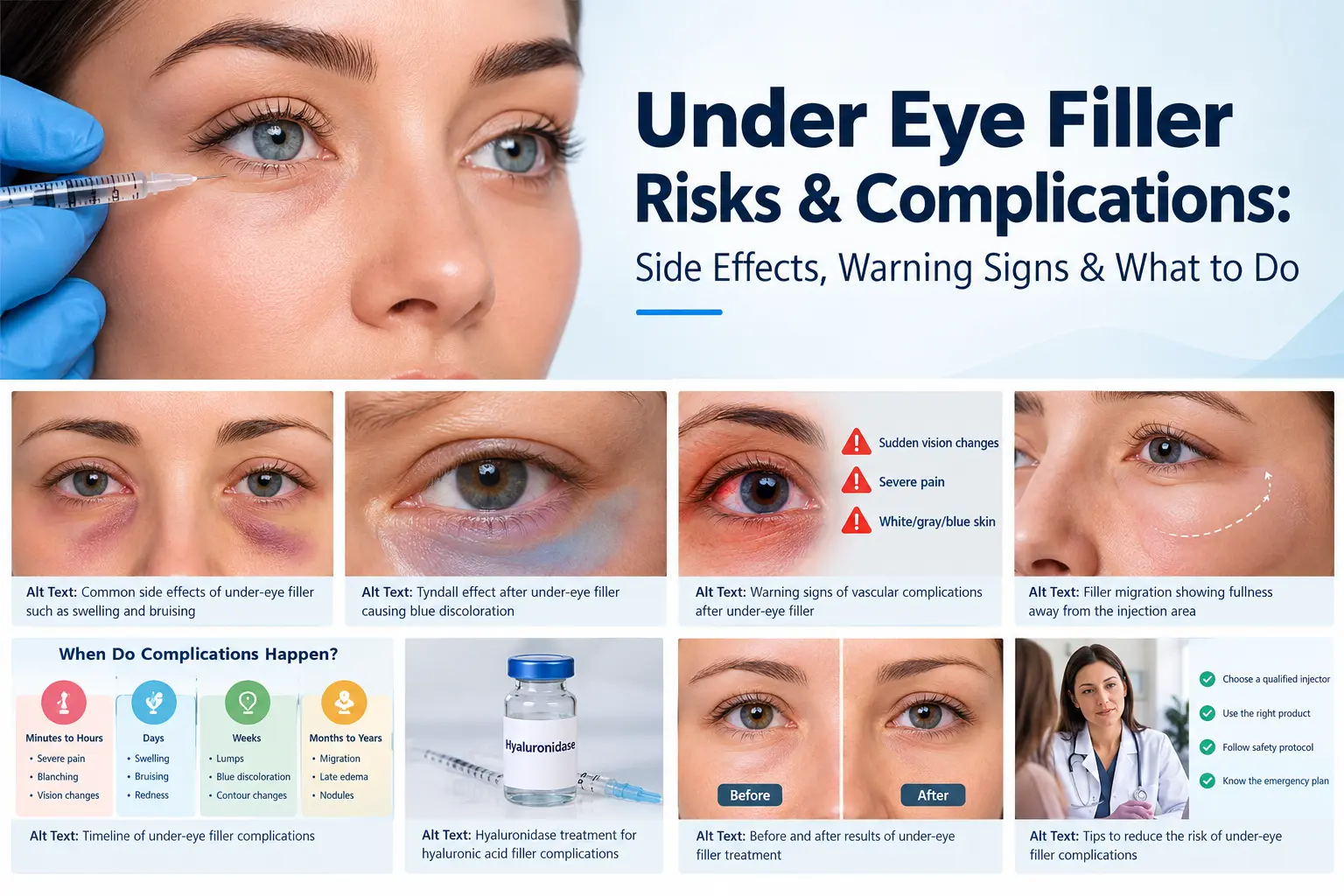
Under eye filler risks & complications range from temporary swelling and bruising to less common problems such as persistent edema, Tyndall effect, infection, filler migration and, very rarely, vision-threatening vascular complications. Under eye filler can improve hollowness and the appearance of a tired-looking lower eyelid, but the treatment is not risk-free.
The important question is not simply whether complications can happen. It is how to recognize what is expected, what is unusual, and when you need medical attention.
Is This a Normal Side Effect or a Complication?
| What you notice | More consistent with | When to seek medical assessment |
|---|---|---|
| Mild swelling | Common early reaction | If worsening or persistent |
| Bruising | Common injection effect | If unusually severe |
| Mild tenderness | Common early effect | If severe/increasing |
| Blue/gray discoloration | Possible Tyndall effect | If persistent |
| Persistent puffiness | Possible edema/filler-related problem | Clinical assessment |
| Lump/nodule | Possible filler-related complication | If persistent/painful |
| Increasing redness/warmth | Possible infection | Prompt assessment |
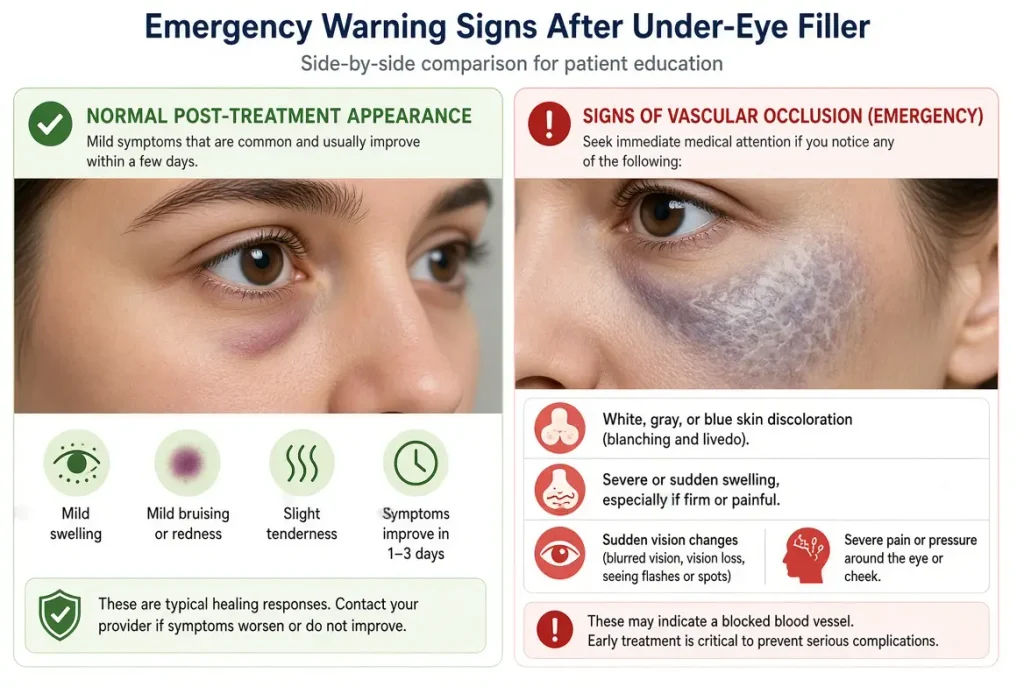
| Severe pain + skin color change | Possible vascular complication | Urgent medical care |
| Vision change | Possible vascular/ocular complication | Emergency care |
Seek immediate medical attention if you develop:
- Sudden vision changes or vision loss
- Severe or unusual pain during or shortly after injection
- White, gray or blue discoloration of the skin near the injection site
- Rapidly worsening skin discoloration or swelling
- Symptoms of a stroke, such as sudden weakness, difficulty speaking, facial drooping, confusion or severe dizziness
These symptoms can indicate a serious vascular complication and should not be monitored at home.
Are Under Eye Fillers Safe?
Under-eye hyaluronic acid (HA) filler is widely used for infraorbital hollowing, and most reported complications are mild and temporary. Common reactions include swelling, bruising, redness and tenderness.
However, the lower-eyelid area is anatomically complex. The skin is thin, the soft-tissue compartment is relatively unforgiving, and irregularities can become highly visible.
A 2025 peer-reviewed review of periorbital HA filler complications found that immediate reactions such as erythema, edema and bruising were among the most frequently reported problems, while persistent edema, blue discoloration, late contour irregularities and vision loss were less common. [2025 peer-reviewed review]
The risk depends on factors such as:
- Patient anatomy
- Filler characteristics
- Injection depth and location
- Amount of filler used
- Injector experience
- Patient selection
- Previous procedures
- Appropriate recognition and management of complications
No cosmetic injection is completely risk-free.
Under Eye Filler Side Effects vs Complications
Not every reaction after filler means something has gone wrong.
Common and Usually Temporary Side Effects
- Swelling
- Bruising
- Redness
- Tenderness
- Mild pain
- Itching or irritation
These reactions generally occur shortly after treatment and often improve over days to weeks.
Less Common Complications
- Persistent swelling
- Malar edema
- Lumps or nodules
- Asymmetry
- Contour irregularities
- Tyndall effect or blue discoloration
- Infection
- Delayed inflammatory reactions
- Filler migration
Rare but Potentially Serious Complications
- Vascular occlusion
- Skin ischemia or necrosis
- Vision loss
- Blindness
- Stroke
- Orbital complications
The FDA reports temporary swelling and bruising among common filler reactions and identifies unintended injection into a blood vessel as the most concerning risk because it can result in tissue necrosis, vision abnormalities including blindness, or stroke. [FDA]
What Are the Most Common Under Eye Filler Risk & Complication Side Effects?
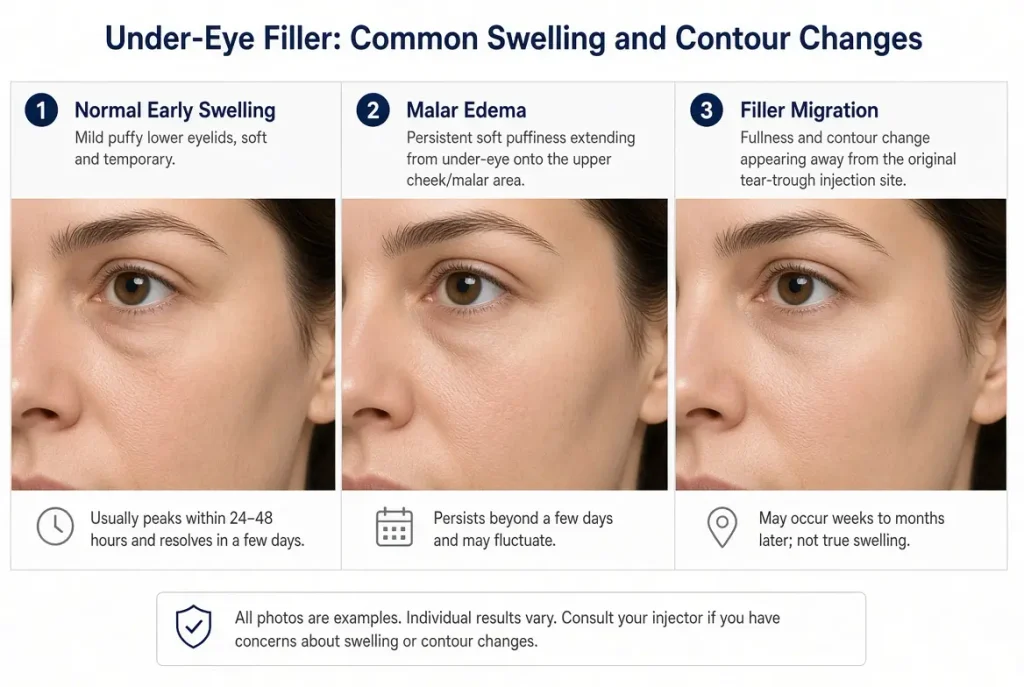
Swelling
Swelling is one of the most common reactions after under-eye filler. The lower eyelid can appear puffy during the early recovery period.
The important distinction is between expected early swelling and persistent or worsening edema.
Bruising
Bruising can occur when small blood vessels are affected during injection. It may change color as it heals and generally improves with time.
Redness
Mild redness around injection sites can occur because of local irritation and inflammation.
Tenderness
The treated area may feel tender or sensitive after injection. Increasing or severe pain is different and deserves prompt assessment.
Mild Lumps or Unevenness
Small areas of firmness or unevenness can occur following injection. Persistent, enlarging or painful nodules should be assessed by the treating professional.
Under-Eye Filler Risks & Complications by Timeline
Complications do not all appear at the same time.
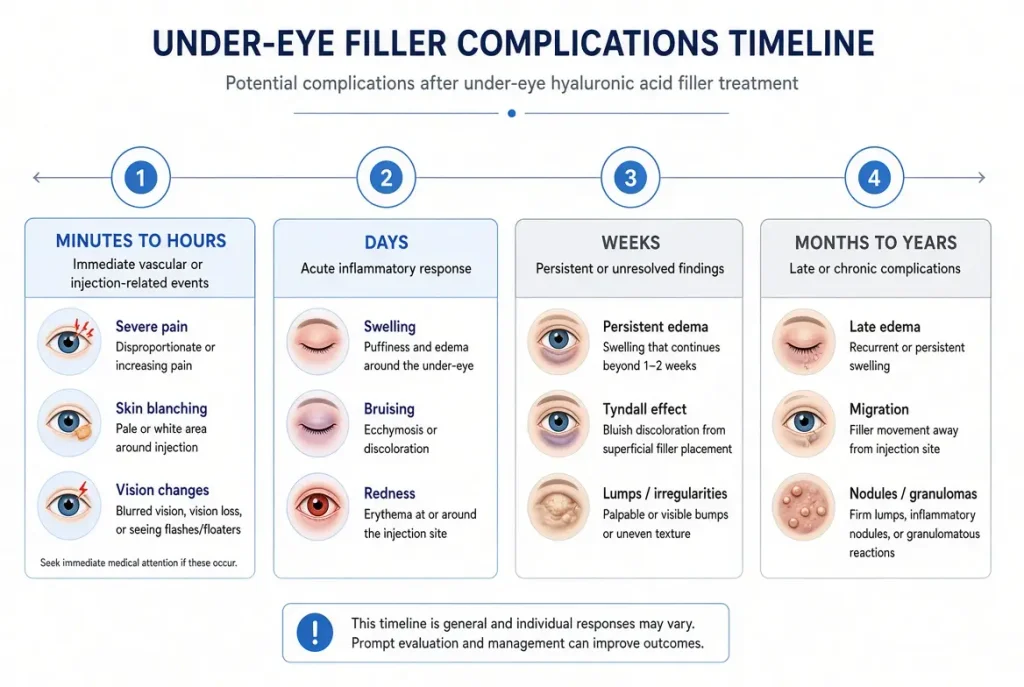
Minutes–hours
- severe pain
- blanching/color change
- visual symptoms
- acute vascular complications
Days
- swelling
- bruising
- tenderness
- infection symptoms
Weeks
- persistent lumps
- Tyndall effect
- prolonged edema
- inflammatory reactions
Months
- delayed swelling
- nodules
- persistent filler-related problems
Longer term
- persistent/recurrent edema
- migration or residual filler
- issues affecting later eyelid surgery
Can Under-Eye Filler Affect Future Blepharoplasty?
Residual hyaluronic acid filler, persistent edema, or altered tissue planes can change surgical anatomy and increase the chance of contour irregularities or prolonged swelling after lower blepharoplasty.
Surgeons need a full previous-filler history (product, dates, volumes, locations) because residual material may be invisible on exam yet affect dissection planes. Imaging (ultrasound or MRI) is sometimes used when the location or volume of residual filler is unclear.
Hyaluronidase can be considered pre-operatively in selected cases to dissolve remaining HA and restore more predictable tissue planes.
Previous under-eye filler does not automatically make blepharoplasty impossible or unsafe. With accurate history, appropriate planning, and experienced technique, surgery remains feasible and successful for most patients.
What Does an Under Eye Filler Complication Look or Feel Like?
For any concerning symptom, consider six questions:
- What does it look like?
- What does it feel like?
- When did it appear?
- Is it getting better or worse?
- Could it be a normal recovery reaction?
- Does it require professional or emergency assessment?
This distinction is especially important for swelling, discoloration, lumps and pain because several different conditions can appear similar.
Normal Swelling vs Malar Edema vs Filler Migration
| Condition | What it may look like | Typical timing | What it means |
|---|---|---|---|
| Normal swelling | Puffy, mildly tender lower eyelids | Early after treatment | Often temporary |
| Malar edema | Persistent puffiness extending toward the cheek/malar area | Days, weeks or later | Should be assessed if persistent |
| Filler migration | Fullness or palpable filler away from the intended treatment area | Weeks, months or potentially later | Requires professional assessment |
Persistent edema can extend beyond the original injection area and may appear as soft, pale swelling. The 2025 review describes persistent edema as lasting more than four weeks despite conservative management and notes that late edema can appear from one month to years after injection. [2025 peer-reviewed review]
Tyndall Effect After Under Eye Filler
The Tyndall effect generally refers to blue or bluish discoloration that can become visible beneath the thin lower-eyelid skin after superficial HA filler placement.
What does Tyndall effect look like?
It may appear as a blue, gray-blue or dusky discoloration beneath the lower eyelid.
Why does it happen?
Superficially placed HA can alter the way light interacts with the tissue. The exact mechanism of delayed blue discoloration is still discussed in the medical literature.
Is it dangerous?
It is generally an aesthetic complication rather than the same type of emergency as vascular occlusion, but it should be professionally assessed because other causes of discoloration can look similar.
Can it be corrected?
Depending on the cause and filler used, management may include observation, adjustment of the filler or treatment with hyaluronidase for HA filler. The appropriate treatment should be determined by a qualified clinician.
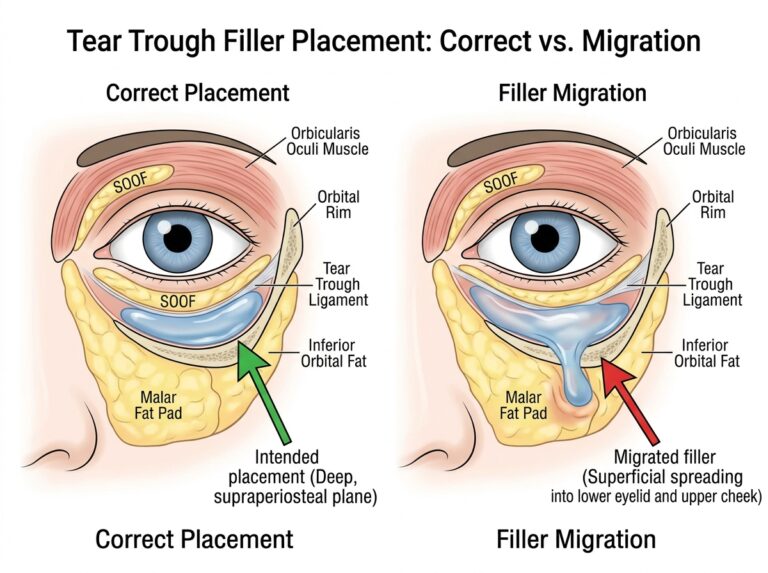
Can Under Eye Filler Migrate?
Yes, filler migration has been reported, although it is not considered a typical outcome.
Migration means filler material is found away from its intended placement. It may become noticeable as new fullness, swelling, a palpable mass or contour change.
The FDA lists migration among rare reported risks of dermal fillers. [FDA]
The 2025 periorbital review also describes orbital filler migration as a rare complication that may present with periorbital edema or a palpable mass months or years after injection. In some cases, imaging may be needed to determine where filler is located. [2025 peer-reviewed review]
Why might migration occur?
Possible contributing factors include:
- Injection technique
- Filler characteristics
- Injection location and depth
- Excessive product volume
- Tissue movement
- Pressure or manipulation
The exact mechanism is not established for every case.
Why Do Under Eye Filler Complications Happen?
Complications can have more than one cause.
Injection Technique
Incorrect placement or injection into an unintended structure can increase risk.
Anatomy
The infraorbital region contains important vessels, nerves, muscles and orbital structures.
Filler Selection
Different fillers have different physical and water-binding characteristics. Product selection should be based on the patient’s anatomy and treatment goal.
Excessive Filler Volume
Using more filler does not necessarily produce a better result and can contribute to overcorrection, puffiness or contour irregularity.
Injection Depth
The appropriate plane depends on the product, anatomy and treatment objective.
Patient Selection
Not every under-eye concern is caused by volume loss, and not every patient is an appropriate candidate for tear-trough filler.
Previous Surgery or Procedures
Previous eyelid surgery, filler or other procedures can change anatomy and should be discussed during assessment.
Who Should Avoid or Carefully Consider Under Eye Filler?
Suitability is individualized. An assessment may need to consider:
- Significant eye bags
- Festoons or malar mounds
- Significant skin laxity
- Active infection or inflammation
- Previous eyelid surgery
- Previous filler
- Relevant allergies or medical history
- The actual cause of the under-eye concern
Diagnosis Comes Before Treatment
An under-eye “dark circle” can result from different factors, including:
- Tear-trough hollowing
- Pigmentation
- Visible blood vessels
- Shadowing
- Eye bags or fat herniation
- Festoons
- Malar edema
- Skin laxity
- Tyndall effect
- Previous filler migration
That is why the question should not simply be “Which filler should I get?”
It should first be:
“What is actually causing my under-eye appearance?”
When Is Under Eye Filler an Emergency?
Contact emergency medical services or seek urgent medical assessment for:
Sudden Vision Changes
Any sudden reduction or loss of vision after filler requires immediate attention.
Severe or Unusual Pain
Severe pain, particularly when accompanied by skin discoloration or visual symptoms, is not something to simply watch at home.
White, Gray or Blue Skin
Marked color change near the injection site can indicate impaired blood flow.
Rapidly Worsening Discoloration or Swelling
Rapid progression should be assessed urgently.
Stroke Symptoms
Sudden weakness, facial drooping, difficulty speaking, confusion, severe dizziness or other acute neurological symptoms require emergency care.
The FDA specifically advises immediate medical attention for unusual pain, vision changes, white/gray/blue skin changes or stroke symptoms during or shortly after dermal-filler treatment. [FDA]
What Should You Do If You Suspect a Filler Complication?
1. Contact Your Injector
For non-emergency concerns such as persistent swelling, lumps, asymmetry or unusual discoloration, contact the treating professional promptly.
2. Do Not Attempt to Treat It Yourself
Avoid attempting to massage, puncture, inject or dissolve filler yourself.
3. Seek Emergency Care for Vision or Vascular Symptoms
Do not wait for a routine appointment if you experience sudden vision changes, severe unusual pain or signs of vascular compromise.
4. Keep Your Treatment Information
If you need medical assessment, have these details available:
- Product name
- Date of injection
- Treatment location
- Approximate amount injected
- Previous filler history
- Previous complications
- Injector/clinic details
How Are Under Eye Filler Complications Treated?
Treatment depends entirely on the complication.
Observation and Conservative Management
Some mild swelling, bruising and redness may only require time and appropriate aftercare.
Hyaluronidase
For complications involving hyaluronic acid filler, hyaluronidase may be used by a qualified medical professional to break down HA.
It is not a universal solution for every filler or every complication.
Infection Treatment
A confirmed infection may require medical treatment such as antibiotics or other interventions.
Inflammatory Nodules
Delayed nodules or inflammatory reactions require assessment to determine the underlying cause before treatment is selected.
Imaging
If the location of filler is uncertain, imaging such as ultrasound, CT or MRI may sometimes help determine where filler or inflammation is located.
Ophthalmology or Emergency Referral
Vision symptoms require urgent specialist assessment because ocular vascular complications can be time-sensitive.
Surgical Removal
In selected cases, persistent filler, orbital filler or complications involving other materials may require surgical intervention.
The current literature emphasizes that early recognition and appropriate management are important, and that treatment varies according to the specific complication. [2025 peer-reviewed review]
Can Under Eye Filler Be Dissolved?
Hyaluronic acid filler can often be degraded with hyaluronidase, but “reversible” does not mean “risk-free.”
The ability to dissolve filler depends on:
- What material was injected
- Where it was placed
- How much was used
- Whether other tissue changes have developed
- The specific complication
The FDA notes that filler removal may require injections, surgery or other interventions and that some permanent or non-HA fillers can be difficult or impossible to remove. [FDA]
Can Under Eye Filler Cause Problems Years Later?
Some delayed complications have been reported months or years after injection.
These may include:
- Late edema
- Persistent filler
- Migration
- Delayed inflammatory reactions
- Nodules
- Contour irregularities
- Issues relevant to later eyelid surgery
However, it is important not to assume that every HA filler will remain problematic for years. Long-term evidence varies by product, patient, technique and follow-up duration.
A 2025 review specifically notes that long-term data are heterogeneous and that some late complications have been reported mainly through case reports and small series. [2025 peer-reviewed review]
How to Reduce the Risk of Under Eye Filler Complications
Before treatment, ask:
- Is the injector appropriately medically qualified?
- How much experience do they have with periocular or tear-trough filler?
- What product will be used?
- Is that product appropriate for the intended treatment?
- Is the product FDA-approved for that specific indication, where applicable?
- What is the clinic’s emergency protocol?
- Is appropriate complication-management equipment available?
- Who will manage an emergency if a serious complication occurs?
- What symptoms should make me seek immediate medical attention?
The most important risk-reduction measures are appropriate patient selection, knowledge of periocular anatomy, suitable product selection, careful injection technique and rapid recognition of complications.
Under Eye Filler vs Lower Blepharoplasty
Filler and lower blepharoplasty address different anatomical problems.
Under-eye filler may be considered when volume deficiency or tear-trough hollowing is a major contributor.
Lower blepharoplasty may be more relevant when prominent fat pads, significant skin excess or other structural changes contribute to the appearance of eye bags.
Neither should automatically be considered “better.” The appropriate option depends on the underlying anatomy and treatment goal.
If prominent bags or festoons are the main concern, simply adding filler may not address the underlying problem and may sometimes increase visible puffiness.
Questions to Ask Before Getting Under Eye Filler
Before treatment, consider asking:
- What is causing my under-eye concern?
- Am I actually a good candidate for filler?
- What product are you recommending?
- Why is that product appropriate for my anatomy?
- How much filler do you expect to use?
- Where and at what depth will it be placed?
- How experienced are you with under-eye filler?
- What complications do you most commonly see?
- What is your emergency protocol for vascular or eye complications?
- What should I do if I develop a concerning symptom after treatment?
Under Eye Filler Risks & Complications FAQs
Is under eye filler dangerous?
Under-eye filler has risks, but most reported complications are mild and temporary. Rare vascular complications can be serious and may cause tissue necrosis, vision abnormalities or stroke.
What is the most serious risk of under eye filler?
One of the most serious complications is unintended vascular injection that compromises blood flow. In rare cases, this can cause vision loss, tissue necrosis or stroke.
How long does swelling last after under eye filler?
Early swelling commonly occurs after injection and often improves over days to weeks. Persistent swelling lasting more than several weeks should be assessed rather than automatically assumed to be normal.
Can under eye filler cause blindness?
Rarely, filler-related vascular complications can cause vision loss or blindness. Any sudden visual change after filler requires immediate medical attention.
What does vascular occlusion look like?
Possible warning signs include severe or unusual pain, abnormal white/gray/blue skin discoloration and other signs of impaired blood flow. Visual symptoms are an emergency.
Can under eye filler migrate?
Migration has been reported, including delayed migration. It may present as fullness, swelling or a palpable mass away from the original injection site.
What is the Tyndall effect?
The Tyndall effect is a term commonly used for blue or bluish discoloration associated with superficially placed HA filler beneath thin skin.
Can under eye filler be dissolved?
HA filler can often be degraded with hyaluronidase by a qualified professional. Other filler materials may not be readily reversible.
Can filler cause problems years later?
Delayed complications such as late edema, migration and contour changes have been reported, although long-term complications are less common and the available evidence is heterogeneous.
When should I contact my doctor after under eye filler?
Contact your treating professional for persistent or worsening swelling, unusual lumps, significant asymmetry, concerning discoloration, increasing pain or other symptoms that do not follow the expected recovery pattern.
Seek emergency care for sudden vision changes, severe unusual pain, significant skin discoloration or stroke symptoms.
Is under-eye filler safe for everyone?
No. Suitability depends on anatomy, the cause of the under-eye concern, medical history, previous procedures and other individual factors.
Is filler or blepharoplasty better for under-eye bags?
They address different problems. Filler may help selected cases of volume deficiency, while blepharoplasty may be considered for structural concerns such as prominent fat pads or excess skin. A qualified assessment is needed to determine which approach fits the individual’s anatomy.
The Bottom Line
Under eye filler risks and complications range from temporary swelling and bruising to rare but serious vascular and ocular complications.
The most useful way to think about risk is not simply as a list of everything that can go wrong. It is to understand:
What happened → what it looks like → when it appeared → whether it is expected → what you should do next.
Most importantly, sudden vision changes, severe unusual pain, abnormal white/gray/blue skin discoloration or stroke symptoms require immediate medical attention.
Choose an appropriately qualified medical professional with specific experience in periocular filler, make sure you understand the product and its intended use, and discuss the clinic’s emergency plan before treatment.
Suggested authoritative sources
- FDA — Dermal Fillers (Soft Tissue Fillers) — FDA Dermal Fillers
- FDA — JUVÉDERM VOLBELLA XC — FDA JUVÉDERM VOLBELLA XC
- FDA — Restylane Eyelight — FDA Restylane Eyelight
- FDA Devices@FDA — Restylane Eyelight PMA — Restylane Eyelight PMA Record
- FDA — Belotero Balance (+) — FDA Belotero Balance (+)
- FDA Devices@FDA — Belotero Balance (+) PMA — Belotero Balance (+) PMA Record
- FDA Devices@FDA — RHA Redensity Eye PMA — RHA Redensity Eye PMA Record
- FDA — 2023 Device Approvals — FDA 2023 Device Approvals
- FDA — Restylane Eyelight Labeling/Training Update — Restylane Eyelight PMA Update
| ✓ Medically Reviewed |
| Medically reviewed by Dr. J. Harper, MD, FAAD Board-certified Dermatologist with 12 years of experience in facial aesthetics and injectable treatments, including specialist focus on complication risks, warning signs, diagnosis and treatment considerations. This educational content was prepared in association with Bascom Palmer Eye Institute and with clinical input from Dr. Emily R. Carter, MD, FACS, Consultant Ophthalmic and Oculoplastic Surgeon. Medical review: [20th August -2024] | Last updated: [10th September-2026] |

Sarah Mitchell is the founder and research editor of Under Eyes Filler, an independent patient-education resource. She is a researcher and writer, not a licensed medical professional. Her work is to read clinical studies and official FDA and ASPS guidance, then translate them into clear, honest explanations of under-eye filler results, recovery, risks, and realistic costs, so readers can prepare better questions for their own qualified provider.