Medically reviewed • Evidence-led under-eye filler education • Updated October 2026
Blepharoplasty Asian Eyes: The Anatomy, the Surgery, and the Risks10 min read
Disclaimer: This article is for educational and informational purposes only and does not replace professional medical advice. Always consult a board-certified plastic surgeon or oculoplastic surgeon before undergoing any cosmetic surgical procedure.
Direct answer: Blepharoplasty for Asian eyes, medically termed Asian blepharoplasty, is a specific surgical technique that creates an upper eyelid crease by addressing anatomical structures that differ from Western eyelid anatomy — most notably a lower attachment point of the levator muscle, a fuller distribution of orbital fat, and, in some patients, an epicanthal fold at the inner corner of the eye. It’s a distinct surgical approach, not a modified version of standard Western blepharoplasty, because the underlying anatomy it works with is structurally different.
That distinction is the most important thing to understand before researching this procedure further, and it’s also the most commonly misunderstood part. Standard blepharoplasty, as practiced on eyelids with an existing natural crease, typically focuses on removing excess skin or fat to reduce hooding or puffiness — the crease itself is already there and being refined. Blepharoplasty for Asian eyes is frequently a different task altogether: in patients without a natural upper eyelid crease, the surgeon is constructing that fold’s internal structure from anatomy that doesn’t currently form it, which is a meaningfully more technical undertaking than trimming existing tissue.
The anatomical reason a natural crease may be absent comes down to how the levator aponeurosis — the internal tendon that lifts the upper eyelid — attaches beneath the skin. In eyelids with a visible crease, this structure attaches close enough to the skin’s surface that its movement creates a visible fold when the eye opens. In eyelids without a crease, that attachment sits lower, closer to the eyelid margin, so the same muscle movement doesn’t produce a visible fold on the skin above it. Blepharoplasty recreates that visible connection surgically, which is fundamentally different from simply removing tissue.
A second anatomical factor, present in some but not all patients, is the epicanthal fold — a skin fold at the inner corner of the eye that can partially cover the tear duct area. When present, this is sometimes addressed alongside the crease procedure through a separate technique called epicanthoplasty, though it’s an individual decision based on anatomy, not a required part of the procedure for every patient.
Because this surgery depends on specific anatomical structures rather than a single universal technique, this guide focuses on what makes it a distinct procedure: the anatomy involved, what actually happens during surgery, anesthesia options, and the risks and complications worth understanding in detail before consulting a surgeon. For a breakdown of the three specific surgical techniques used to perform this procedure and a realistic recovery timeline, this companion guide to Asian eyelid surgery covers that ground separately.

The Anatomical Differences That Shape This Procedure
Direct answer: Asian blepharoplasty differs from standard eyelid surgery because it works with a lower levator aponeurosis attachment point, a thicker distribution of preseptal and pretarsal fat, and, in some patients, an epicanthal fold — three structural factors that don’t apply the same way to eyelids with a naturally occurring crease.
- Levator aponeurosis attachment. As explained above, this internal tendon’s attachment point determines whether eyelid movement produces a visible crease. Surgery recreates this attachment at a higher point to establish a fold where the natural anatomy doesn’t currently produce one.
- Orbital fat distribution. A fuller layer of fat sitting closer to the surface, particularly in the preseptal area just above the lash line, is common in this anatomy and can obscure crease definition even where some natural fold exists. Addressing this fat distribution, when present in excess, is part of what full-incision technique specifically allows a surgeon to do.
- Epicanthal fold. Present in some patients at the inner corner of the eye, this fold can affect both aesthetic goals and, in some cases, functional vision at the extreme inner corner of the visual field. When surgically addressed, this is typically planned as a distinct decision alongside — not automatically included within — the crease procedure itself.
Understanding these three factors is what allows a surgeon to plan technique, incision length, and fat management specific to an individual’s anatomy, rather than applying one default approach to every patient.
What Actually Happens During Blepharoplasty Surgery
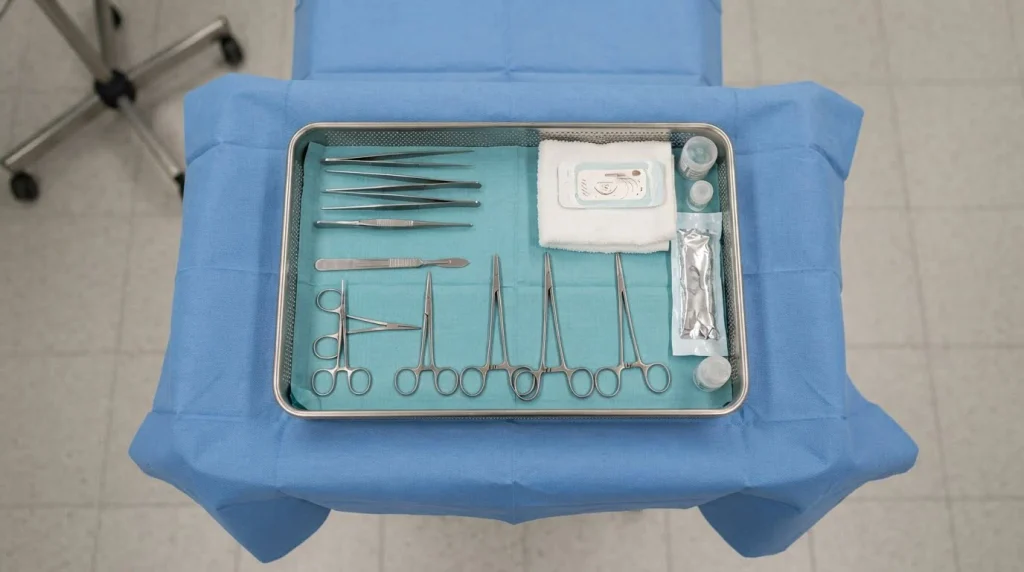
The procedure itself follows a structured sequence, regardless of which specific incision technique is ultimately used:
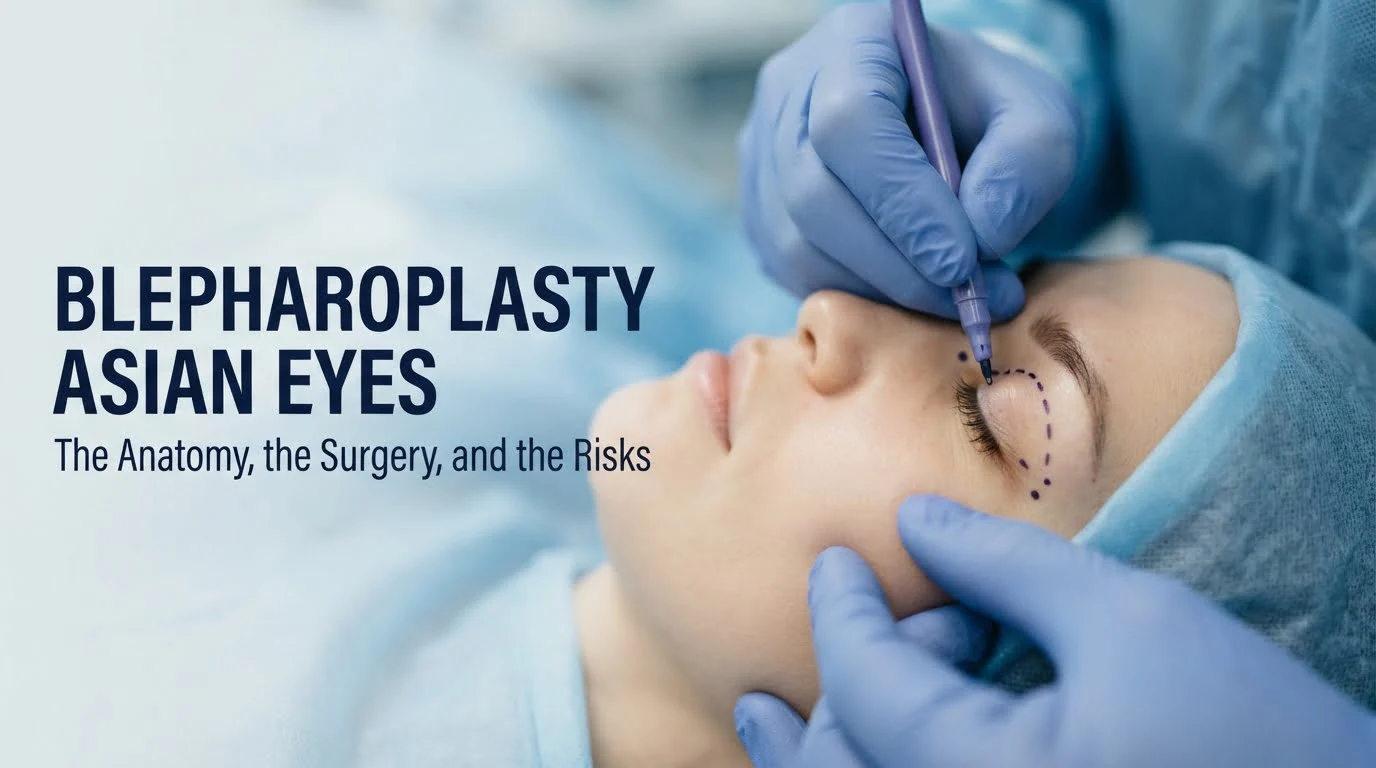
- Pre-operative marking. With the patient upright and eyes open, the surgeon marks the intended crease height and shape directly on the skin, since gravity and eye position change how the eyelid sits compared to lying down.
- Anesthesia. Most Asian blepharoplasty procedures are performed under local anesthesia, often combined with light sedation, allowing the patient to remain comfortable while enabling the surgeon to have the patient open and close their eyes during the procedure to check crease symmetry in real time — something general anesthesia would prevent.
- Incision or puncture access. Depending on the technique selected, the surgeon creates either a continuous incision along the marked crease line, a shorter partial incision, or several small punctures, based on how much excess skin and fat needs to be addressed.
- Fat and tissue management. Excess fat and, where relevant, excess skin are addressed through the access created, adjusted specifically to avoid either an over-hollowed or an under-corrected result.
- Crease fixation. Sutures are placed to anchor the skin to the levator aponeurosis at the marked height, which is the step that actually establishes the permanent (or, in the no-incision method, semi-permanent) crease.
- Symmetry check. With local anesthesia allowing the patient to open and close their eyes on request, the surgeon verifies both sides match before closing.
The ability to check symmetry with the patient conscious and responsive during the procedure is one of the more clinically important aspects of this surgery, since final crease height and shape are difficult to fully judge on an anesthetized, closed eye.

Blepharoplasty Asian Eyes: Complications and Risks Specific to This Procedure
Every surgical procedure carries risk, and blepharoplasty for Asian eyes has a specific risk profile shaped by the anatomy it works with:
- Asymmetry. Because the procedure constructs a crease rather than refining an existing one, achieving identical height and shape on both sides is technically demanding, and minor asymmetry is the most commonly reported concern requiring a revision.
- Under-correction or over-correction. Too conservative a crease height can look uneven with the patient’s expectations; too aggressive a height or excessive fat removal can create a hollowed, overly surgical appearance that’s difficult to reverse.
- Crease loss or softening over time. Particularly relevant to the no-incision technique, since it relies more on scar adhesion than direct surgical fixation, some patients experience gradual softening or loss of the crease months to years after surgery.
- Scarring. Full and partial incision techniques leave a scar along the crease line. In appropriately selected patients, this scar is typically well-camouflaged within the new fold itself, though scarring risk varies by individual healing tendency.
- Ptosis (eyelid drooping). A rare but serious complication where the levator mechanism is disrupted rather than properly reinforced during surgery, resulting in an eyelid that sits lower than intended. This typically requires a secondary corrective procedure.
- Hematoma or prolonged swelling. Bleeding beneath the skin or unusually prolonged swelling beyond the typical recovery window can occasionally occur and generally requires prompt evaluation by the surgeon.
Choosing a surgeon with specific, extensive experience in this anatomy — not just general blepharoplasty experience — is the factor most consistently associated with lower rates of these complications, given how much the outcome depends on correctly reading levator attachment and fat distribution during surgery itself.
Blepharoplasty vs. Under-Eye Concerns: Making Sure You’re Researching the Right Procedure
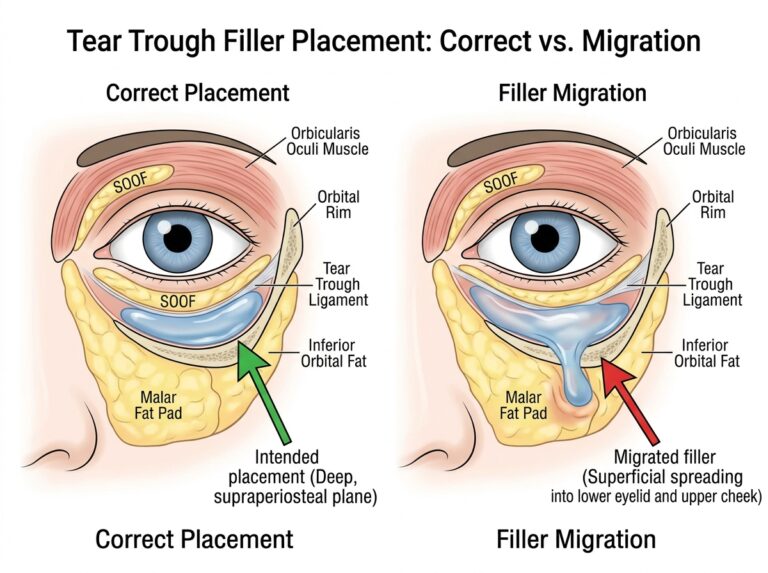
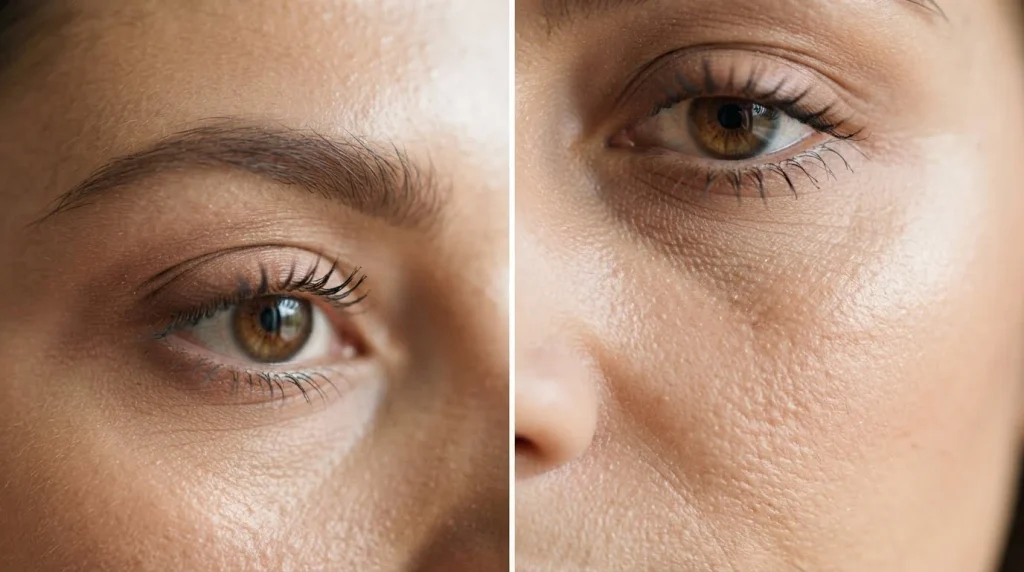
It’s worth pausing on a distinction that trips up a meaningful number of people researching this topic: blepharoplasty for Asian eyes addresses the upper eyelid crease. If your actual concern is hollowing, dark circles, or puffiness in the area beneath the eye, that’s an anatomically separate issue, typically addressed with dermal filler rather than eyelid surgery, and it carries its own distinct set of risks and considerations. This guide to under-eye filler risks and complications covers that different procedure in detail if under-eye volume, rather than upper eyelid crease, is your actual concern.
Frequently Asked Questions
What is blepharoplasty for Asian eyes, medically speaking?
It’s a surgical technique that creates or redefines an upper eyelid crease by reattaching the levator aponeurosis (the eyelid-lifting tendon) at a higher point beneath the skin, while managing orbital fat distribution specific to this anatomy — distinct from standard blepharoplasty, which typically refines an already-existing crease.
Why don’t some people have a natural eyelid crease to begin with?
It comes down to where the levator aponeurosis attaches beneath the skin. A higher attachment point produces a visible crease when the eye opens; a lower attachment point, common in a meaningful share of people of East Asian descent, does not produce a visible fold on the surface, even though the underlying muscle functions normally.
What anesthesia is used for this procedure?
Most procedures use local anesthesia, often with light sedation, specifically so the surgeon can have the patient open and close their eyes during surgery to verify symmetry in real time — a check that general anesthesia would not allow.
What’s the most common complication after this surgery?
Asymmetry between the two eyelids is the most frequently reported concern, given the technical demands of constructing a matching crease height and shape on both sides during a single procedure.
Can the crease disappear after surgery?
It’s possible, particularly with the no-incision technique, since that method relies more on scar tissue adhesion than direct surgical fixation to hold the fold in place. Full and partial incision techniques, which directly anchor the crease structure, are generally more durable.
Is this the same procedure as under-eye filler for dark circles or hollows?
No. Blepharoplasty addresses the upper eyelid crease through surgery; under-eye concerns like hollowing or dark circles are a separate anatomical area typically treated with injectable filler rather than eyelid surgery.
Key Takeaways
Blepharoplasty for Asian eyes is a distinct surgical procedure built around specific anatomical realities — a lower levator attachment point, a particular fat distribution, and in some patients an epicanthal fold — rather than a variation on generic eyelid surgery. Understanding this anatomy is what makes the difference between a surgeon capable of constructing a natural, symmetrical crease and one working outside their area of specific experience. Because outcomes depend so heavily on correctly reading this anatomy during the procedure itself, choosing a surgeon with focused, demonstrated experience in this specific technique is the single factor most likely to separate a result that looks natural from one that requires revision.

Sarah Mitchell is the founder and research editor of Under Eyes Filler, an independent patient-education resource. She is a researcher and writer, not a licensed medical professional. Her work is to read clinical studies and official FDA and ASPS guidance, then translate them into clear, honest explanations of under-eye filler results, recovery, risks, and realistic costs, so readers can prepare better questions for their own qualified provider.