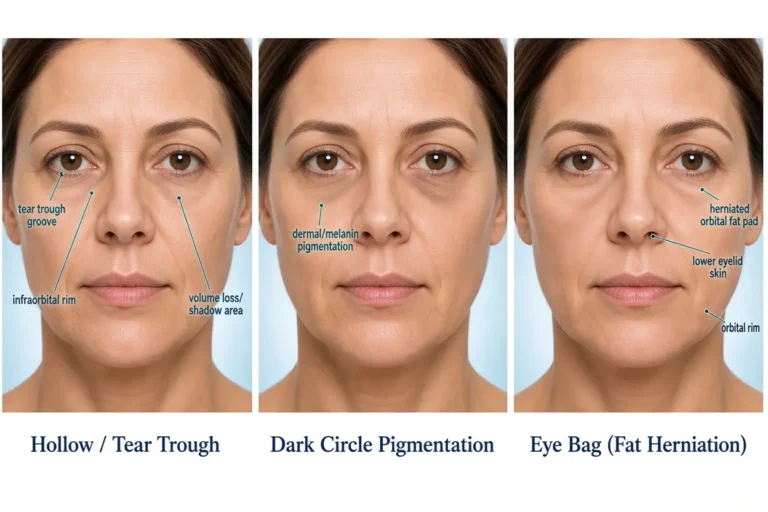
Medically reviewed • Evidence-led under-eye filler education • Updated October 2026
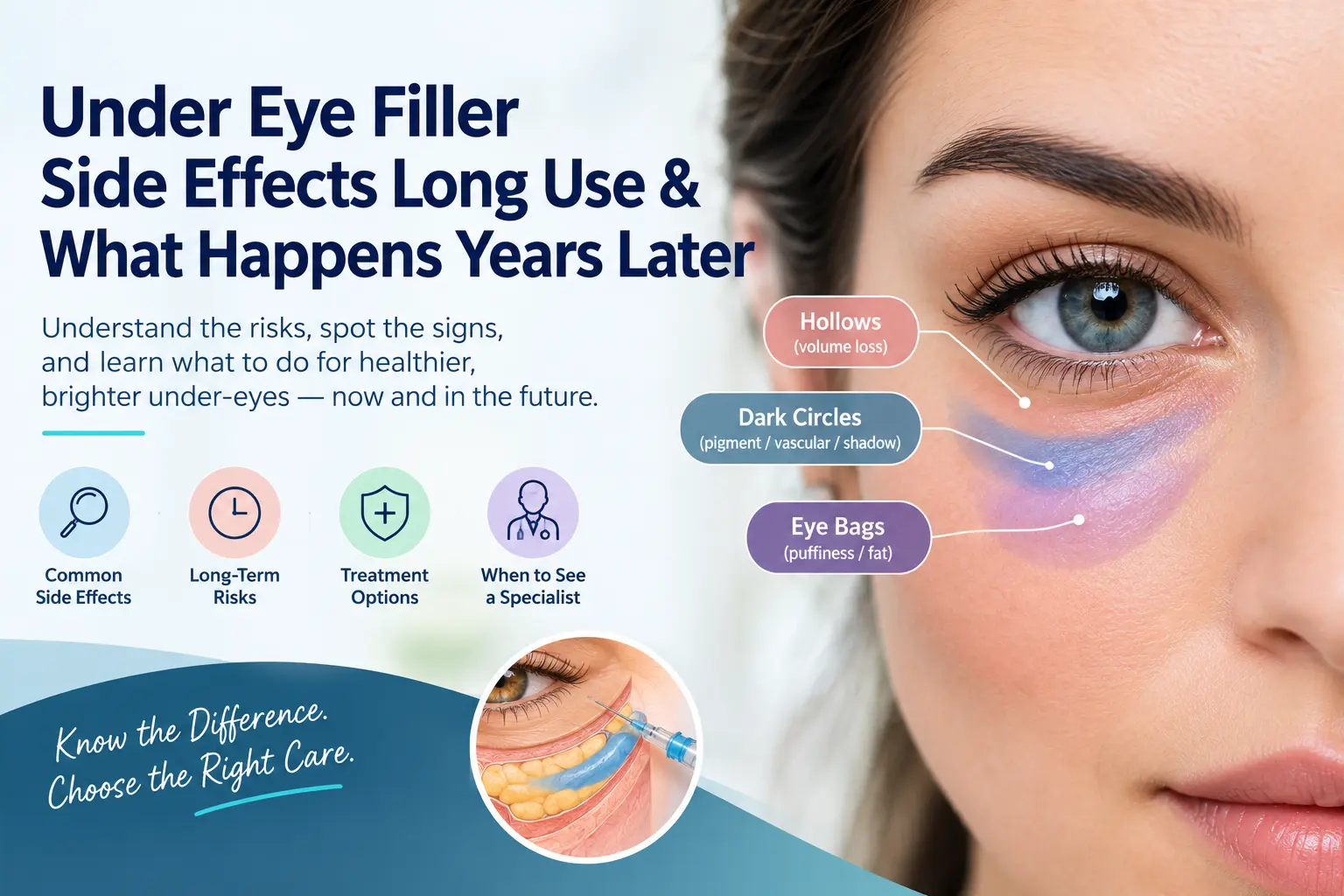
Under Eye Filler Side Effects Long Term Use & What Happens Years Later24 min read
Yes, some under-eye filler side effects can appear or remain relevant months or years after treatment, although that does not mean long-lasting filler is automatically dangerous.
Most immediate effects—such as bruising, redness, tenderness and swelling—occur soon after injection and often improve within days to weeks. However, the FDA notes that some dermal-filler side effects can emerge weeks, months, or even years later.
Under-eye filler can also persist longer than patients expect. A 2025 retrospective study of 155 patients treated with tear-trough hyaluronic acid filler found significant improvement in infraorbital hollowing through 18 months. Older long-term research has also documented aesthetic complications at five-year follow-up.
The important distinction is this:
Filler persistence, long-lasting results and a long-term complication are not the same thing.
A filler that remains effective for longer than expected may simply be providing continued correction. By contrast, persistent swelling, blue-gray discoloration, lumps, contour changes or other new symptoms may require medical assessment.
Quick Answer: What Are the Long-Term Side Effects of Under-Eye Filler?
Possible long-term or delayed issues include persistent swelling, malar edema, blue-gray discoloration from the Tyndall effect, contour irregularities, lumps or nodules, inflammatory reactions, filler migration and retained filler.
| Long-term issue | Can it occur? | What it may look like |
|---|---|---|
| Persistent swelling | Yes | Puffy or heavy-looking lower eyelids |
| Malar edema | Yes | Swelling extending toward the upper cheek |
| Tyndall effect | Yes | Blue-gray or bluish under-eye discoloration |
| Lumps/nodules | Yes | Firm or visible bumps |
| Contour irregularity | Yes | Uneven or overfilled appearance |
| Filler migration | Reported | Fullness outside the intended treatment area |
| Filler persistence | Yes | Product or its effects remain longer than expected |
| Delayed inflammation | Possible | New swelling, redness or tenderness |
| Delayed infection | Possible | Increasing redness, pain, warmth or swelling |
| Vision complications | Extremely rare | Visual disturbance or loss of vision |
| Surgical considerations | Possible | Previous filler may affect future eyelid-surgery planning |
Recent ophthalmology literature classifies periocular HA filler complications by timing and includes immediate reactions, early complications and late complications such as persistent or late edema, contour irregularities, blue discoloration and filler within the orbit.
What Does “Long-Term Use” of Under-Eye Filler Actually Mean?
The phrase long-term use of under-eye filler can mean several different things, and separating them prevents unnecessary alarm.
One treatment lasting longer than expected
A patient may receive one treatment and continue seeing an effect well beyond the commonly quoted duration.
The 2025 retrospective tear-trough study found significant improvement through 18 months in its 155-patient cohort. The researchers specifically concluded that tear-trough HA filler can have extended efficacy beyond the conventional 6–12-month expectation.
Repeated maintenance injections
Another situation is receiving additional filler whenever the result appears to fade.
This is different from one injection simply lasting longer.
With repeated treatments, a clinician should reassess the area rather than automatically assuming that all previously injected product has disappeared.
Residual or retained filler
Residual filler means some product or treatment effect may remain after the patient assumes it has completely disappeared.
This matters because adding new filler over residual product can potentially produce an appearance that is different from what was expected.
Cumulative filler
“Filler accumulation” is often used online to describe repeated injections.
However, visible fullness does not prove that filler has literally accumulated into one permanent mass. It may reflect:
- persistent filler
- repeated volume additions
- edema
- malar edema
- overcorrection
- anatomical changes
- or another cause.
Delayed complications
A delayed complication is a problem that becomes apparent after the initial recovery period.
Examples include:
- delayed swelling
- nodules
- inflammatory reactions
- persistent contour irregularities
- blue-gray discoloration
- filler-related fullness.
How Long Does Under-Eye Filler Really Last?
There is no single expiration date for every under-eye filler.
Duration depends on factors including:
- the specific product
- formulation and cross-linking
- amount injected
- injection plane
- individual anatomy
- metabolism
- previous treatments
- treatment technique.
The FDA states that the duration of dermal fillers depends on the filler material and the area where it is injected. Many FDA-approved fillers are temporary because the body gradually absorbs them, although the time course varies.
For tear-trough HA filler specifically, published evidence challenges the assumption that all clinically relevant effects disappear within six to 12 months. The 2025 retrospective study reported significant improvement through 18 months.
So if your filler still appears to be working after one year, that does not automatically mean something has gone wrong.
Can Under-Eye Filler Still Be Present Years Later?
It can remain clinically relevant for longer than expected, and published long-term studies have documented complications years after treatment.
A five-year follow-up study of 147 patients receiving periocular HA filler reported malar edema, blue-gray dyschromia and contour irregularities at long-term follow-up. Most of the reported complications were mild and required no intervention.
The American Academy of Ophthalmology’s EyeWiki also notes that patients may present with malar edema years after treatment and discusses the relationship between HA filler, water retention and lymphatic drainage.
But an important distinction remains:
The presence or persistence of filler does not by itself prove that the filler is causing harm.
A person can have residual filler with a satisfactory cosmetic result. Another person may have persistent filler associated with puffiness, discoloration or contour changes.
That is why symptoms and examination matter more than the calendar alone.
Under-Eye Filler Side Effects: Short-Term vs Long-Term
Common short-term side effects
Immediately or shortly after injection, patients may experience:
- bruising
- swelling
- redness
- tenderness
- soreness
- itching
- mild asymmetry
- temporary uneven texture.
The FDA lists bruising, redness, swelling, pain and tenderness among common dermal-filler risks and notes that many side effects resolve within days to weeks.
Persistent or delayed side effects
Less immediate problems may include:
- persistent swelling
- prolonged swelling
- late-onset edema
- chronic eyelid edema
- malar edema
- persistent puffiness
- contour irregularities
- lumps
- nodules
- inflammatory reactions
- filler migration
- blue-gray discoloration
- retained filler.
The 2025 major ophthalmology review specifically distinguishes immediate injection reactions from early and late complications.
Long-Term Side Effects of Under-Eye Filler
Persistent or delayed swelling
Persistent swelling is one of the most important long-term concerns because the under-eye region has thin skin and complex anatomy.
Swelling may relate to:
- edema
- lymphatic drainage changes
- filler characteristics
- placement
- excess volume
- underlying anatomy
- inflammation.
Importantly, persistent puffiness does not automatically mean filler migration.
Malar edema
Malar edema is swelling around the upper cheek/lower eyelid transition.
It can be particularly frustrating because it may make the face look puffy even when the original tear trough hollow has been improved.
Periocular filler literature describes malar edema as a recognized complication, and EyeWiki discusses the role of tissue compartments and lymphatic drainage in its development.
Tyndall effect
The Tyndall effect refers to a blue-gray or bluish appearance that can occur when hyaluronic acid filler is placed too superficially beneath thin skin.
It may be confused with:
- bruising
- visible veins
- vascular dark circles
- pigmentation.
Moorfields specifically identifies bluish discoloration and superficial filler placement as a recognized under-eye complication.
Lumps and nodules
A lump can have several possible explanations.
It may represent:
- residual swelling
- uneven filler
- superficial placement
- a nodule
- inflammatory tissue
- granuloma
- infection.
The FDA notes that nodules and granulomas can occur and may sometimes require medical treatment or removal.
Filler migration
Filler migration means filler appears outside its intended treatment area.
Possible signs may include:
- fullness away from the original hollow
- unexpected contour changes
- persistent puffiness
- visible or palpable product.
However, migration should not be diagnosed from appearance alone.
Edema, malar anatomy, orbital fat and overcorrection can sometimes produce similar appearances.
Overfilling and contour changes
Repeated under-eye filler can become problematic if additional product is placed before the existing anatomy and filler are properly reassessed.
The goal should not be to maintain a particular number of syringes or a yearly injection schedule.
The goal is appropriate correction for the patient’s current anatomy.
Delayed inflammatory reactions
Delayed inflammation can occur weeks or months after treatment.
The FDA notes that inflammation near a filler site can develop following illnesses, infections, vaccinations or dental procedures.
This is another reason not to assume that every delayed symptom has a single obvious cause.
Delayed infection
Infection is uncommon but important.
Possible warning signs include:
- increasing redness
- warmth
- worsening pain
- swelling
- drainage
- systemic symptoms.
An increasing or painful reaction should be assessed by a qualified healthcare professional rather than treated as routine post-filler swelling.
Can Under-Eye Filler Cause Problems Years Later?
Yes, delayed problems have been reported, but a symptom appearing years later does not prove that filler caused it.
Possible explanations include:
- persistent filler
- delayed edema
- inflammatory reaction
- migration
- nodules
- changes in facial anatomy
- unrelated swelling
- infection
- allergies or illness
- pre-existing malar anatomy.
The FDA explicitly acknowledges that some dermal-filler side effects can emerge weeks, months or years after injection.
The correct question is therefore not simply:
“How many years ago did I have filler?”
It is:
“What changed, when did it change, what product was injected, where was it placed, and what alternative explanations need to be considered?”
What Happens If You Keep Getting Under-Eye Filler for Years?
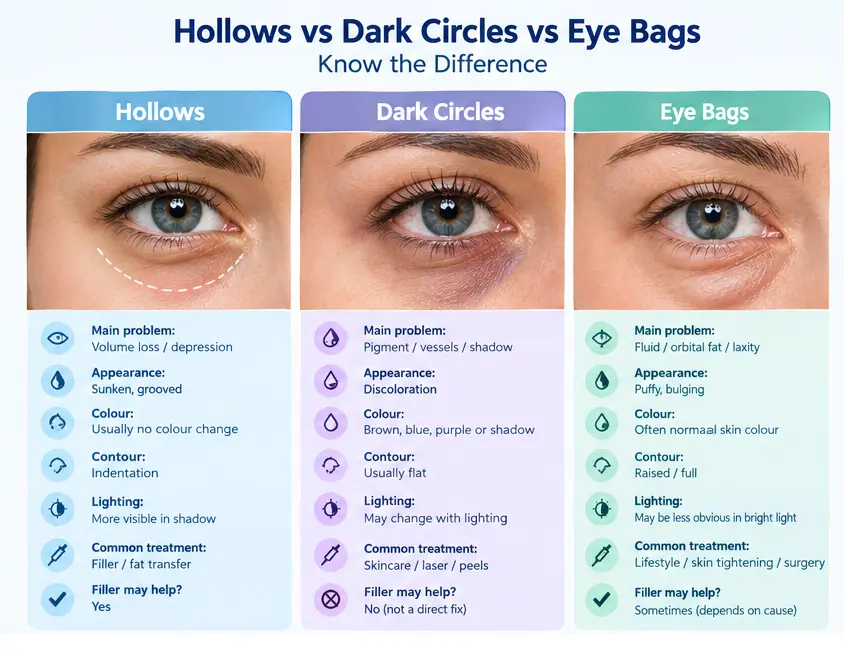
There is no universal number of under-eye filler treatments that is considered safe for everyone.
Repeated treatment should be individualized.
Before another injection, a qualified provider may need to consider:
- whether previous filler is still present
- whether the original hollow has changed
- whether the patient has developed swelling
- whether there is overcorrection
- whether the patient has eye bags or malar bags instead of simple hollowing
- whether additional volume is actually needed
- whether another treatment would better address the anatomy.
This is particularly important because the face continues to age.
A treatment that was appropriate at 30 may not be the right treatment at 40 or 50.
Automatic yearly top-ups are therefore not an evidence-based rule.
Does Under-Eye Filler Build Up Over Time?
“Build up” can mean different things.
True accumulation
Repeated filler may leave residual product when new injections are added before the previous treatment has completely resolved.
Persistent product
A previous injection may remain clinically relevant longer than expected.
Repeated volume addition
Each treatment may add additional volume even if some previous filler remains.
Swelling that looks like excess filler
Edema or malar edema can make the area appear overfilled even when the apparent volume is not simply a large quantity of filler.
Therefore:
Puffy eyes after repeated filler do not automatically prove that filler has accumulated.
An examination may be needed to determine the cause.
Can Under-Eye Filler Migrate Years Later?
Migration is a documented concern, but visible fullness does not prove migration.
What migration may look like
Possible signs include:
- fullness beyond the original tear trough
- unusual contour
- persistent swelling
- filler appearing in an unexpected location.
Migration vs swelling
Swelling is fluid-related.
Migration refers to movement or presence of filler outside the intended placement area.
The two can look similar.
Migration vs eye bags
Orbital fat protrusion can also create fullness beneath the eye.
Someone with an existing lower-eyelid fat pad may incorrectly assume that new fullness means filler migration.
A specialist examination can help distinguish:
- filler
- edema
- orbital fat
- malar bags
- contour changes.
Can Under-Eye Filler Cause a Tyndall Effect Years Later?
The Tyndall effect is usually associated with superficial HA filler and thin overlying skin.
It typically appears as a blue-gray or bluish discoloration rather than true brown pigmentation.
It may be confused with:
- bruising
- visible veins
- vascular dark circles
- pigmentation.
If the discoloration is persistent, a qualified provider should determine whether filler is actually responsible before considering treatment such as hyaluronidase.
Can Old Under-Eye Filler Cause Puffy Eyes?
It can be one possible explanation, but it should not be assumed without assessment.
Possible causes of puffy eyes years after filler include:
- retained HA filler
- malar edema
- lymphatic changes
- inflammation
- filler migration
- excessive volume
- natural aging
- orbital fat
- allergies
- unrelated fluid retention.
EyeWiki describes malar edema occurring years after treatment and discusses the relationship between HA filler and water retention in the under-eye region.
How Can You Tell If a Long-Term Problem Is Actually From Filler?
If you develop a new under-eye concern months or years after treatment, consider these questions:
- When was the filler injected?
- What product was used?
- How much was injected?
- Where was it placed?
- Was more filler added later?
- Did the symptom begin immediately or much later?
- Is there redness, warmth or pain?
- Is the problem on one side or both?
- Is there blue-gray discoloration?
- Is there a firm or visible lump?
- Has the appearance changed with time?
- Are there any vision symptoms?
These questions don’t diagnose a complication. They help organize the history that a healthcare professional may need.
Long-Term Under-Eye Filler Problems: What Could It Be?
| Appearance or symptom | Possible explanation |
|---|---|
| Persistent puffiness | Edema, retained filler, malar edema or another cause |
| Blue-gray color | Tyndall effect or visible vessels |
| Brown discoloration | Pigmentation rather than filler |
| Firm lump | Nodule, inflammatory reaction or filler irregularity |
| Fullness away from injection area | Possible migration, edema or anatomy |
| Red, hot, painful swelling | Possible infection or inflammation |
| New eye bags | Orbital fat or age-related anatomical change |
| Sudden severe pain + skin color change | Possible vascular complication |
| Vision changes | Potential ocular vascular emergency |
Similar appearance does not always mean the same diagnosis.
That is one of the most important reasons to avoid automatically dissolving filler or adding more filler without professional assessment.
Can Long-Term Under-Eye Filler Affect Future Blepharoplasty?
Previous filler does not automatically mean that lower blepharoplasty is impossible.
However, the surgeon should know about previous filler.
Retained filler, edema, altered tissue planes or contour changes may affect assessment and surgical planning. Moorfields specifically discusses concerns about previous filler in patients who later undergo eyelid surgery.
A consultation may consider:
- where filler was placed
- which product was used
- whether filler remains
- whether there is persistent edema
- whether hyaluronidase is appropriate
- the condition of the orbital fat
- skin laxity
- the overall lower-eyelid anatomy.
The important point is:
Previous filler may influence surgical planning, but it does not automatically determine the outcome.
Can Under-Eye Filler Be Dissolved After Years?
If the filler is hyaluronic acid, hyaluronidase may be used by a qualified medical professional to reduce or dissolve HA filler when clinically appropriate.
Potential reasons for considering dissolution include:
- overfilling
- persistent puffiness
- Tyndall effect
- unwanted contour
- lumps
- suspected migration
- complications.
However, hyaluronidase is not a universal “reset button.”
Some filler materials are more difficult or impossible to remove completely. The FDA notes that removing or reducing dermal fillers may require additional procedures or surgery and that some materials can be difficult or impossible to remove.
Do not attempt to dissolve, massage or otherwise manipulate filler yourself.
Are Repeated Under-Eye Filler Treatments Safe?
There is no universal “safe number” of repeated treatments.
The decision should depend on:
- your anatomy
- remaining filler
- previous reactions
- amount of product
- time since treatment
- current appearance
- treatment goal
- provider assessment.
The FDA recommends choosing a licensed healthcare provider experienced with dermal fillers, facial anatomy and complication management.
For repeated treatment, a useful question is not:
“Am I due for another syringe?”
Instead ask:
“Do I still have the same anatomical problem, and is additional filler still the appropriate treatment?”
Who May Have a Higher Risk of Long-Term Problems?
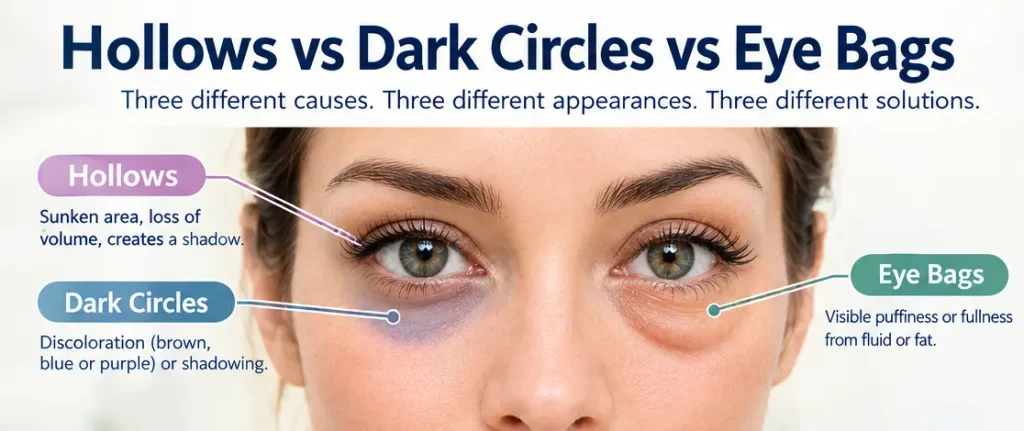
Risk is individualized, but assessment becomes especially important when someone has:
- pre-existing under-eye edema
- malar bags or festoons
- prominent orbital fat
- significant skin laxity
- very thin skin
- visible vessels
- previous prolonged swelling
- previous filler complications
- previous eyelid surgery
- anatomy that is poorly suited to tear-trough filler
- a history of multiple filler treatments.
The under-eye region is anatomically complex, and peer-reviewed literature emphasizes the importance of anatomy, filler properties, placement and patient selection.
How to Reduce Long-Term Under-Eye Filler Risks
Before treatment
- Have your anatomy assessed.
- Disclose all previous filler treatments.
- Ask exactly which product will be used.
- Ask whether the product is appropriate for the intended treatment.
- Discuss alternatives if you have eye bags, festoons or significant edema.
- Ask about the provider’s experience with periocular filler complications.
- Understand the emergency plan.
During treatment
Appropriate product selection, injection technique, anatomy knowledge and conservative treatment planning matter.
The goal should be appropriate correction, not maximum filling.
After treatment
- Attend recommended follow-up.
- Don’t automatically schedule another injection simply because a certain number of months has passed.
- Report persistent or worsening symptoms.
- Keep records of the product, date and treatment area.
- Seek urgent care for visual symptoms or severe vascular warning signs.
🚨 When Is an Under-Eye Filler Problem an Emergency?
Most filler side effects are not emergencies. Vision symptoms and signs of a serious vascular complication are different.
Seek urgent medical attention for symptoms such as:
- sudden vision change
- partial or complete loss of vision
- severe or unexpected pain
- unusual skin blanching
- white, gray or mottled skin
- rapidly changing skin color
- neurological symptoms.
Accidental injection of filler into a blood vessel can cause tissue necrosis, stroke or blindness. The FDA describes this as the most serious risk associated with dermal fillers, although the probability is low.
A 2025 American Academy of Ophthalmology report identified 198 published cases of filler-associated vision loss in its reviewed literature, emphasizing that this complication is rare but potentially devastating.
Do not wait for a routine cosmetic follow-up if you develop sudden vision symptoms.
What Should You Do If You Think You Have a Long-Term Filler Complication?
Step 1: Don’t automatically add more filler
More filler can make an incorrectly diagnosed problem harder to evaluate.
Step 2: Find your treatment records
If possible, identify:
- product
- amount
- date
- injection location
- provider.
Step 3: Document the change
Photographs taken under similar lighting can help show how the appearance has changed over time.
Step 4: Arrange an appropriate medical assessment
For persistent periocular problems, an ophthalmologist, oculoplastic surgeon, dermatologist or appropriately qualified injector experienced in filler complications may be able to assess the cause.
Step 5: Treat emergencies differently
Vision changes, severe pain or signs of vascular compromise require urgent medical evaluation.
Long-Term Under-Eye Filler vs Lower Blepharoplasty
These treatments are not interchangeable.
| Factor | HA under-eye filler | Lower blepharoplasty |
|---|---|---|
| Invasive | Minimally invasive injection | Surgical |
| Volume loss | Can address selected hollowing | May address/reposition tissues depending on technique |
| Orbital fat | Does not remove protruding fat | Can address/reposition fat |
| Skin laxity | Does not remove excess skin | Can address selected skin laxity |
| Reversibility | HA may be reduced with hyaluronidase | Surgical changes are not simply reversible |
| Maintenance | May be required | Generally intended as a longer-lasting structural treatment |
| Main risks | Filler/injection complications | Surgical complications |
The appropriate option depends on anatomy, goals, skin quality, orbital fat, hollowing and previous treatments.
A medical consultation is more useful than assuming either filler or surgery is universally superior.
What Does Long-Term Under-Eye Filler Treatment Cost?
Long-term treatment costs include more than the initial syringe.
Your site’s current 2026 pricing guide estimates typical U.S. under-eye filler treatment at approximately $600–$1,500, with costs varying by location, provider experience, product and amount used. It also notes that correction or hyaluronidase treatment can add a separate expense.
Potential long-term costs include:
- initial treatment
- follow-up visits
- maintenance filler
- correction
- hyaluronidase
- specialist assessment
- imaging when clinically indicated
- surgical consultation
- possible revision treatment.
For a detailed geographic and syringe-by-syringe breakdown, see your under-eye filler cost guide.
The cheapest initial injection may not be the cheapest overall outcome if correction becomes necessary.
What Does the Medical Research Say About Long-Term Under-Eye Filler?
Several sources provide useful but different types of evidence.
2025 retrospective study: 155 patients
A 2025 study evaluated 155 patients who received tear-trough HA filler between 2007 and 2023. Significant improvement in infraorbital hollowing persisted through 18 months, challenging the assumption that all clinically meaningful effects disappear within six to 12 months. The authors also state that further research is needed to understand factors contributing to prolonged longevity.
Five-year follow-up: 147 patients
A long-term review of 147 patients with at least five years of follow-up reported malar edema, blue-gray dyschromia and contour irregularities. Importantly, most of these complications were mild and required no intervention.
2025 ophthalmology review
A major review classified periocular HA filler complications according to timing and examined their incidence, risk factors, symptoms, mechanisms and treatment. It identifies immediate reactions such as edema and bruising alongside early and late complications including persistent/late edema, contour irregularities, blue discoloration and orbital filler.
FDA safety guidance
The FDA confirms that most filler side effects occur shortly after injection, but some can emerge weeks, months or years later. It also stresses provider qualifications, informed discussion of risks and appropriate complication management.
Long-Term Filler Evidence: What We Know vs What We Don’t
What we know
Research supports that:
- under-eye filler can cause common short-term side effects
- some complications can be delayed
- HA filler may remain clinically effective longer than expected
- persistent or late edema can occur
- blue-gray discoloration and contour irregularities can occur
- nodules and inflammatory reactions are recognized complications
- rare vascular complications can threaten vision.
What remains uncertain
There is less certainty about:
- exactly how long every individual filler remains in every patient
- the incidence of very rare delayed complications
- the mechanisms behind every delayed inflammatory reaction
- the long-term effects of repeated under-eye injections over many years
- whether a new symptom years later is actually caused by residual filler.
This distinction is important.
A case report can show that something can happen; it does not necessarily tell us how frequently it happens.
Likewise, a retrospective study can provide valuable long-term information but cannot establish the same level of causal certainty as a well-designed prospective trial.
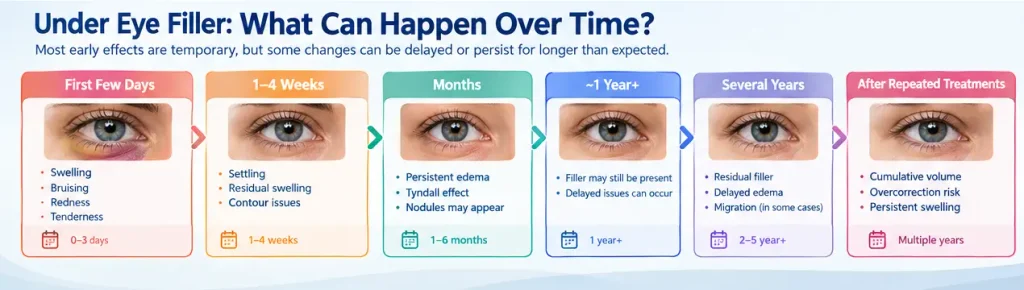
What Can Happen to Under-Eye Filler After 1, 2, 3 or 5 Years?
There is no guaranteed year-by-year pathway, but the following framework can help explain the possibilities.
| Time after treatment | What may happen |
|---|---|
| First few days | Swelling, bruising, redness and tenderness may occur |
| 1–4 weeks | Early swelling generally settles; residual contour issues may become clearer |
| Several months | Persistent edema, Tyndall effect or nodules may become apparent in some patients |
| Around 1 year | Filler may still have a clinically meaningful effect in some people |
| 18 months+ | Published evidence shows some tear-trough HA effects can remain clinically significant |
| Several years | Residual filler or delayed filler-related problems may remain relevant in some cases |
| After repeated treatments | Existing product and new treatment should be reassessed before further volume is added |
These are not guaranteed milestones. Product, anatomy, injection technique and individual response all influence the course.
What Should You Avoid After Long-Term Under-Eye Filler Problems?
Avoid:
- self-injecting anything into the area
- attempting to dissolve filler yourself
- aggressive massage without professional instructions
- assuming every swelling problem is migration
- assuming every blue discoloration is Tyndall effect
- adding more filler to correct an undiagnosed problem
- choosing a provider solely because of a low price
- hiding previous filler from a surgeon or injector
- delaying urgent assessment when vision symptoms occur.
The FDA specifically advises against buying fillers directly for self-use and against self-injection.
Can Long-Term Under-Eye Filler Problems Happen Again?
Yes, recurrence is possible when the underlying cause remains.
For example, a person who is prone to:
- malar edema
- persistent fluid retention
- overcorrection
- unsuitable anatomy
- recurrent inflammatory reactions
may experience the problem again if the same treatment approach is repeated.
That is why correction should address the cause, not simply the visible symptom.
How Can You Prevent Long-Term Under-Eye Filler Problems?
There is no way to guarantee zero complications.
Risk reduction starts with appropriate patient selection and treatment planning.
A practical checklist is:
Before injection
☐ Have the tear trough and surrounding anatomy assessed
☐ Discuss existing eye bags, festoons and edema
☐ Tell the provider about all previous filler
☐ Ask which product will be used
☐ Understand potential short- and long-term risks
☐ Ask what happens if a complication develops
Before repeat treatment
☐ Confirm whether previous filler remains
☐ Reassess whether you still need additional volume
☐ Discuss whether your anatomy has changed
☐ Review any previous swelling or complications
☐ Consider alternatives when filler is no longer the best fit
The FDA recommends a licensed healthcare provider who is experienced with dermal fillers, understands anatomy and knows how to manage complications.
Frequently Asked Questions
Can under-eye filler cause problems years later?
Yes. The FDA notes that some dermal-filler side effects can appear weeks, months or years after injection. However, a new symptom years later does not automatically prove that filler is responsible.
What are the long-term side effects of under-eye filler?
Reported long-term or delayed problems include persistent edema, malar edema, blue-gray discoloration, contour irregularities, nodules, inflammatory reactions and possible filler migration or persistence.
Can under-eye filler migrate years later?
Migration has been reported, but fullness years later can have other causes, including edema, malar anatomy, orbital fat or overcorrection. Clinical assessment is needed to distinguish them.
Does under-eye filler completely dissolve?
Not necessarily on a predictable timetable. HA filler is biodegradable, but clinical effects can persist longer than expected. Published studies have documented meaningful tear-trough effects beyond 12 months.
Can under-eye filler cause permanent swelling?
Persistent or long-lasting swelling can occur, but “permanent” should not be assumed from a period of prolonged puffiness. The cause needs to be determined before deciding on treatment.
Can repeated under-eye filler cause puffiness?
It may contribute in some patients, particularly when there is existing edema, unsuitable anatomy, excessive volume or persistent product. But puffiness does not prove that filler has accumulated.
Can you get under-eye filler every year?
There is no universal schedule that is appropriate for everyone. Before another treatment, the provider should reassess your anatomy, previous filler and current result rather than automatically repeating treatment.
Can old filler cause Tyndall effect?
Persistent superficial HA filler can potentially remain visible as blue-gray discoloration. However, vascular darkness, thin skin and other causes can produce similar appearances.
Can under-eye filler affect future blepharoplasty?
Previous filler may influence surgical assessment and planning, particularly if filler remains or has caused edema or contour changes. It does not automatically make blepharoplasty impossible.
Can old under-eye filler be dissolved?
HA filler can often be reduced with hyaluronidase when clinically appropriate. Non-HA or permanent materials may be much harder or impossible to remove completely.
How do I know if my swelling is from filler?
You usually cannot determine this from appearance alone. A clinician may need to distinguish retained filler, edema, malar edema, migration, inflammation, orbital fat and other causes.
When should I see an oculoplastic surgeon?
Consider specialist assessment for persistent or unexplained swelling, recurrent nodules, significant contour changes, suspected retained/migrated filler, previous filler complications or questions about future eyelid surgery. Sudden vision changes require urgent medical attention rather than a routine cosmetic consultation.
Bottom Line: Is Long-Term Under-Eye Filler Safe?
Long-term under-eye filler is not automatically unsafe, but it should not be treated as a simple yearly maintenance procedure without reassessment.
Some HA filler can remain clinically effective longer than expected. At the same time, delayed or persistent complications—including edema, malar edema, blue-gray discoloration, contour irregularities and nodules—have been documented.
The most important distinction is between filler that lasts and filler that causes a problem.
If you have persistent puffiness, a new lump, blue-gray discoloration, unusual contour changes or suspected migration, don’t automatically add more filler or attempt to dissolve it yourself. Have the area assessed by an appropriately qualified medical professional.
And if you develop sudden vision changes, severe pain or signs of vascular compromise, seek urgent medical attention.
Reliable Sources for Further Reading
- FDA — Dermal Fillers (Soft Tissue Fillers) — FDA Dermal Fillers
- FDA — JUVÉDERM VOLBELLA XC — FDA JUVÉDERM VOLBELLA XC
- FDA — Restylane Eyelight — FDA Restylane Eyelight
- FDA Devices@FDA — Restylane Eyelight PMA — Restylane Eyelight PMA Record
- FDA — Belotero Balance (+) — FDA Belotero Balance (+)
- FDA Devices@FDA — Belotero Balance (+) PMA — Belotero Balance (+) PMA Record
- FDA Devices@FDA — RHA Redensity Eye PMA — RHA Redensity Eye PMA Record
- FDA — 2023 Device Approvals — FDA 2023 Device Approvals
- FDA — Restylane Eyelight Labeling/Training Update — Restylane Eyelight PMA Update
Priority: Use FDA and FDA PMA records as the primary citations for approval, indications, age requirements, safety, and clinical-study claims.
Medically reviewed by Dr. J. Harper, MD, FAAD
Board-certified Dermatologist with 12 years of experience in facial aesthetics and injectable treatments, including specialist focus on complication risks, warning signs, diagnosis and treatment considerations.
This educational content was prepared in association with Bascom Palmer Eye Institute and with clinical input from Dr. Emily R. Carter, MD, FACS, Consultant Ophthalmic and Oculoplastic Surgeon.
Medical review: [20th August -2024] | Last updated: [10th September-2026]
Bascom Palmer Eye Institute
Written in association with Dr. Emily R. Carter, MD, FACS, Consultant Ophthalmic and Oculoplastic Surgeon

Sarah Mitchell is the founder and research editor of Under Eyes Filler, an independent patient-education resource. She is a researcher and writer, not a licensed medical professional. Her work is to read clinical studies and official FDA and ASPS guidance, then translate them into clear, honest explanations of under-eye filler results, recovery, risks, and realistic costs, so readers can prepare better questions for their own qualified provider.