Medically reviewed • Evidence-led under-eye filler education • Updated October 2026
Hollows vs Dark Circles vs Eye Bags: How to Tell the Difference & What Actually Helps24 min read
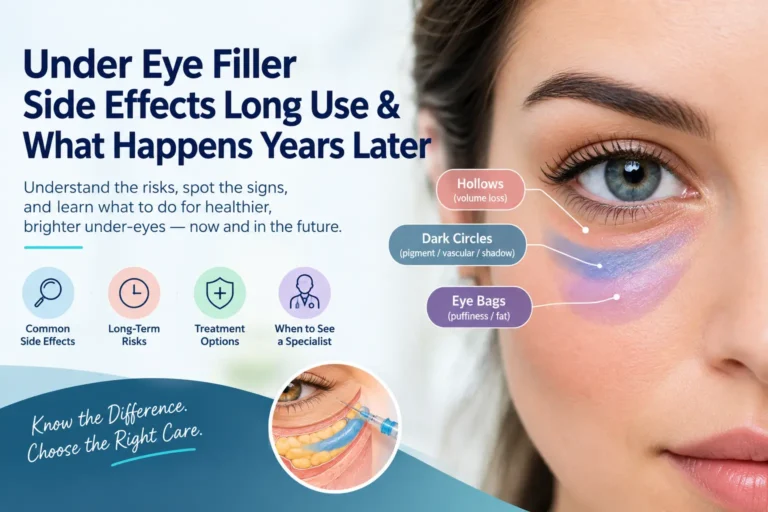
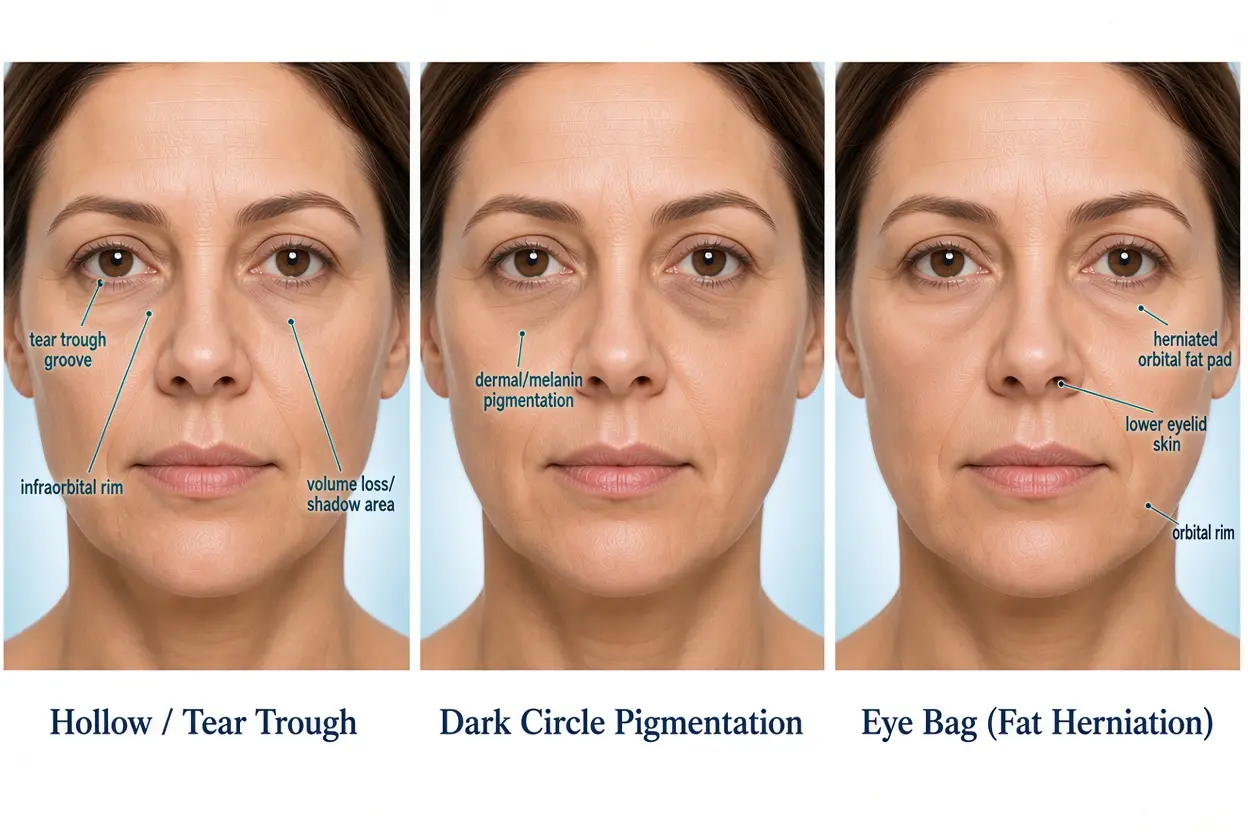
Hollows vs dark circles vs eye bags are three different problems that can create a surprisingly similar tired-looking appearance. A hollow is usually a depression or loss of volume that creates shadowing. A dark circle may be caused by pigmentation, visible blood vessels, thin skin, or structural shadowing. An eye bag is usually a visible fullness or bulge caused by fluid, orbital fat, skin changes, or a combination of factors.
And you can have more than one at the same time.
That distinction matters because treating the wrong problem can produce disappointing results. A cream cannot replace lost volume, filler cannot remove an orbital fat pad, and a pigment treatment will not necessarily correct a shadow created by a deep tear trough.
The most useful way to think about the under-eye area is:
Cause → Appearance → Identification → Appropriate treatment
Hollows vs Dark Circles vs Eye Bags at a Glance
| Feature | Under-Eye Hollows | Dark Circles | Eye Bags |
|---|---|---|---|
| Main problem | Depression or structural volume deficiency | Colour/discoloration or shadow | Fullness, puffiness or bulging |
| Typical appearance | Sunken, grooved or indented | Brown, blue, purple or shadowed | Raised, puffy or rounded |
| Common anatomical term | Tear trough / infraorbital hollow | Periorbital darkening | Lower-eyelid bag / orbital fat protrusion |
| May change with lighting? | Often | Sometimes, especially if structural | Shadows may change |
| Visible bulge? | No | No | Often |
| Colour change required? | No | Usually | No |
| Common contributors | Genetics, aging, volume loss, anatomy | Pigment, vessels, thin skin, shadows | Fluid, orbital fat, skin laxity, genetics |
| Can coexist with the others? | Yes | Yes | Yes |
| Could filler help? | Sometimes, if appropriate | Only when structural hollowing contributes | Usually not if the main problem is a prominent fat pad |
| Surgical option? | Sometimes | Depends on cause | Lower blepharoplasty may be considered for structural bags |
The important point is that dark circles are not a single condition. Medical literature describes infraorbital dark circles as multifactorial, with contributions from skin pigmentation, vascular structures, anatomy, soft tissue, and structural shadowing.
What Are Under-Eye Hollows?
Under-eye hollows are depressions beneath the lower eyelids that can create a sunken or tired appearance.
They are often associated with the tear trough, infraorbital hollow, nasojugal groove, or broader changes at the lower eyelid–cheek junction.
What do under-eye hollows look like?
Typical signs include:
- A visible groove beneath the lower eyelid
- A sunken or concave appearance
- An indentation between the lower eyelid and cheek
- A shadow that becomes stronger under overhead lighting
- A darker-looking area that may improve when the lighting changes
- A less smooth transition between the eyelid and cheek
A tear trough can create the appearance of dark circles because the depression changes how light falls across the face. Research on tear-trough anatomy has long recognized that structural depressions can create a shadow that makes the lower eyelid look darker.
What causes under-eye hollowness?
Several factors can contribute, including:
- Genetics
- Aging
- Facial bone structure
- Orbital rim anatomy
- Loss or redistribution of soft tissue
- Midface volume loss
- Changes in the lower-eyelid fat compartments
- Significant weight loss in some people
- Natural facial anatomy
Terms such as infraorbital hollowing, tear trough deformity, structural hollow, and under-eye indentation describe different aspects of the same general problem.
Skeletal anatomy can also influence how pronounced a hollow appears. The relationship between the orbital rim, cheek and midface can make an existing groove look deeper. Terms such as maxillary retrusion may appear in specialist discussions of facial structure, but they are not something you can reliably diagnose yourself from a mirror.
Hollows vs structural dark circles
This is where the terminology becomes confusing.
A hollow itself is a structural depression. But the shadow produced by that depression can look like a dark circle.
That means you can have a “dark circle” that is not primarily caused by excess melanin or visible veins.
What Are Dark Circles?
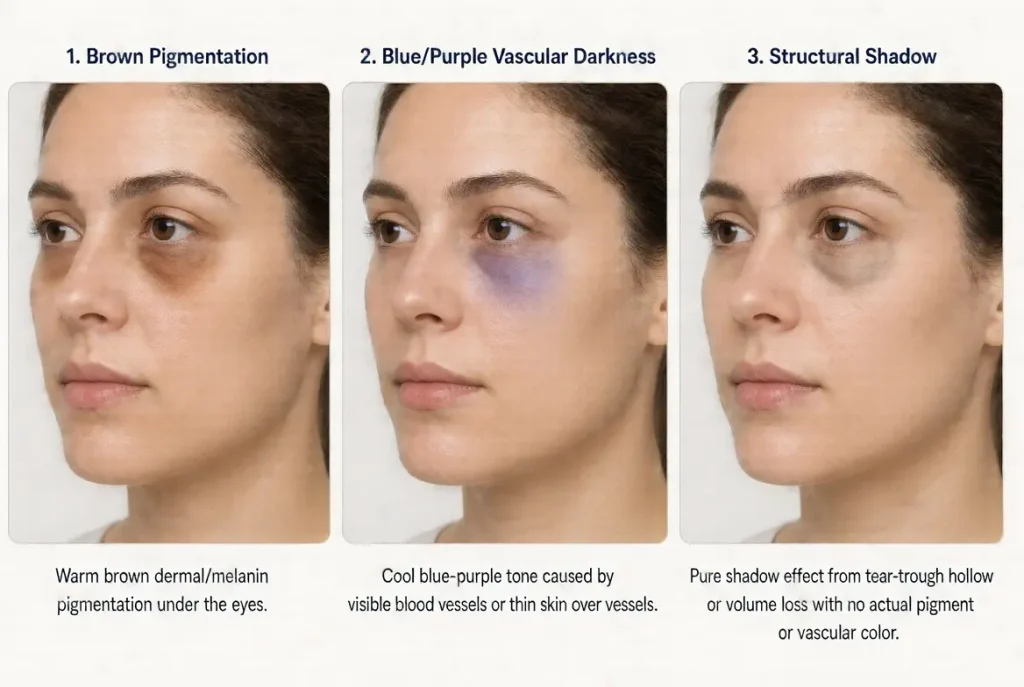
Dark circles under the eyes describe a darker appearance around the lower eyelid. The underlying cause can be very different from person to person.
A useful clinical framework is to think about three major contributors:
- Pigment
- Vascular/skin transparency
- Structural shadowing
Some people have all three.
Pigmented dark circles
Brown or brown-black darkness may be related to increased melanin, hyperpigmentation, post-inflammatory changes, sun exposure or repeated irritation.
Potential contributors include:
- Genetics
- Sun exposure
- Post-inflammatory pigmentation
- Dermatitis or allergies
- Eye rubbing
- Uneven skin tone
- Increased melanin
Periorbital hyperpigmentation is recognized as multifactorial, and published reviews describe pigmented, vascular, structural and mixed presentations.
Vascular dark circles
Blue, purple or pinkish darkness may be associated with visible blood vessels beneath thin under-eye skin.
This can become more noticeable when the skin becomes thinner or more translucent.
People often describe these as:
- Blue dark circles
- Purple dark circles
- Vascular dark circles
- Visible veins under the eyes
Genetics, skin thickness, aging and other factors can all contribute.
Structural dark circles
A structural dark circle is essentially shadowing created by facial contours.
The darkness may become more obvious when light comes from above and less obvious when the face is illuminated more directly.
This is why someone can have “dark circles” even when the skin itself is not significantly darker.
Can dark circles have more than one cause?
Absolutely.
You may have:
- Pigmentation + vascular darkness
- Pigmentation + hollowness
- Vascular darkness + hollowness
- Eye bags + structural shadows
- All three components together
That is one reason why a single eye cream, filler treatment or laser cannot be expected to fix every type of under-eye darkness.
What Are Under-Eye Bags?
Eye bags are primarily a contour problem: something is creating visible fullness or protrusion beneath the eyes.
This may be temporary puffiness or a more structural lower-eyelid change.
Temporary under-eye puffiness
Temporary puffiness can be associated with:
- Poor sleep
- Allergies
- Crying
- High-salt meals
- Alcohol
- Fluid retention
- Certain environmental or inflammatory triggers
Morning eye bags that become less noticeable later in the day are more suggestive of a fluid component than a fixed structural bulge.
Structural eye bags
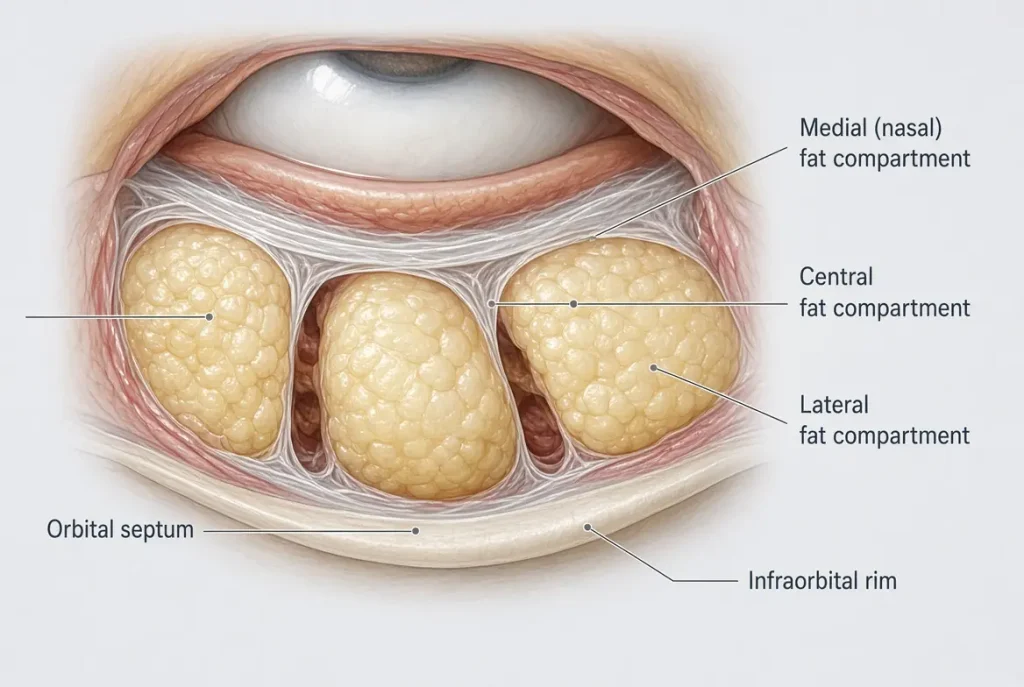
Structural under-eye bags can occur when orbital fat protrudes or shifts forward, often together with changes in the supporting tissues and lower-eyelid skin.
Signs can include:
- A persistent bulge beneath the lower eyelid
- Fullness that remains despite adequate sleep
- A rounded lower-eyelid contour
- Loose or sagging skin
- A shadow beneath the bulge
Specialist literature describes lower-eyelid bags in relation to orbital fat herniation or “steatoblepharon,” while modern lower-blepharoplasty techniques may involve fat removal, preservation or repositioning depending on anatomy.
How to Tell If You Have Hollows, Dark Circles or Eye Bags
You can use the following as an educational self-check, but it cannot establish a medical diagnosis.
Step 1 — Look for a visible bulge
If the area beneath your lower eyelid is visibly raised or puffy, you may have eye bags or puffiness.
If the area is smooth but looks sunken, a hollow may be contributing.
Step 2 — Look at the colour
Ask what you actually see:
- Brown: pigmentation may contribute.
- Blue or purple: vascular visibility or thin skin may contribute.
- Skin-coloured depression with a dark shadow: structural hollowing may contribute.
- No obvious colour change but visible fullness: an eye bag may be more relevant.
Colour alone is not enough to diagnose the cause.
Step 3 — Change the lighting
Look at your face in different lighting.
If the darkness becomes much stronger under overhead lighting and less obvious with front-facing light, shadowing from facial anatomy may be contributing.
Structural dark circles can behave this way because the contour creates a shadow.
Step 4 — Look for a groove or indentation
A visible groove running from the inner lower eyelid toward the cheek can indicate a tear trough or nasojugal groove.
The presence of a groove does not automatically mean filler is appropriate. The surrounding cheek, orbital rim, skin quality and lower-eyelid anatomy also matter.
Step 5 — Compare morning with later in the day
If your under-eyes are much puffier when you wake up and improve later, fluid retention may be contributing.
If the contour remains essentially unchanged throughout the day, a structural component becomes more plausible.
Step 6 — Consider whether multiple causes are present
This is the step people often miss.
You may simultaneously have:
A hollow + brown pigmentation
or
A hollow + visible vessels
or
Eye bags + dark circles
or even:
Hollows + dark circles + eye bags.
The goal is not to force your appearance into one category. It is to understand which factors are contributing.
Can You Have Hollows, Dark Circles and Eye Bags at the Same Time?
Yes.
Hollows + pigmentation
The hollow creates a shadow while pigmentation creates actual colour change.
Treating only the hollow may reduce the shadow without eliminating the brown component.
Hollows + vascular circles
A tear trough can make already-visible vessels appear even darker.
Hollows + eye bags
This combination is particularly important because adding volume to an area that already has significant protrusion may not address the underlying problem.
Eye bags + dark circles
An eye bag can cast a shadow beneath itself, creating the appearance of a dark circle.
All three together
A person can have:
- A structural tear trough
- Brown pigmentation
- Blue/purple vascular darkness
- Lower-eyelid fullness
This is why “What is the best treatment for dark circles?” has no universal answer.
Hollows vs Dark Circles vs Eye Bags: What Causes Each?
| Concern | Primary issue | Common contributors |
|---|---|---|
| Hollows | Depression/volume relationship | Genetics, aging, bone structure, soft-tissue changes |
| Dark circles | Colour and/or shadow | Pigment, vessels, thin skin, inflammation, anatomy |
| Eye bags | Fullness/bulging | Fluid, orbital fat, skin laxity, aging, genetics |
| Malar bags | Lower cheek fullness | Soft-tissue/fat and fluid-related changes |
| Festoons | Cheek-area folds/fullness | Skin, muscle and soft-tissue changes |
The medical literature emphasizes that infraorbital darkening is often multifactorial rather than a single disease or cosmetic defect.
Why Do My Under-Eyes Look Dark Even When I Sleep Enough?
Getting adequate sleep does not necessarily remove under-eye darkness.
Possible explanations include:
- Structural tear-trough shadowing
- Brown pigmentation
- Visible blood vessels
- Thin or translucent skin
- Genetics
- Eye bags casting shadows
- Facial aging
- Midface volume changes
So if you have persistent dark circles despite adequate sleep, that does not automatically mean you need more sleep or a stronger eye cream.
The first question should be:
Is the darkness caused by colour, contour, or both?
Why Are My Under-Eyes Puffy in the Morning?
Morning puffiness can have a fluid-retention component.
Potential contributors include:
- Sleeping position
- Salt intake
- Alcohol
- Allergies
- Crying
- Poor sleep
- Nasal or sinus congestion
- Individual anatomy
Temporary puffiness often changes during the day.
A persistent lower-eyelid bulge is different and may involve orbital fat or skin/tissue changes.
Are They Actually Eye Bags? Malar Bags, Festoons and Puffiness
Not every under-eye bump is an eye bag.
Eye bags
Usually refer to fullness or bulging associated with the lower eyelid.
Malar bags
Malar bags are lower on the face, around the upper cheek or malar region. They can be confused with conventional lower-eyelid bags.
Festoons
Festoons are folds or fullness involving the skin and soft tissue over the cheekbone area.
Why the distinction matters
A treatment designed for a tear trough may not address a malar bag or festoon.
This is another reason why diagnosis should come before treatment.
What Treatments Help Hollows?
Treatment depends on the anatomy and severity of the hollow.
Under-eye filler
Hyaluronic acid filler may be considered when the primary issue is appropriate infraorbital hollowing.
In the United States, four named product lines have FDA infraorbital indications: Restylane Eyelight and JUVÉDERM VOLBELLA XC for adults over 21, Belotero Balance (+) for adults over 21, and RHA Redensity Eye / Eye Lido for adults 22 or older. Their approved uses differ; check the exact label with your clinician.
FDA approval is product- and indication-specific; it does not mean every dermal filler is approved for under-eye use.
Fat transfer or micro-fat transfer
Autologous fat can be used for volume restoration in selected patients.
PRP, PRF and regenerative treatments
These are sometimes used to target skin quality, fine lines or tissue characteristics rather than simply replacing a structural volume deficit. Evidence and indications vary by treatment.
When hollows may not need filler
A hollow does not automatically mean you need an injectable.
The appearance may be mild, stable and simply part of your normal facial anatomy.
And yes, questions such as “Are under-eye hollows attractive?” are ultimately subjective. A tear trough or hollow is not inherently a medical problem or something that must be corrected.
What Treatments Help Dark Circles?
The treatment should match the type of darkness.
Pigmentation
Depending on the diagnosis and skin type, clinicians may consider:
- Broad-spectrum sunscreen
- Vitamin C
- Niacinamide
- Retinoids
- Tranexamic acid
- Arbutin
- Selected pigment treatments
- Chemical peels
- Laser or light-based treatments
Hydroquinone may also be used in some settings, but it should not be treated as a universal under-eye remedy; availability, skin type and safety considerations vary.
Medical reviews describe topical agents, chemical peels and laser-based treatments among options for selected types of periorbital hyperpigmentation.
Vascular darkness
If visible blood vessels or thin translucent skin are major contributors, pigment-only treatment may not address the problem.
Selected vascular treatments, skin-quality approaches or camouflage may be considered by a qualified clinician.
Shadow-based dark circles
If the darkness is primarily caused by a tear-trough hollow, correcting the underlying contour may be more relevant than applying a pigment-lightening product.
Why one treatment does not work for every dark circle
Because “dark circles” is an appearance, not one single cause.
What Treatments Help Eye Bags?
Temporary puffiness
When fluid retention or allergies contribute, addressing the trigger may help.
A cool compress can temporarily reduce the appearance of swelling.
Skincare and lifestyle measures
Depending on the cause, people may benefit from:
- Adequate sleep
- Allergy management
- Sun protection
- Avoiding eye rubbing
- Appropriate hydration
- Reducing factors that worsen temporary puffiness
These measures are more useful for modifiable contributors than for a fixed orbital-fat bulge.
Skin tightening
When skin laxity is significant, selected energy-based or resurfacing treatments may be considered.
Lower blepharoplasty
For structural lower-eyelid bags caused by orbital fat, excess skin or related anatomical changes, lower blepharoplasty may be considered.
Modern approaches can involve removing, preserving or repositioning fat rather than simply removing everything. Surgical technique depends on the individual’s anatomy.
Can Under-Eye Filler Fix Dark Circles or Eye Bags?
This is one of the most important distinctions for anyone considering tear-trough filler.
| Concern | Can filler help? | Why |
|---|---|---|
| True under-eye hollow | Potentially | Adds volume to an appropriate depression |
| Shadow caused by hollowing | Potentially | Reducing the depression may reduce shadowing |
| Brown pigmentation | Not directly | Filler does not remove melanin |
| Visible veins | Not directly | Filler does not eliminate vascular visibility |
| Large orbital-fat bag | Usually not | Filler does not remove protruding fat |
| Temporary puffiness | No | Fluid retention is a different problem |
| Mild structural contour deficiency | Sometimes | Depends on anatomy |
| Significant skin laxity | Limited | Excess skin requires a different strategy |
This is why under-eye filler is not a universal dark-circle treatment.
A peer-reviewed review of infraorbital dark circles likewise describes treatment as dependent on the underlying cause, with options ranging from skincare and camouflage to lasers, fillers, fat transfer and surgery.
Under-Eye Filler vs Lower Blepharoplasty
These procedures address different anatomical problems, although there can be overlap.
| Under-Eye Filler | Lower Blepharoplasty | |
|---|---|---|
| Main role | Volume-related hollowing | Structural lower-eyelid changes |
| Adds volume? | Yes | Can reposition existing fat; technique varies |
| Removes fat? | No | Sometimes, depending on technique |
| Treats pigmentation? | No | Not directly |
| Treats a prominent fat bag? | Usually not | Often considered |
| Surgery? | No | Yes |
| Reversible? | HA filler can often be treated with hyaluronidase | Surgical changes require surgical management |
| Suitability | Depends heavily on anatomy | Depends on anatomy, skin, fat and eyelid factors |
Lower blepharoplasty can address orbital fat prolapse, excess skin and/or the lid-cheek transition, while contemporary techniques may reposition fat to improve hollowing rather than simply remove it.
The correct choice is therefore not “filler vs surgery” in isolation.
It is:
What anatomical problem are you actually trying to correct?
Can Skincare Fix Hollows, Dark Circles or Eye Bags?
Skincare can help some skin-related contributors, but it cannot do everything.
| Problem | What skincare may help | What it generally cannot replace |
|---|---|---|
| Pigmentation | Brightening and pigment-management ingredients | Structural correction |
| Thin/dry skin | Hydration and skin-quality support | Major volume restoration |
| Mild puffiness | Some cooling/de-puffing products | Correction of a fixed fat bulge |
| Hollowness | Skin quality around the area | Lost structural volume |
| Eye bags | Temporary appearance improvement | Surgical correction of significant fat protrusion |
The mistake is assuming that every under-eye problem is a skincare problem.
When Should You See a Doctor or Specialist?
Consider professional assessment if you have:
- A sudden new change
- Significant one-sided swelling
- Persistent unexplained swelling
- Pain
- Vision changes
- Significant redness or warmth
- A rapidly changing lump
- New symptoms affecting the eye itself
- A cosmetic concern that is not improving despite reasonable self-care
An ophthalmologist or oculoplastic surgeon may be particularly relevant when the problem involves the eyelid, orbit, vision or significant structural change.
A dermatologist may be useful for pigmentation, dermatitis, skin quality or vascular/skin-related concerns.
A qualified aesthetic injector may assess whether an injectable treatment is appropriate, but not every under-eye concern should be treated with filler.
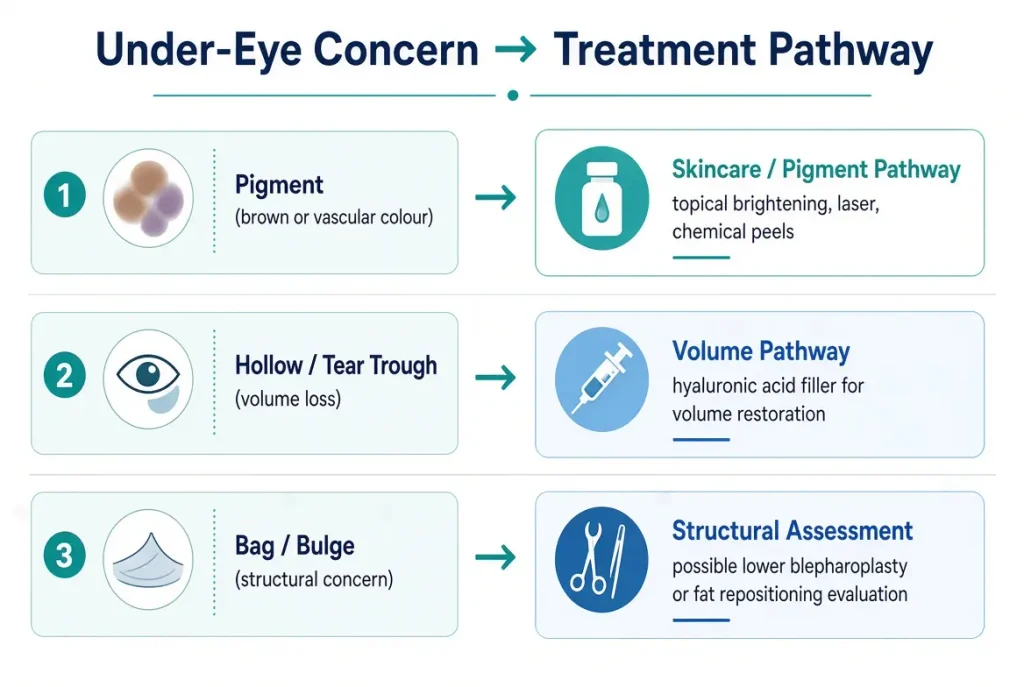
How to Choose the Right Treatment for Your Under-Eye Concern
Use this as a starting framework:
Brown/pigmented → pigment and skin pathway
Blue/purple/vascular → vascular and skin pathway
Hollow → structural/volume pathway
Prominent fat-pad bag → structural/surgical assessment
Temporary puffiness → trigger/fluid pathway
Mixed presentation → combination assessment
This “condition → cause → appearance → treatment” framework is more useful than simply searching for the “best treatment for dark circles.”
Quick Self-Check: Which One Sounds Most Like You?
“I have brown colour under my eyes.”
Pigmentation may be contributing.
“I have blue or purple colour.”
Vascular visibility or thin skin may contribute.
“I have a visible groove.”
A tear trough or infraorbital hollow may contribute.
“I have a visible bulge.”
Consider puffiness or an eye bag.
“It is much worse in the morning.”
A fluid component may be contributing.
“It changes dramatically with lighting.”
Structural shadowing may be contributing.
“I have several of these.”
A mixed presentation is possible.
This is an educational guide, not a diagnosis.
How Long Do Hollows, Dark Circles and Eye Bags Last?
There is no single timeline.
Hollows
Structural hollows can be long-standing and may become more noticeable with aging or changes in facial volume.
Dark circles
Pigmentation can persist for years, while vascular darkness and structural shadowing may fluctuate in appearance.
Temporary puffiness
Fluid-related puffiness may improve within hours or during the day when the underlying trigger resolves.
Structural eye bags
Orbital-fat-related bags are generally persistent rather than something that disappears permanently after a good night’s sleep.
The duration therefore depends on what is causing the appearance.
What Does Treatment Cost?
Under-eye treatment costs vary substantially by country, city, provider, product, technique and complexity.
There is no independently verified nationwide under-eye price for this comparison. Consult the cost guide for quote components, then request an itemized local estimate stating the product, amount, follow-up and any separate fees.
For surgery, the American Society of Plastic Surgeons cost page reports an average surgeon fee of $3,876 for lower blepharoplasty; anesthesia, operating-room and other expenses are excluded. This is not a patient total or a quote.
Other treatments can vary widely:
- Skincare: generally the lowest initial cost
- Pigment treatments: varies by product, peel or device
- Laser/light treatments: usually charged per session
- PRP/PRF: commonly charged per session
- Under-eye filler: usually charged per syringe or treatment
- Lower blepharoplasty: surgical fee plus facility/anesthesia costs
The key point is that the cheapest treatment is not necessarily the appropriate treatment.
Can These Problems Come Back?
Yes.
Even when a treatment works, the underlying contributors may remain.
For example:
- Pigmentation can recur with UV exposure or inflammation.
- Puffiness can return when the trigger returns.
- Aging continues after filler or surgery.
- Structural shadows can become more noticeable as facial anatomy changes.
- Existing eye bags may persist or progress.
- A combination of causes can become more obvious over time.
This is another reason to treat the underlying cause rather than repeatedly treating the visible symptom.
How Can You Prevent or Reduce Under-Eye Problems?
You cannot prevent genetics or completely stop facial aging, but you can reduce some modifiable contributors.
Useful habits include:
- Use broad-spectrum SPF around the eye area as appropriate.
- Avoid rubbing the eyes.
- Manage known allergies.
- Maintain consistent sleep.
- Avoid excessive alcohol if it worsens puffiness.
- Be mindful of high-salt meals if they consistently cause morning swelling.
- Use gentle skincare around the eyes.
- Treat persistent dermatitis or inflammation with professional guidance.
- Do not assume every dark circle requires filler.
If the appearance is structural, lifestyle changes may improve the surrounding skin or temporary swelling without eliminating the underlying anatomy.
What Does Medical Research Say?
Research supports a central conclusion:
Under-eye darkness and lower-eyelid aging are multifactorial.
Peer-reviewed reviews describe contributions from:
- Skin pigmentation
- Blood vessels
- Thin/translucent skin
- Orbicularis muscle
- Soft-tissue changes
- Bone and orbital anatomy
- Tear-trough depression
- Fluid accumulation
- Fat redistribution
- Skin laxity
That means treatment should be individualized according to the dominant cause rather than selected solely because something is marketed for “dark circles.”
The same principle applies to surgery. Contemporary lower-eyelid literature recognizes that bags, hollows, skin laxity and tear-trough deformity can coexist, and surgical planning may involve preservation or repositioning of fat rather than a single standardized technique.
For filler, FDA approval is product and indication specific. Restylane Eyelight, JUVÉDERM VOLBELLA XC, Belotero Balance (+), and RHA Redensity Eye / Eye Lido have distinct U.S. infraorbital indications and age thresholds; this does not mean every filler is approved for this area.
Frequently Asked Questions
Are hollows and dark circles the same thing?
No. Hollows are structural depressions that can create shadows. Dark circles describe a darker appearance that may result from pigmentation, vascular visibility, thin skin, structural shadowing or a combination.
Are eye bags and dark circles the same thing?
No. Eye bags usually involve visible fullness or puffiness, while dark circles primarily describe colour or shadow. However, an eye bag can cast a shadow that makes the area look darker.
How can I tell if I have eye bags or hollows?
Look for the contour. A visible raised bulge suggests a bag or puffiness; a smooth, depressed groove suggests hollowness. Some people have both.
Can hollows cause dark circles?
Yes. A tear trough can create a shadow that looks like a dark circle even when there is little actual pigmentation.
Can eye bags cause dark circles?
Yes. A protruding lower-eyelid contour can cast a shadow beneath itself.
Can you have dark circles and eye bags?
Yes. Pigmentation or vascular darkness can coexist with puffiness or structural eye bags.
Can you have hollows and eye bags?
Yes. Hollows and orbital-fat protrusion can occur together, particularly as facial aging changes multiple tissues.
Can lack of sleep cause hollows?
Poor sleep can make the under-eye area look more tired or shadowed, but it does not necessarily create a structural tear-trough hollow.
Can lack of sleep cause eye bags?
It can worsen temporary puffiness, particularly when fluid retention or other contributing factors are present.
Can under-eye filler fix dark circles?
It may improve darkness when the main contributor is structural hollowing and shadowing. It will not directly remove true pigmentation or visible blood vessels.
Can under-eye filler fix eye bags?
Usually not when the main problem is a prominent orbital-fat bulge. Adding volume to an already full area may not address the underlying issue.
What is the difference between a tear trough and dark circles?
A tear trough is an anatomical depression or groove. Dark circles are an appearance of darkness that can have several causes. A tear trough can create a dark shadow.
What is the difference between a tear trough and eye bags?
A tear trough is a depression; an eye bag is fullness or protrusion. They can occur together.
Are under-eye bags permanent?
Temporary puffiness may resolve, but structural bags caused by orbital fat or tissue changes tend to persist.
Do under-eye hollows get worse with age?
They can become more noticeable as facial volume, soft tissue, skin and skeletal relationships change with age, although genetics and individual anatomy strongly influence the appearance.
What treatment is best for under-eye hollows?
There is no universal “best” treatment. Depending on anatomy, options may include hyaluronic acid filler, fat transfer, fat repositioning or other approaches. A qualified professional should determine whether the visible problem is actually a hollow before treatment.
How can I fix under-eye hollows naturally?
Lifestyle measures can support overall skin health, but they cannot reliably replace structural volume loss. If the hollow is primarily anatomical, professional assessment is usually more informative than relying on creams or home remedies alone.
Why do my under-eyes look dark but not puffy?
The darkness may be related to pigmentation, visible blood vessels, thin skin or structural shadowing rather than an eye bag.
Why are my under-eyes puffy?
Temporary puffiness can relate to fluid retention, allergies, sleep, diet or other triggers. Persistent fullness may instead reflect structural lower-eyelid changes.
Is “eye bags vs dark circles Reddit” advice reliable?
Online discussions can help you understand how people describe their experiences, but forum anecdotes cannot establish whether your own darkness is pigmentation, vascular visibility, hollowness or an eye bag. A clinical assessment is more reliable when the cause is unclear.
The Bottom Line: Don’t Treat the Wrong Under-Eye Problem
Hollows, dark circles and eye bags are not interchangeable terms.
A hollow is primarily a contour problem.
A dark circle is primarily an appearance of darkness, which may involve pigment, vessels, thin skin, shadowing or several factors.
An eye bag is primarily a fullness or bulging problem.
And many people have a combination.
The most useful question is therefore not:
“What is the best under-eye treatment?”
It is:
“What is actually causing the appearance I want to change?”
Once the cause is identified, the treatment options become much easier to understand.
If you are considering under-eye filler, start by determining whether you actually have structural hollowing, because filler is designed to add volume—not remove pigmentation, fluid or a prominent orbital-fat pad.
For medical or procedural decisions, seek an assessment from an appropriately qualified professional who understands lower-eyelid and midface anatomy
Publication Sources
FDA — Product approvals & safety
- FDA — Restylane Eyelight: P040024/S135 — FDA approval and indication for infraorbital hollowing.
FDA — Restylane Eyelight - FDA — Dermal Fillers (Soft Tissue Fillers) — General FDA information on dermal fillers, approved uses and safety considerations.
FDA — Dermal Fillers (Soft Tissue Fillers)
Ophthalmology / Plastic Surgery Literature
- Journal of Cutaneous and Aesthetic Surgery — Infraorbital Dark Circles: A Review of the Pathogenesis, Evaluation and Treatment — Anatomy, causes, evaluation and treatment of under-eye darkness.
Journal of Cutaneous and Aesthetic Surgery — Infraorbital Dark Circles Review - Indian Journal of Ophthalmology — Lower Eyelid Blepharoplasty: An Overview — Lower-eyelid anatomy, orbital fat, tear troughs, hollows and surgical treatment.
Indian Journal of Ophthalmology — Lower Eyelid Blepharoplasty: An Overview
Dermatology Literature
- Indian Journal of Dermatology — Periorbital Hyperpigmentation: A Comprehensive Review — Pigmented, vascular, structural and mixed causes of dark circles.
Indian Journal of Dermatology — Periorbital Hyperpigmentation: A Comprehensive Review - Indian Journal of Dermatology — Periorbital Hyperpigmentation: What Lies Beneath? — Classification and causes of periorbital pigmentation, including vascular and structural factors.
Indian Journal of Dermatology — Periorbital Hyperpigmentation: What Lies Beneath?
Additional Peer-Reviewed Source
- Archives of Plastic Surgery — Treatments of Infra-Orbital Dark Circles by Various Etiologies — Useful for explaining why treatment should be matched to the underlying cause rather than simply treating “dark circles.”
Archives of Plastic Surgery — Treatments of Infra-Orbital Dark Circles by Various Etiologies
Editorial note: Product indications were checked against FDA Belotero and FDA RHA approval records. An independent clinician review and date for this page have not been verified.

Sarah Mitchell is the founder and research editor of Under Eyes Filler, an independent patient-education resource. She is a researcher and writer, not a licensed medical professional. Her work is to read clinical studies and official FDA and ASPS guidance, then translate them into clear, honest explanations of under-eye filler results, recovery, risks, and realistic costs, so readers can prepare better questions for their own qualified provider.