Medically reviewed • Evidence-led under-eye filler education • Updated October 2026
FDA-Approved Under-Eye Fillers: Best 4 Approved Options & Uses16 min read
As of September 2026, four hyaluronic-acid fillers have specific FDA-approved indications for correcting infraorbital hollowing in the United States: JUVÉDERM VOLBELLA XC, Restylane Eyelight, Belotero Balance (+), and RHA Redensity Eye. Their approved ages, indications and labeling differ, so FDA approval does not mean that one product is universally best or appropriate for every under-eye concern.
That does not mean one is automatically the best FDA-approved under-eye filler for everyone. The right treatment depends first on whether the problem is actually an infraorbital hollow, rather than pigmentation, puffiness, an eye bag, malar edema, or another lower-eyelid concern.
FDA-Approved Under-Eye Fillers at a Glance
| Filler | FDA under-eye approval | Approved age | FDA indication | FDA-reported duration* |
|---|---|---|---|---|
| JUVÉDERM VOLBELLA XC | May 28, 2021 | Over 21 | Infraorbital hollow | Up to 12 months |
| Restylane Eyelight | May 8, 2023 | 21+ | Infraorbital hollowing | Up to 12 months |
| Belotero Balance (+) | Sept. 27, 2023 | Over 21 | Infraorbital hollow | Up to 48 weeks |
| RHA Redensity Eye / Eye Lido | May 12, 2026 | 22+ | Moderate-to-severe infraorbital tissue-volume deficiency | See current labeling |
*Duration is product- and study-specific; it should not be interpreted as a guarantee for an individual patient. FDA records confirm the respective indications and product-specific study information.
How Many Under-Eye Fillers Are FDA Approved?
The current U.S. landscape includes four important HA filler products with specific FDA indications for the infraorbital region:
- JUVÉDERM VOLBELLA XC
- Restylane Eyelight
- Belotero Balance (+)
- RHA Redensity Eye and RHA Redensity Eye Lido
The important SEO and medical distinction is that this is a list of products with specific FDA indications involving infraorbital hollowing or tissue-volume deficiency. It is not a list of every dermal filler that can physically be injected somewhere on the face.
For example, JUVÉDERM VOLBELLA XC had previously been approved for other facial uses before its May 2021 indication was expanded to include the infraorbital hollow in adults over 21.
What Does “FDA Approved for Under-Eye Filler” Actually Mean?
What FDA approval means
FDA approval means the agency has reviewed information supporting the safety and effectiveness of a particular product for a defined indication.
The key words are particular product and defined indication.
FDA approval therefore provides much more specific information than simply saying a brand is “FDA approved.”
What FDA approval does not mean
FDA approval does not mean:
- the filler is risk-free;
- the product is suitable for every patient;
- the product is universally the best filler;
- every use of that product is FDA approved;
- treatment will produce identical results in every person.
The FDA notes that dermal fillers can produce temporary or permanent complications, and some complications can occur weeks, months, or even years after treatment.
FDA-approved product vs FDA-approved indication
This distinction is particularly important when comparing FDA-approved dermal fillers.
A product can have FDA authorization for one facial area or indication without having a specific approval for the under-eye region.
When researching an FDA-approved filler for under-eye hollows, check the actual FDA indication rather than relying only on the product’s brand name.
FDA-approved vs off-label filler
An off-label use generally means an approved product is being used in a way that is outside its FDA-approved labeling.
That is different from using an unapproved or counterfeit product.
Patients should ask their provider exactly:
“Is this product FDA approved for the specific under-eye indication being treated?”
The 4 FDA-Approved Under-Eye Fillers
1. JUVÉDERM VOLBELLA XC
JUVÉDERM VOLBELLA XC received its specific infraorbital approval on May 28, 2021.
The FDA describes it as a crosslinked hyaluronic-acid filler containing 0.3% lidocaine. Its approved under-eye use is for the infraorbital hollow in adults over age 21. In the clinical study described by FDA, patients generally required one or two treatments with multiple injections, and results may last up to 12 months.
This is why searches such as Juvéderm Volbella FDA approval, “Volbella under eyes before and after,” and “Juvéderm for under eyes” need to be interpreted through the specific infraorbital indication rather than the broader JUVÉDERM product family.
2. Restylane Eyelight
Restylane Eyelight received FDA approval for infraorbital hollowing on May 8, 2023.
The FDA identifies it as a hyaluronic-acid dermal filler containing BDDE and 0.3% lidocaine. Its approved indication is improvement of depressed, sunken, or hollow areas under the eyes in people 21 years of age and older.
The FDA reports that the pivotal clinical study included 333 participants and that one or two treatment sessions were used in the study; results may last up to 12 months.
This makes Restylane Eyelight FDA approval an important search intent for anyone comparing currently approved tear trough and infraorbital fillers.
3. Belotero Balance (+)
Belotero Balance (+) received its infraorbital indication on September 27, 2023.
The FDA states that the product is intended to improve infraorbital hollowing in adults over 21. Its under-eye indication was added to previous approved uses for facial wrinkles and folds.
The FDA reports a clinical study involving 144 participants, with one or two treatment sessions used to achieve the study outcomes. Results may last up to 48 weeks.
4. RHA Redensity Eye
RHA Redensity Eye and RHA Redensity Eye Lido represent the newest addition to this list.
The FDA’s PMA record shows a decision date of May 12, 2026. The approval expands the indication to injection into the sub-dermis and supraperiosteum for correction of moderate-to-severe tissue-volume deficiencies in the infraorbital region in adults 22 years or older.
This is an important update for anyone relying on older articles that list only Volbella, Eyelight, or Belotero.
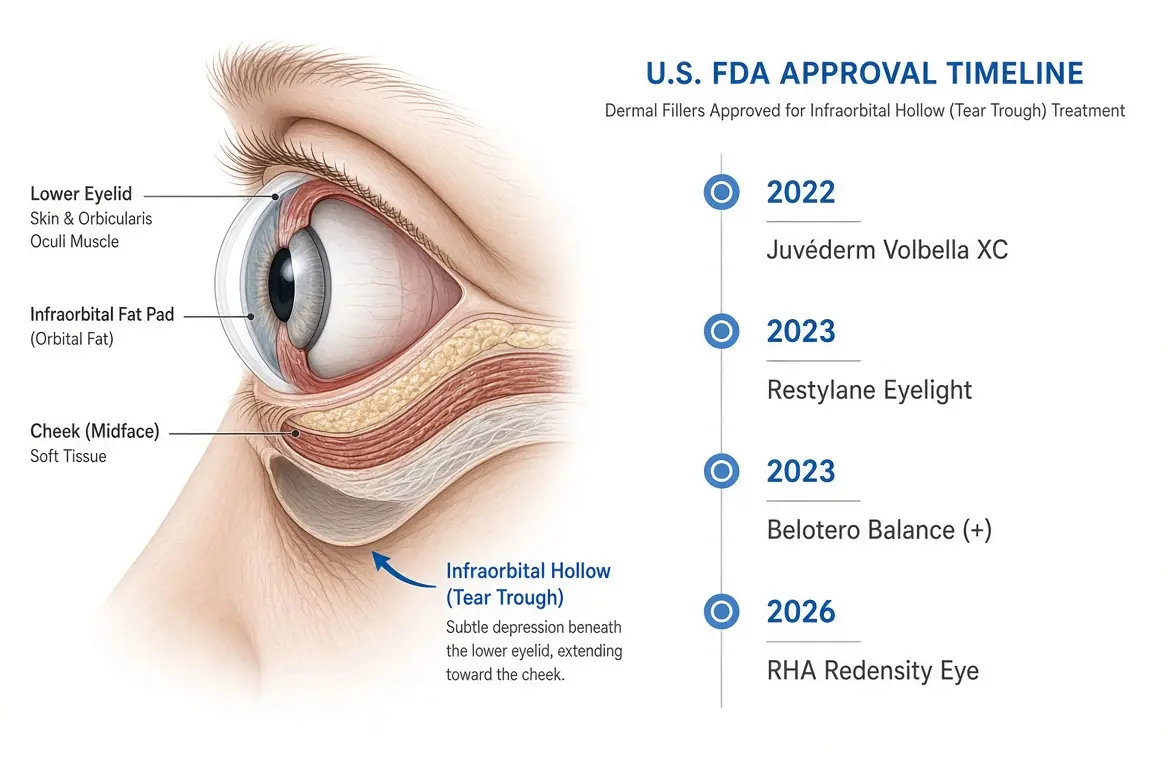
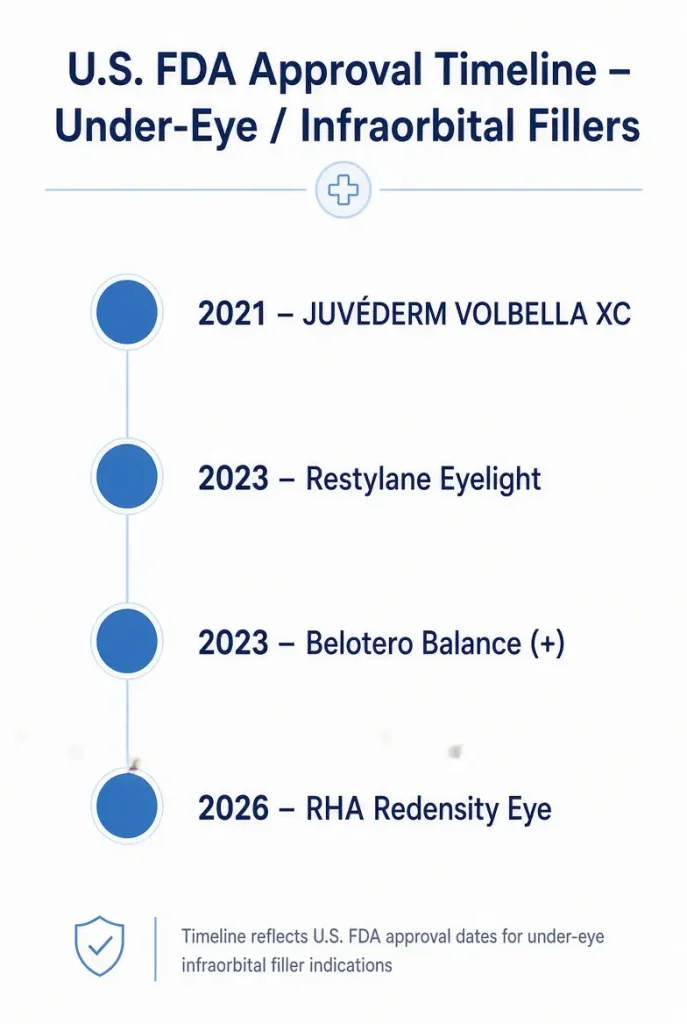
FDA Approval Timeline for Under-Eye Fillers
The development of FDA-approved infraorbital fillers can be summarized as:
2021 → JUVÉDERM VOLBELLA XC
2023 → Restylane Eyelight
2023 → Belotero Balance (+)
2026 → RHA Redensity Eye
This timeline is useful because older “list of FDA approved fillers 2025” articles may no longer represent the current landscape after the 2026 RHA approval.
Which Under-Eye Problems Can FDA-Approved Fillers Treat?
The clearest indication across these products is infraorbital hollowing or tissue-volume deficiency.
Infraorbital hollows
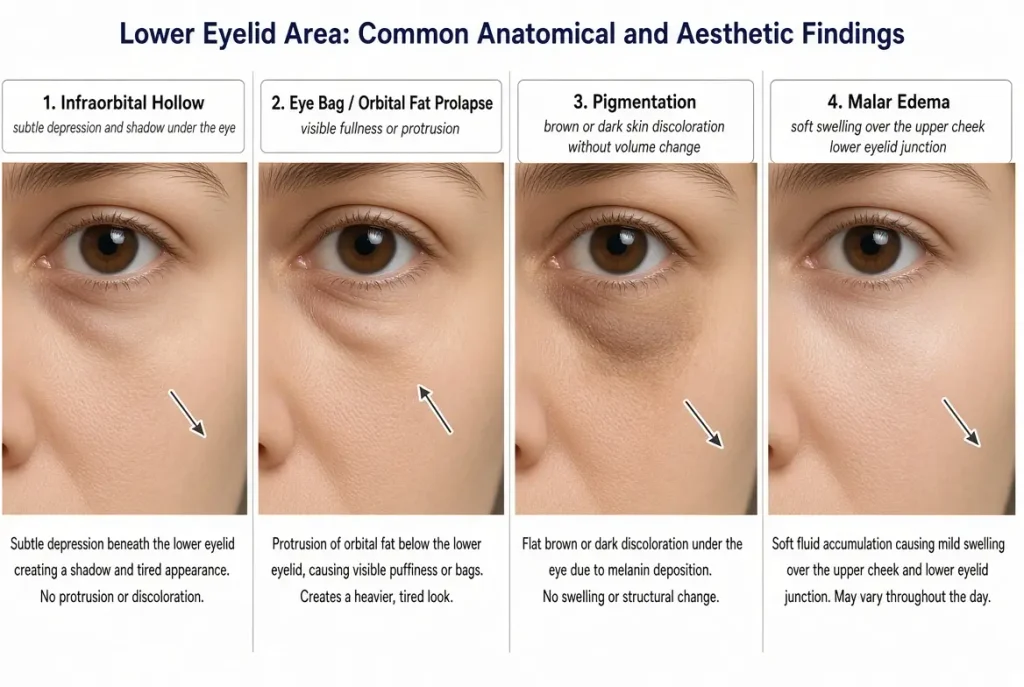
An infraorbital hollow is a depression beneath the lower eyelid that can create a shadow or tired appearance.
Tear trough depressions
The tear trough is a visible depression along the transition between the lower eyelid and cheek. Not every tear trough is identical, and the underlying anatomy should be assessed before treatment.
Shadowing caused by volume loss
Some people describe their under-eye concern as a dark circle when the darkness is primarily caused by a shadow created by a hollow.
Some types of dark circles
An FDA-approved filler for dark circles does not mean filler treats every cause of dark circles.
Filler can address a volume-related shadow, but it does not directly correct all pigmentation, vascular coloration, or skin-quality problems.
Which Under-Eye Problems May Not Be Filler Problems?
Under-eye bags caused by orbital fat
If the primary issue is protruding orbital fat, adding filler does not necessarily address the underlying cause.
Pigmentation
Brown or other pigment-related dark circles may require a completely different treatment approach.
Vascular dark circles
Bluish or reddish discoloration can have a vascular component rather than a volume-loss component.
Malar edema and festoons
Puffiness below the lower eyelid or over the upper cheek can be mistaken for an under-eye hollow.
Skin laxity
Loose lower-eyelid skin is a different anatomical problem from a simple volume deficiency.
Severe lower-eyelid changes
Some patients may require an assessment for surgical or other treatment options rather than filler.
How to Tell if You Have an Under-Eye Hollow
Before asking which filler is best for under eye, ask a more fundamental question:
What is actually causing the appearance I want to change?
Hollow vs dark circle
A hollow creates a depression and may produce darkness through shadowing.
Pigmentation can remain visible even when the skin is stretched or the lighting changes.
Hollow vs eye bag
A hollow appears as a depression.
An eye bag generally refers to visible fullness or protrusion.
A person can also have both a hollow and a bag, making diagnosis more complicated.
Hollow vs malar edema
Malar edema is swelling or fluid-related fullness around the cheek and lower-eyelid region. It should not automatically be interpreted as migrated filler or insufficient volume.
Hollow vs pigmentation
If the skin itself is discolored, adding volume may not remove the underlying pigment.
This distinction is one of the most important parts of choosing an FDA-approved under-eye filler.
Are FDA-Approved Under-Eye Fillers Safe?
FDA approval does not mean zero risk.
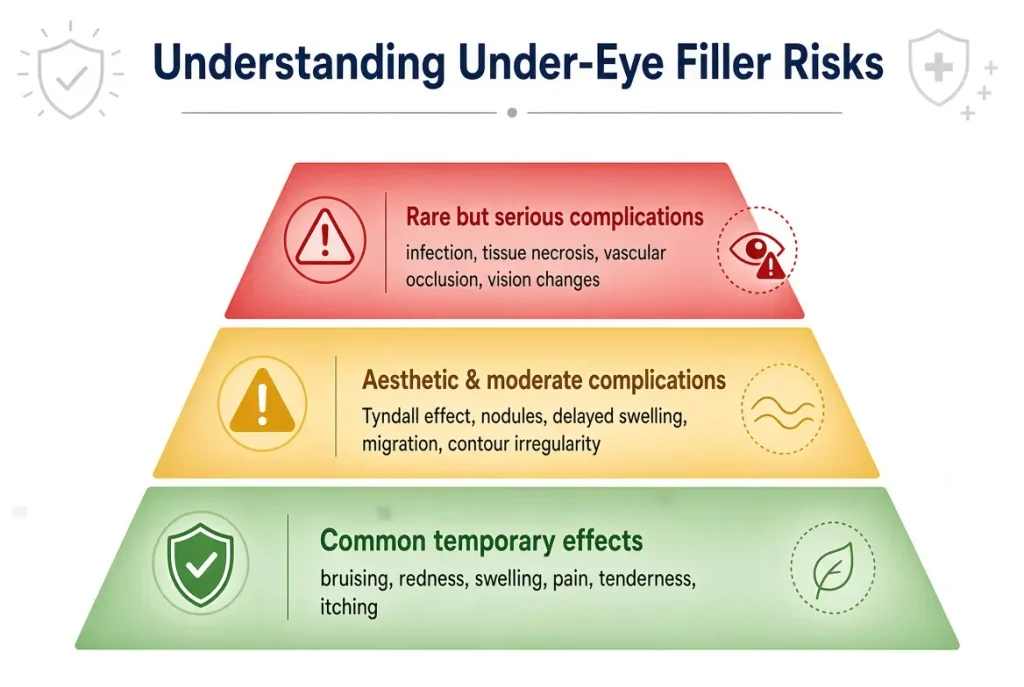
The FDA lists common dermal-filler effects such as:
- bruising;
- redness;
- swelling;
- pain;
- tenderness;
- itching;
- rash.
Less common complications include infection, nodules or granulomas, allergic reactions and tissue necrosis.
Delayed swelling
Some reactions may occur well after the initial injection. The FDA notes that certain dermal-filler side effects can develop weeks, months, or years after treatment.
Tyndall effect
A bluish discoloration can occur when some HA filler is visible through relatively thin skin. Under-eye anatomy makes this an important clinical consideration.
Filler migration
The FDA lists migration—the movement of filler material away from the injection site—as a rare reported risk of dermal fillers.
Vascular complications
The most serious concern is accidental injection into a blood vessel. The FDA states that vascular complications can result in tissue necrosis, vision abnormalities including blindness, or stroke.
When to seek urgent medical attention
New visual disturbance, severe or unusual pain, marked skin discoloration, or other sudden symptoms after filler injection require prompt medical assessment.
Can FDA-Approved Under-Eye Filler Migrate?
Yes, migration is a recognized reported risk of dermal fillers, although an apparent change in the under-eye area does not automatically prove that filler has migrated.
Persistent puffiness, delayed swelling, Tyndall effect, malar edema, contour irregularity and true filler migration can look different and require clinical assessment.
This is why a diagnosis should come before assuming that every post-treatment change represents migration.
Can FDA-Approved Under-Eye Filler Be Dissolved?
Most of the products discussed here are hyaluronic-acid fillers.
HA filler can sometimes be reduced using hyaluronidase, but dissolving filler is a medical procedure and is not appropriate for every situation.
The FDA also notes that filler removal may require injections, surgery, or other interventions, and that removing filler can itself carry risks.
If you develop persistent swelling, lumps, discoloration, pain, or another unexpected change, seek assessment rather than automatically assuming you need filler removal.
FDA-Approved Under-Eye Filler vs Off-Label Filler
| FDA-approved indication | Off-label use |
|---|---|
| Specific indication reviewed by FDA | Use outside the product’s labeled indication |
| Specific product and treatment area | Different product, area, or use |
| Evidence submitted for that indication | Evidence may come from other sources |
| FDA labeling applies | FDA labeling does not establish that particular use |
This distinction is particularly important when reading clinic websites that use phrases such as “FDA-approved filler” without specifying what the FDA actually approved the product for.
How Long Do FDA-Approved Under-Eye Fillers Last?
There is no single answer to “how long does FDA-approved under-eye filler last?”
FDA-reported information differs by product:
- JUVÉDERM VOLBELLA XC: results may last up to 12 months.
- Restylane Eyelight: results may last up to 12 months.
- Belotero Balance (+): results may last up to 48 weeks.
- RHA Redensity Eye: use the current product labeling for its specific durability information rather than applying another filler’s duration to it.
These figures describe clinical-study or labeling information and should not be treated as guarantees.
How Much Under-Eye Filler Is Needed?
There is no universal number of syringes that every patient needs.
The amount can depend on:
- severity of the hollow;
- anatomy;
- symmetry;
- skin thickness;
- existing edema;
- desired correction;
- product characteristics;
- injection technique.
One syringe also does not automatically mean one eye.
A conservative treatment plan may be appropriate in some patients because excessive volume can create unwanted puffiness or contour changes.
What Does Under-Eye Filler Cost?
The cost of an FDA-approved under-eye filler depends on the product, amount used, provider, geographic location, consultation fees and clinic pricing structure.
Searches such as Restylane under-eye filler cost therefore cannot be answered accurately with one universal number.
Before comparing prices, ask whether the quoted amount includes:
- consultation;
- product;
- injection procedure;
- follow-up;
- touch-up;
- treatment of complications if required.
The lowest advertised price does not necessarily represent the same treatment, product, quantity, or level of medical supervision as another quote.
How to Choose Between FDA-Approved Under-Eye Fillers
Instead of asking which product is universally “best,” consider:
Your type of under-eye concern
Is the problem genuinely volume loss?
Severity of the hollow
A mild depression and moderate-to-severe tissue-volume deficiency are not necessarily treated in the same way.
Skin thickness
Thin lower-eyelid skin may make certain aesthetic complications more visible.
Edema or puffiness tendency
Existing swelling should be assessed before adding volume.
Product labeling
Confirm that the intended product has an FDA indication relevant to your treatment.
Injector experience
Under-eye injection requires knowledge of facial and orbital anatomy.
Your desired outcome
A natural correction may require a different treatment strategy from a dramatic volume change.
What Should You Look for in an Under-Eye Filler Injector?
Ask about:
- experience treating the infraorbital region;
- medical qualifications;
- knowledge of lower-eyelid and facial anatomy;
- the exact filler being used;
- the product’s FDA indication;
- expected amount of filler;
- potential complications;
- emergency protocols;
- follow-up arrangements;
- management options if an unwanted reaction occurs.
The injector should also be able to explain why filler is appropriate for your particular anatomy.
How to Verify Your Under-Eye Filler Is Authentic
Before treatment:
- Confirm the exact product name.
- Ask to see the product packaging.
- Check the lot or batch information.
- Check the expiration date.
- Confirm that the product is sealed appropriately.
- Ask whether the product is FDA approved for the intended indication.
- Make sure treatment is performed by an appropriately qualified medical professional.
- Avoid purchasing dermal filler online for self-injection.
The FDA specifically warns about unapproved dermal fillers and emphasizes that the safety and effectiveness of unapproved products are not established.
FDA-Approved Under-Eye Filler vs Blepharoplasty
Filler and lower-eyelid surgery address different problems.
When filler may address volume deficiency
Filler can add volume where an under-eye hollow is the primary concern and the patient is an appropriate candidate.
When surgery may address excess skin or fat
If the dominant problem involves significant skin laxity or protruding orbital fat, a surgical consultation may be more relevant.
Why hollowing and eye bags are different
A hollow is a depression.
A bag is generally a fullness or protrusion.
Treating one does not automatically correct the other.
Questions to Ask Before Your Under-Eye Filler Treatment
Take these questions to your consultation:
- What exact filler are you using?
- Is it FDA approved for this specific under-eye indication?
- What is causing my under-eye appearance?
- Am I actually a candidate for filler?
- What injection plane are you planning to use?
- How much product do you expect to use?
- What risks apply to my anatomy?
- What is your emergency protocol?
- What happens if I develop persistent swelling?
- What happens if I am unhappy with the result?
- What treatment options are available if a complication occurs?
Frequently Asked Questions
What under-eye fillers are FDA approved?
The current FDA records identify JUVÉDERM VOLBELLA XC, Restylane Eyelight, Belotero Balance (+), and RHA Redensity Eye/RHA Redensity Eye Lido as products with specific FDA indications involving the infraorbital region.
Is Restylane FDA approved for under eyes?
Restylane Eyelight is FDA approved for improvement of infraorbital hollowing in patients over 21. It received that approval on May 8, 2023.
Is Juvéderm FDA approved for under-eye hollows?
JUVÉDERM VOLBELLA XC received an FDA indication for the infraorbital hollow in adults over 21 on May 28, 2021.
Is Belotero FDA approved for under eyes?
Yes. Belotero Balance (+) received an FDA indication for improvement of infraorbital hollowing in adults over 21 on September 27, 2023.
Is RHA Redensity Eye FDA approved?
Yes. The FDA approved RHA Redensity Eye and RHA Redensity Eye Lido for correction of moderate-to-severe tissue-volume deficiencies in the infraorbital region in adults aged 22 or older on May 12, 2026.
Is FDA-approved under-eye filler safe?
FDA approval means the product has been reviewed for its approved use; it does not mean treatment is risk-free. Dermal fillers can cause swelling, bruising, nodules, infection, necrosis and, rarely, serious vascular complications including vision loss.
Does FDA approval mean a filler is the best?
No. FDA approval establishes an approved use and provides evidence about safety and effectiveness for that indication. It does not establish that one filler is universally best for every patient.
Can FDA-approved filler treat dark circles?
It can improve the appearance of dark circles when the darkness is substantially caused by under-eye hollowing and shadowing. It will not directly correct every cause of dark circles, such as pigmentation or vascular discoloration.
Can filler fix under-eye bags?
Not necessarily. If the main issue is protruding orbital fat or another cause of lower-eyelid fullness, filler may not address the underlying problem.
Can under-eye filler migrate?
Migration is a reported risk of dermal fillers, according to the FDA. However, swelling, edema, Tyndall effect and other post-treatment changes can sometimes resemble migration, so a clinical assessment is important before assuming migration has occurred.
Can under-eye filler be dissolved?
Many under-eye fillers are hyaluronic-acid based and may be treated with hyaluronidase when clinically appropriate. However, filler removal is itself a medical intervention and should be evaluated by a qualified professional.
How long does FDA-approved under-eye filler last?
Duration depends on the product. FDA materials report up to 12 months for Volbella and Eyelight and up to 48 weeks for Belotero Balance (+); product-specific labeling should be consulted for RHA Redensity Eye.
What age can you get FDA-approved under-eye filler?
The approved age differs by product. Volbella, Eyelight and Belotero Balance (+) have under-eye indications for adults over/at least 21 depending on the product wording, while the 2026 RHA Redensity Eye indication is for adults 22 years or older.
Source check: The product-specific FDA indication records linked below were checked on September 25, 2026. This article is educational; no independent clinician review of this version has been documented. For individual treatment questions, consult a qualified licensed clinician.
Authoritative Sources
- FDA — Dermal Fillers (Soft Tissue Fillers) — FDA Dermal Fillers
- FDA — JUVÉDERM VOLBELLA XC — FDA JUVÉDERM VOLBELLA XC
- FDA — Restylane Eyelight — FDA Restylane Eyelight
- FDA Devices@FDA — Restylane Eyelight PMA — Restylane Eyelight PMA Record
- FDA — Belotero Balance (+) — FDA Belotero Balance (+)
- FDA Devices@FDA — Belotero Balance (+) PMA — Belotero Balance (+) PMA Record
- FDA Devices@FDA — RHA Redensity Eye PMA — RHA Redensity Eye PMA Record
- FDA — 2023 Device Approvals — FDA 2023 Device Approvals
- FDA — Restylane Eyelight Labeling/Training Update — Restylane Eyelight PMA Update
Priority: Use FDA and FDA PMA records as the primary citations for approval, indications, age requirements, safety, and clinical-study claims.
The Bottom Line
The phrase “FDA-approved under-eye filler” should always be interpreted precisely.
The relevant question isn’t simply whether a brand is FDA approved. It is:
Is this specific filler FDA approved for this specific under-eye indication, and is that indication appropriate for my anatomy?
As of 2026, the FDA-approved infraorbital landscape includes JUVÉDERM VOLBELLA XC, Restylane Eyelight, Belotero Balance (+), and RHA Redensity Eye/RHA Redensity Eye Lido.
Before treatment, identify the actual cause of your under-eye concern, verify the product and its indication, discuss the risks, and have the treatment performed by an appropriately qualified medical professional.

Sarah Mitchell is the founder and research editor of Under Eyes Filler, an independent patient-education resource. She is a researcher and writer, not a licensed medical professional. Her work is to read clinical studies and official FDA and ASPS guidance, then translate them into clear, honest explanations of under-eye filler results, recovery, risks, and realistic costs, so readers can prepare better questions for their own qualified provider.