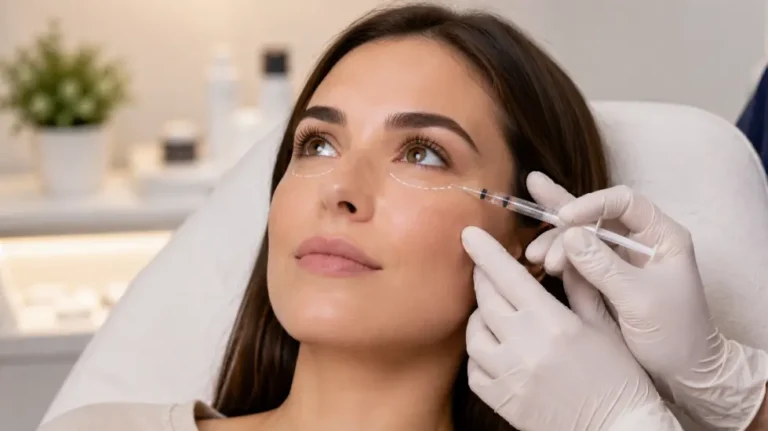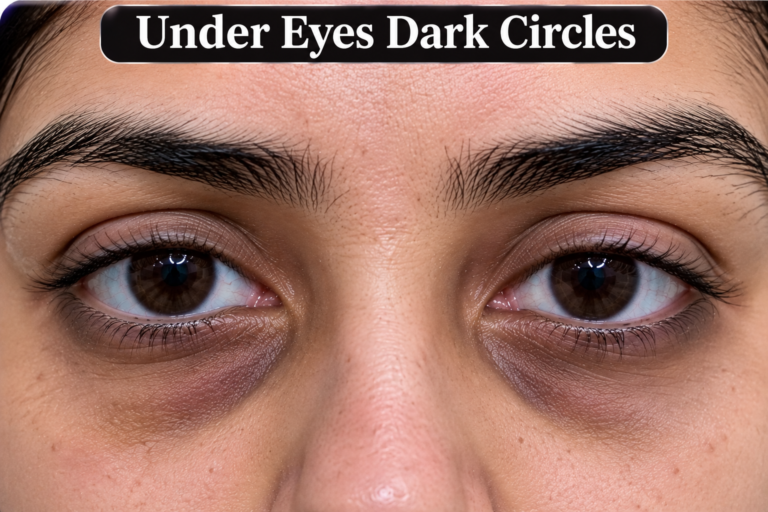
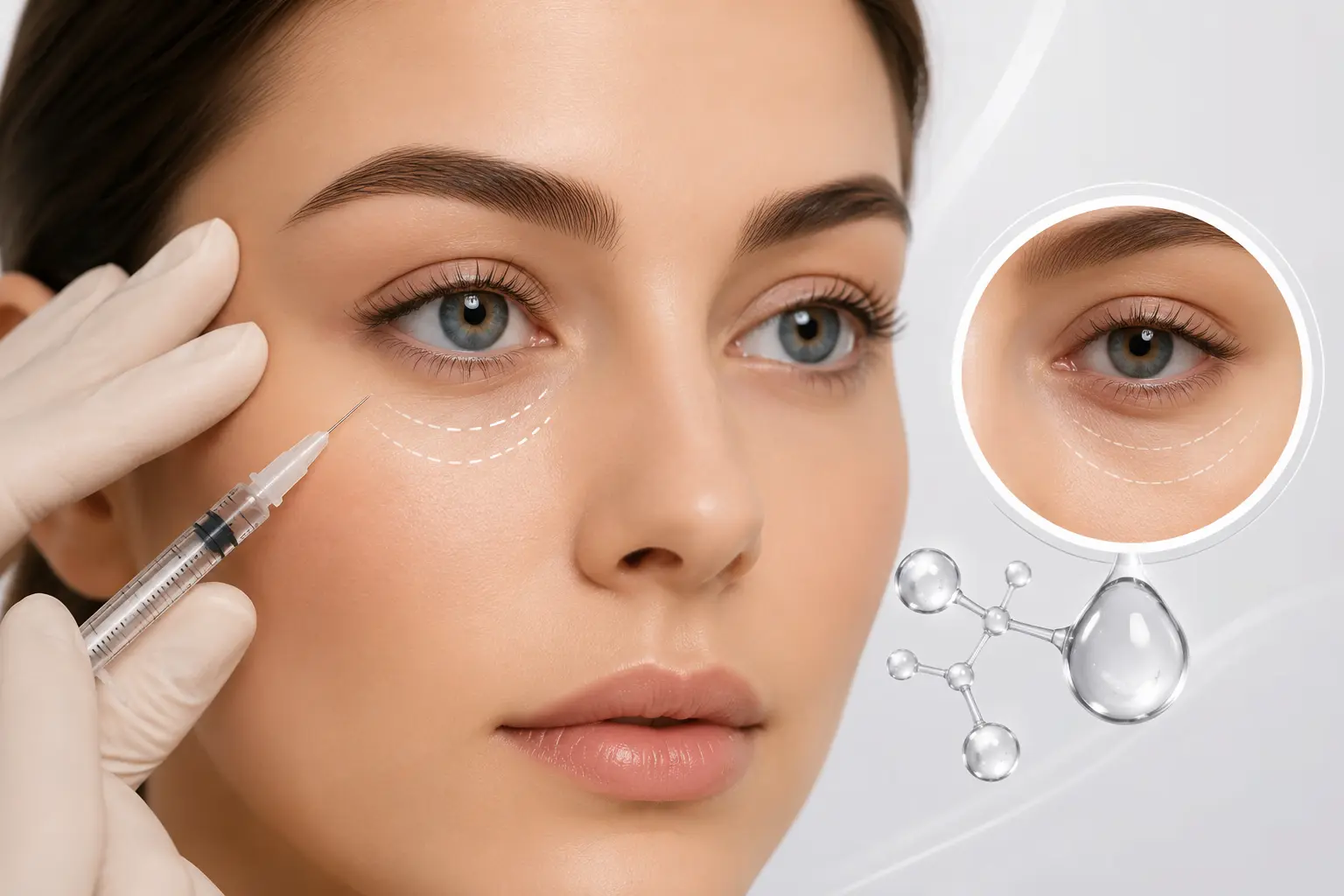
If you’re looking for the best filler for under eyes, you’ve probably noticed that not every filler works the same way in this area and that’s exactly why so many people end up disappointed with results. The skin under the eyes is thinner and more delicate than almost anywhere else on the face, which means the best filler for under eyes isn’t automatically the same product that works well for lips or cheeks. Choosing wrong here can lead to puffiness, a bluish discoloration, or lumps that are hard to reverse.
This guide breaks down exactly what makes a filler the best under eyes, which specific products dermatologists and injectors actually recommend, how much they cost, how long they last, and who should avoid under-eye filler altogether.
What Makes a Filler the Best Filler for Under Eyes?
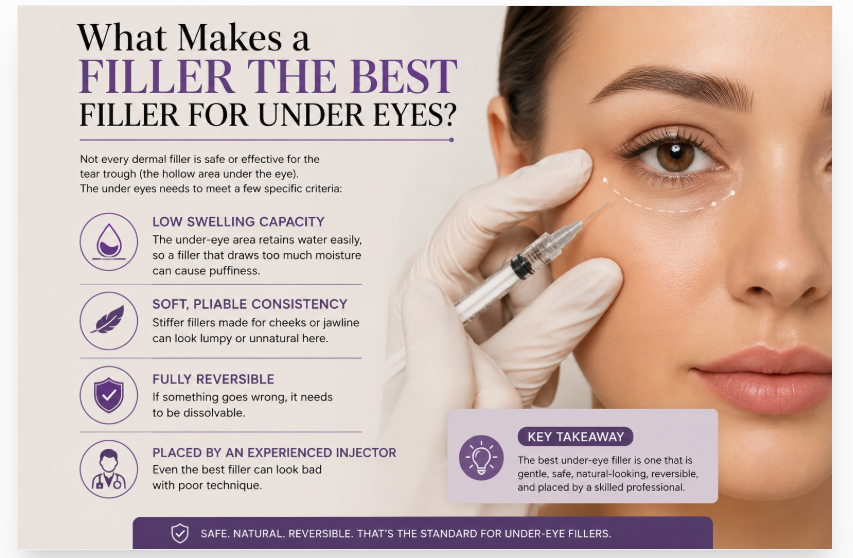
There is no single filler that is automatically best for every under-eye. The appropriate product depends on the anatomy being treated, the depth and location of the hollowing, skin thickness, existing puffiness or bags, previous filler, treatment goals, and the injector’s assessment.
The infraorbital area is particularly challenging because the skin is thin, the underlying tissues are compartmentalized, and important blood vessels and lymphatic structures are nearby. Small differences in filler placement or volume can therefore become visible.
When considering an under-eye filler, an injector may evaluate several characteristics:
- Consistency and flexibility: The filler should be appropriate for the delicate tissue and desired degree of correction.
- Water interaction: Some hyaluronic acid formulations can contribute to swelling or prolonged edema in susceptible patients.
- Placement characteristics: The product needs to behave predictably at the depth and location where the injector intends to place it.
- Reversibility: With hyaluronic acid fillers, hyaluronidase can be used to break down the HA when clinically indicated.
- Clinical indication: A product specifically approved for infraorbital hollowing has a different regulatory status from a filler being used elsewhere on the face and applied off-label.
Importantly, the product is only one part of the decision. Patient selection, anatomy, injection technique, and the experience of the treating clinician can all influence the outcome. Clinical reviews emphasize individualized assessment because some patients with prominent fat pads, malar edema, significant skin laxity, or other structural concerns may be better candidates for a different approach rather than tear-trough filler alone.
Top Contenders for Best Filler for Under Eyes
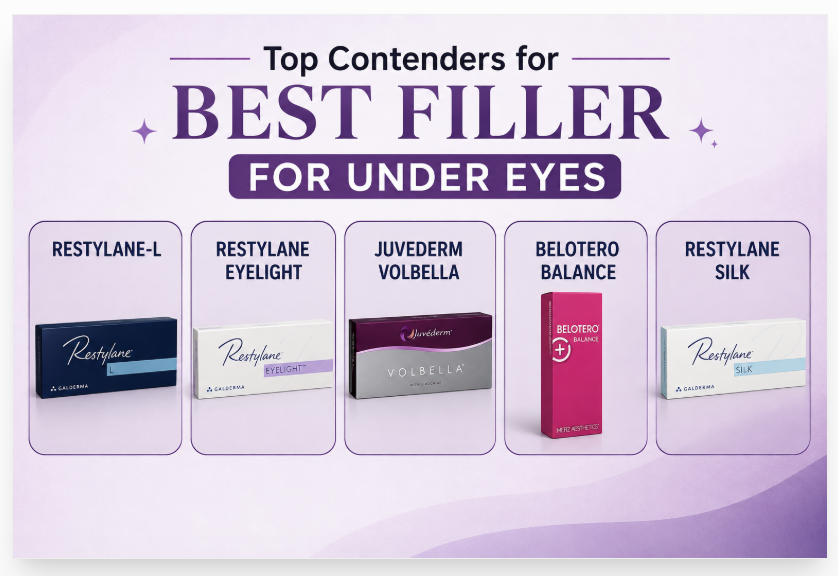
Here’s a breakdown of the products most frequently recommended as the best under eyes by board-certified dermatologists and oculoplastic surgeons.
In the United States, two hyaluronic acid fillers currently have FDA approval specifically for improvement of infraorbital hollowing in adults age 21 and older:
- Restylane Eyelight
- JUVÉDERM VOLBELLA XC
This does not mean that either product is universally “the best.” FDA approval establishes that the product has been evaluated for a particular intended use and meets the applicable regulatory requirements. It does not mean that every patient is a candidate for that product or that one approved product is superior to the other for every anatomy.
Restylane Eyelight
Restylane Eyelight received FDA approval in May 2023 for improvement of infraorbital hollowing in patients over age 21. It is a hyaluronic acid gel containing 0.3% lidocaine. The FDA’s clinical information reports that patients in the pivotal study could receive one or two treatments, with results reported as lasting up to 12 months.
The important point is that Restylane Eyelight is specifically indicated for infraorbital hollowing. That makes its regulatory status different from fillers that may be used in the under-eye area off-label.
However, FDA approval does not mean that Eyelight is appropriate for every person with dark circles or under-eye bags. An injector still needs to determine whether the primary problem is true hollowing, pigmentation, skin laxity, prominent fat pads, edema, or a combination of these concerns.
JUVÉDERM VOLBELLA XC
JUVÉDERM VOLBELLA XC received FDA approval in May 2021 for improvement of infraorbital hollowing in adults over age 21. It is a crosslinked hyaluronic acid gel formulated with 0.3% lidocaine.
The FDA reports that the clinical study evaluated VOLBELLA XC for infraorbital hollowing and that results may last up to 12 months. Patients may require one or two treatments depending on the desired correction.
As with Restylane Eyelight, FDA approval for infraorbital hollowing does not establish VOLBELLA XC as universally superior. The appropriate choice still depends on the patient’s anatomy, skin characteristics, treatment goals, and the clinician’s assessment.
- Restylane Eyelight – A newer product specifically designed for the tear trough, making it one of the most targeted options when searching for the best filler for under eyes for genuine hollowing.
- Juvederm Volbella – A thinner, softer gel that’s a popular choice for subtle correction. It tends to attract slightly more water than Restylane-L, so it’s used carefully in patients prone to puffiness.
- Belotero Balance – Known for integrating smoothly into thin skin with a lower risk of visible discoloration (the Tyndall effect), though it offers less lift than Restylane-L or Volbella.
- Restylane Silk – The thinnest, softest Restylane formulation, but it has a higher swelling tendency, which can make it less ideal for very thin under-eye skin.
Most providers agree there isn’t one universal best filler for under eyes — the right choice depends on skin thickness, the depth of hollowing, and whether puffiness or bags are already present.
Table 1: Best Filler for Under Eyes Product Comparison
| Filler | Consistency | Swelling Risk | Typical Duration | Best For |
|---|---|---|---|---|
| Restylane-L | Firm, moldable | Low | ~12 months | First-time patients, deeper hollows |
| Restylane Eyelight | Soft, targeted | Low | 9–12 months | Genuine tear trough hollowing |
| Juvederm Volbella | Thin, soft | Moderate | 9–12 months | Subtle, superficial correction |
| Belotero Balance | Very soft | Low-moderate | 6–9 months | Fine lines, minimal lift needed |
| Restylane Silk | Thinnest | Higher | 6–9 months | Very fine surface-level correction |
| Filler | U.S. FDA status for infraorbital hollowing | What to know |
|---|---|---|
| Restylane Eyelight | FDA-approved | Specifically indicated for improvement of infraorbital hollowing in adults 21+ |
| JUVÉDERM VOLBELLA XC | FDA-approved | Specifically indicated for improvement of infraorbital hollowing in adults 21+ |
| Other HA fillers | May be off-label for this indication | Selection depends on the clinician’s assessment, product characteristics, and patient anatomy |
| Other filler categories | Varies by product and indication | Should not be treated as interchangeable with FDA-approved infraorbital products |
Why Hyaluronic Acid Is the Top Filler for Under Eyes (And What to Avoid)
Almost every credible source agrees the best filler for under eyes is a cross-linked hyaluronic acid gel, and for good reason:
- HA is naturally found in the body, so allergic reactions are rare
- It can be dissolved instantly with hyaluronidase if something looks wrong
- It integrates smoothly into thin, delicate skin
On the other hand, certain fillers should be avoided in this area entirely, no matter how they’re marketed:
- Calcium hydroxylapatite (Radiesse) – Too stiff for the thin under-eye skin, can create a rough or lumpy texture
- Poly-L-lactic acid (Sculptra) – Stimulates collagen over time but isn’t precise enough or reversible for this delicate zone
- Permanent or semi-permanent fillers (like silicone) – Cannot be removed if complications occur, making them a poor and risky choice despite claims of being the best filler for under eyes for longevity
If you ever see permanent fillers marketed as the best under eyes, treat that as a red flag rather than a selling point.
How Much Does the Best Filler for Under Eyes Cost?
Pricing for the under eyes varies by provider, location, and product, but general ranges look like this:
- Per syringe: $600–$1,200
- Typical amount needed: 0.5 to 1.5 syringes per session
- Total session cost: Often $800–$1,800 depending on the extent of correction needed
Cheaper options exist, but going for the lowest price rather than an experienced, board-certified injector is one of the most common reasons people end up unhappy even after using what’s technically the best filler for under eyes on paper.
How Long Does the Best Filler for Under Eyes Last?
Most patients can expect results from the best filler for under eyes to last:
- 6 to 12 months for most HA fillers in this area
- Up to 18 months in some patients with slower metabolism and proper aftercare
- Results typically fade gradually rather than disappearing suddenly, so touch-ups are usually done before the effect is fully gone
Table 2: Top Filler for Under Eyes Cost & Longevity Summary
| Filler | Avg. Cost per Syringe | Duration |
|---|---|---|
| Restylane-L | $650–$900 | ~12 months |
| Restylane Eyelight | $700–$950 | 9–12 months |
| Juvederm Volbella | $600–$850 | 9–12 months |
| Belotero Balance | $600–$800 | 6–9 months |
| Restylane Silk | $600–$800 | 6–9 months |
Which Filler Is Best for Under Eyes?
There is no universal number-one filler for everyone.
Which filler is best depends on anatomy, treatment goals, previous filler, skin characteristics, the presence or absence of puffiness or fat pads, and the injector’s assessment.
Restylane Eyelight and JUVÉDERM VOLBELLA XC are both FDA-approved specifically for improvement of infraorbital hollowing in adults 21 and older. That regulatory distinction is useful when comparing products, but FDA approval does not mean one product is automatically superior for every patient.
Other fillers may be used off-label in selected circumstances, but the clinician should be able to explain the reasoning behind that choice.
For under-eye filler, the most important question is therefore not simply “Which brand is best?” It is:
“Which treatment is appropriate for my anatomy, and why?”
Who Should Avoid Under-Eye Filler?
Even the best filler for under eyes isn’t right for everyone. You may be a poor candidate if you have:
- Significant puffiness or visible under-eye bags (filler can worsen this)
- Loose, crepey skin with poor elasticity
- Dark circles caused by pigmentation rather than hollowing (filler won’t fix this)
- A history of allergic reactions to HA products
- Active skin infections near the treatment area
In these cases, alternative treatments like skin tightening, pigment-targeted skincare, or blepharoplasty (eyelid surgery) may be more effective than even the best filler for under eyes.
Risks and Side Effects to Know Before Choosing
No matter which product you pick, understanding the risks is part of finding the best under eyes safely:
- Bruising and swelling – Common in the first few days
- Tyndall effect – A bluish tint if filler is placed too superficially
- Lumps or bumps – More common with stiffer fillers or inexperienced injectors
- Infection – Rare, but possible with any injectable
- Migration – Filler shifting slightly from the injection site over time
Choosing the under best is only half the equation — the other half is choosing a qualified, experienced injector who understands facial anatomy in this specific area.
Why an Injector May Choose One Product Over Another
Two patients with similar-looking tear troughs may not receive the same filler.
An injector may consider:
- The depth and shape of the hollow
- Whether the hollow extends toward the cheek
- Skin thickness
- Existing puffiness or malar edema
- Prominent lower-eyelid fat pads
- Previous filler treatments
- Previous reactions to filler
- How much correction is needed
- Whether a subtle or more substantial change is desired
- The injector’s experience with a particular product
- Whether the filler can be dissolved if necessary
The goal should not be to find the filler with the best marketing claims. The goal is to select a product and treatment plan that fit the patient’s anatomy and risk profile.
Filler Characteristics That Matter
When comparing under-eye fillers, looking only at the brand name can be misleading. Several physical and clinical characteristics may matter more.
Gel Consistency
The filler needs to integrate appropriately with the tissue in which it is placed. A product that works well for adding structure in another facial area may not behave the same way in thin lower-eyelid tissue.
Degree of Cross-Linking and Gel Properties
Hyaluronic acid fillers are manufactured with different physical properties. Their behavior can vary in terms of cohesivity, elasticity, firmness, water interaction, and integration with surrounding tissue.
These differences are one reason products should not be treated as interchangeable simply because they all contain hyaluronic acid.
Water Interaction
Hyaluronic acid is hydrophilic, meaning it interacts with water. The amount of swelling or fluid retention following treatment can vary between products and between patients.
This is particularly relevant beneath the eyes because the area has delicate lymphatic drainage and limited soft-tissue space.
Reversibility
Hyaluronic acid fillers can generally be degraded using hyaluronidase when a clinician determines that dissolution is appropriate.
This is an important consideration when treating an anatomically sensitive area, although “reversible” should not be interpreted as meaning that every complication can be instantly or completely corrected.
Thin Skin and the Tyndall Effect
The lower-eyelid skin is thin and relatively translucent. When hyaluronic acid filler is placed too superficially, the treated area can sometimes develop a blue or blue-gray appearance.
This is commonly referred to as the Tyndall effect. Medical literature has documented blue discoloration after infraorbital HA filler and notes that it can sometimes become apparent weeks, months, or even years after treatment.
The exact mechanism of the discoloration has been debated in the literature, so it is more accurate to describe it as a blue-gray discoloration associated with superficially placed HA rather than suggesting that the optical explanation is completely settled.
The risk reinforces why injection depth and anatomy matter in the under-eye area.
Swelling and Water Attraction
Swelling is one of the most common issues associated with infraorbital filler.
Some swelling immediately after treatment is expected. More persistent swelling is different. Published reviews describe persistent edema lasting more than four weeks and late edema that can appear months or even years after treatment.
The anatomy of the lower eyelid and cheek can contribute to fluid accumulation. Existing malar mounds, skin laxity, prominent fat pads, allergies, rosacea, and a tendency toward periorbital fluid retention may also influence the risk.
The water-attracting properties of hyaluronic acid can be relevant because the filler may contribute to fluid retention in an area where lymphatic drainage is already limited.
For this reason, someone with significant pre-existing under-eye puffiness may not be an ideal candidate for tear-trough filler.
Is Under-Eye Filler Reversible?
One of the advantages of hyaluronic acid filler is that it can be treated with hyaluronidase, an enzyme that breaks down hyaluronic acid.
This can be useful when a patient develops an unwanted result such as persistent fullness, a visible lump, or certain filler-related complications.
However, reversibility does not mean that every problem disappears immediately or that treatment with hyaluronidase is always straightforward. Some complications may require more than one treatment, and the clinician first needs to determine what is actually causing the problem.
Importantly, hyaluronidase is not a substitute for appropriate emergency management of every complication. Suspected vascular compromise or vision loss requires urgent medical assessment.
Questions to Ask Your Injector
Before having under-eye filler, consider asking:
- Am I actually a good candidate for tear-trough filler?
- Is my concern caused by hollowing, pigmentation, puffiness, fat pads, skin laxity, or a combination?
- Which filler are you recommending, and is it FDA-approved specifically for infraorbital hollowing?
- If you are recommending an off-label product, why is it appropriate for me?
- Why did you choose this filler instead of another option?
- How much filler do you expect to use?
- What are the risks of swelling, lumps, asymmetry, and Tyndall-like discoloration in my anatomy?
- What happens if I develop persistent swelling or an unwanted result?
- Do you have hyaluronidase available if it is needed?
- What is your emergency protocol for suspected vascular occlusion or vision changes?
- What alternatives would you recommend if filler is not appropriate for me?
- How often do you perform infraorbital filler treatments?
A good consultation should involve more than choosing a brand from a menu. The clinician should assess the anatomy around the eyes and explain why a particular treatment is appropriate—or why filler may not be the best option.
| ✓ MEDICALLY REVIEWED |
| Medically reviewed by Dr. J. Harper, MD, FAAD Board-certified Dermatologist with 12 years of experience in facial aesthetics and injectable treatments, including specialist focus on Periorbital rejuvenation and tear trough correction. Medical review: [20th August -2024] | Last updated: [10th September-2026] |
Frequently Asked Questions
Q1: What is generally considered the best filler for under eyes?
Restylane-L is the most frequently recommended product for its balance of lift, softness, and low swelling risk, though the under eyes ultimately depends on individual skin thickness and the depth of hollowing.
Q2: Is the best under eyes painful?
Most patients report mild discomfort rather than significant pain, since providers typically use topical numbing cream and fillers often contain built-in local anesthetic (lidocaine) to minimize sensation during injection.
Q3: Can the best filler for under eyes be reversed if I don’t like the results?
Yes hyaluronic acid fillers, which make up nearly all of the under eyes options, can be dissolved with an enzyme injection (hyaluronidase) within minutes if the result isn’t right.
Q4: How soon will I see results from the best under eyes?
Results are usually visible immediately after injection, though initial swelling can temporarily mask the final look. The true result typically settles within 1–2 weeks.
Final Thoughts
There’s no single under eyes that works for every face the right choice depends on your anatomy, skin thickness, and the specific issue you’re trying to correct. Hyaluronic acid options like Restylane-L, Restylane Eyelight, Juvederm Volbella, and Belotero Balance consistently come up as the best under eyes because they’re safe, reversible, and gentle enough for thin skin. The final result, though, depends just as much on choosing an experienced, board-certified injector as it does on the product itself.
This article is for general information only and isn’t a substitute for professional medical advice. Consult a board-certified dermatologist or plastic surgeon before undergoing any cosmetic filler treatment.

Sarah Mitchell is the founder and research editor of Under Eyes Filler, an independent patient-education resource. She is a researcher and writer, not a licensed medical professional. Her work is to read clinical studies and official FDA and ASPS guidance, then translate them into clear, honest explanations of under-eye filler results, recovery, risks, and realistic costs, so readers can prepare better questions for their own qualified provider.