Medically reviewed • Evidence-led under-eye filler education • Updated October 2026
Under Eye Fillers for Dark Circles & Hollowness: Do They Works, Benefits & What They Can’t Fix25 min read
Under-eye fillers, also known as tear trough fillers, use hyaluronic acid gel to restore lost volume beneath the eyes, soften hollows, and reduce the appearance of dark shadows. Under eye fillers (tear trough filler) improves dark circles that come from hollows and volume loss casting shadows, but it has no effect on hyperpigmentation or actual dark discoloration of the skin.
Under eye fillers for dark circles works only when a hollow is causing the shadow. Hyaluronic acid (HA) filler restores lost volume in the tear trough, which softens the shadow and can make the area look brighter. It does not remove pigment, visible blood vessels, fat bags or loose skin.
FDA-approved HA fillers such as Restylane Eyelight and JUVÉDERM VOLBELLA XC are labeled for infraorbital hollowing in adults over 21, with results that may last up to 12 months. The first step is working out which type of dark circle you have.
Medically reviewed by Dr. J. Harper, MD, FAAD Board-certified Dermatologist with 12 years of experience in facial aesthetics and injectable treatments, including specialist focus on complication risks, warning signs, diagnosis and treatment considerations.
This educational content was prepared in association with Bascom Palmer Eye Institute and with clinical input from Dr. Emily R. Carter, MD, FACS, Consultant Ophthalmic and Oculoplastic Surgeon.
Medical review: [20th August -2024] | Last updated: [10th September-2026]
Under-eye fillers for dark circles at a glance (updated for 2026)
| Question | Answer |
|---|---|
| Works best for | Hollow-related shadows: a groove along the tear trough with mild-to-moderate volume loss |
| Will not fix | Brown pigment, blue vessels, fat bags, festoons, loose skin |
| FDA-approved HA fillers for under the eyes | Restylane Eyelight (FDA approval May 2023), JUVÉDERM VOLBELLA XC (May 2021), Belotero Balance (+) (announced 2023), RHA Redensity Eye (announced 2026) |
| How long it lasts | Up to 12 months per FDA labeling of Eyelight and VOLBELLA XC; most people see about 9 to 12 months |
| When to judge the result | 2 to 4 weeks, after swelling settles |
| Reversible? | HA can be broken down with hyaluronidase, though removal has not been formally studied |
| Most common mistake | Treating pigment or a fat bag as if it were a hollow |
| Get emergency care for | Vision changes, severe pain, white or blotchy skin, stroke-like symptoms |
The 3-signal check: Light · Groove · Color. It takes one minute and two photos, one in overhead light and one with flash.
| Signal | What to look for | Points toward a good filler fit if… |
|---|---|---|
| Light | Compare the overhead-light photo with the flash photo | The darkness fades under flash |
| Groove | Look from the side | A concave line runs from the inner eye toward the cheek |
| Color | Check in every lighting | No brown, blue or purple tint remains |
Reading your result:
- All three match: a good reason to ask a qualified clinician about filler.
- Light and Groove match, but Color stays: a mixed type. Filler may soften the hollow, but the tint will remain.
- Only Color shows up: filler is unlikely to help, so ask about skin-directed care.
- A soft bulge sits above the groove: ask about fat bags before any filler, because added volume can make a bag look heavier.
Can Under-Eye Filler Really Help With Dark Circles
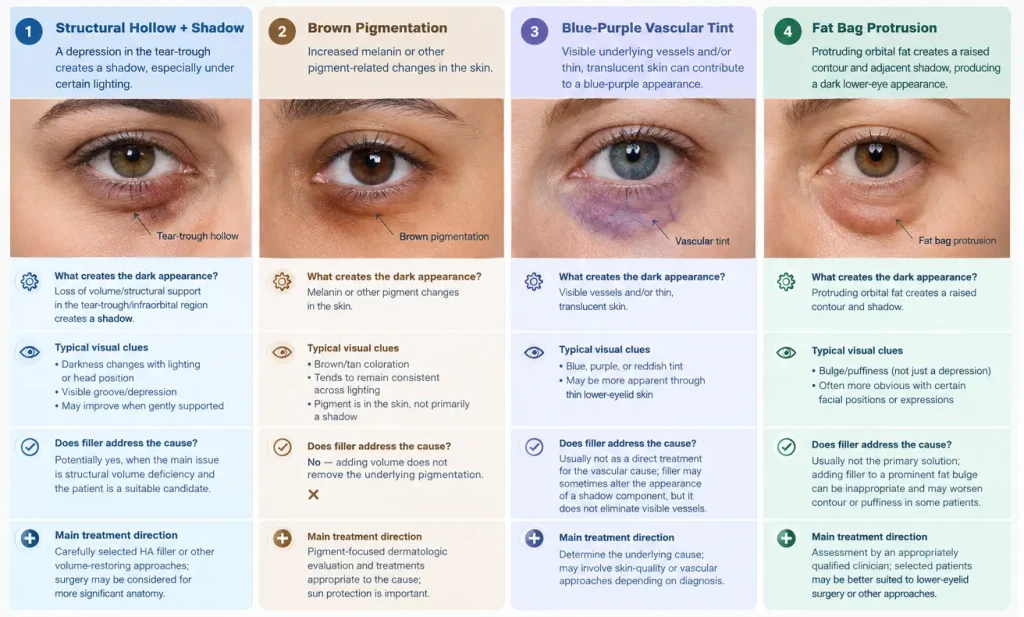
Under-eye filler can improve dark circles when the main cause is a tear-trough hollow that creates a shadow, but it does not treat every type of under-eye discoloration. Hyaluronic acid (HA) filler adds volume beneath the skin, which may soften the depression between the lower eyelid and cheek and make the area appear smoother or brighter.
However, dark circles may also result from brown pigmentation, visible blood vessels beneath thin skin, under-eye bags, puffiness, or a combination of factors. These concerns may need different treatments. The first step is to identify the main cause rather than assume that every dark circle needs an injection.
- What filler actually changes: a clinician places small amounts of HA dermal filler into the infraorbital hollow to replace lost volume.
- Why hollowing creates darkness: a groove along the tear trough catches light and casts a shadow that looks like a dark circle.
- Why filler cannot remove pigmentation: melanin sits in the skin. Filler sits beneath it and does not change its color.
- Why diagnosis matters: the same dark circle can come from a hollow, pigment, visible vessels, a fat bag or a mix. Only one of those is a direct filler target.
The one-table diagnostic
| What you see | More likely contributor | Does filler directly treat it? |
|---|---|---|
| A groove that creates a shadow | Structural hollow | Often |
| Brown discoloration | Pigmentation | No |
| Blue or purple appearance | Visible vessels or thin skin | Not directly |
| A puffy bulge | Fat, edema or bags | Usually not |
| Darkness that changes with lighting | Structural shadow | Potentially |
| Darkness that stays when lighting changes | Pigment or vascular | Usually not |
| Hollow plus pigment | Mixed | Only the hollow part |
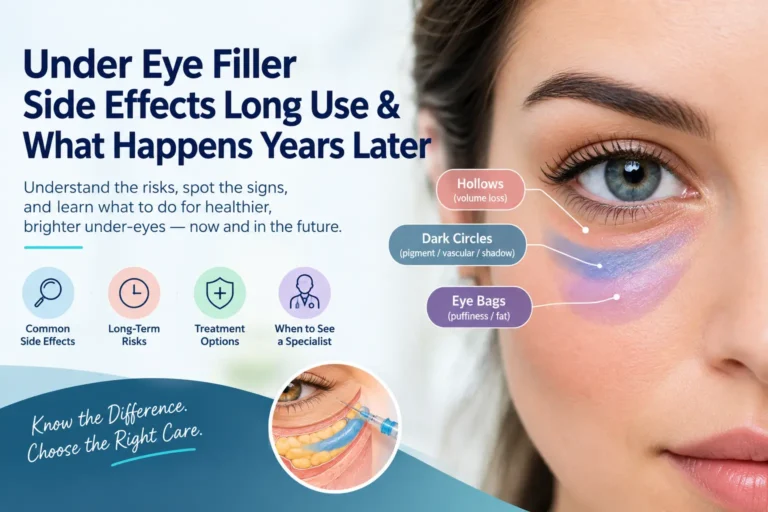
Why Do You Have Dark Circles?
Structural hollowing and tear-trough shadows
Facial aging, genetics and bone structure all play a part. Fat redistribution and volume loss deepen the tear trough (also called the nasojugal groove) at the lid-cheek junction. The orbital retaining ligament (also called the orbicularis retaining ligament) anchors skin to bone there, and as the midface, upper cheek, malar area and malar fat pad lose support, the groove shows. The shape of the maxilla, cheekbone and orbital rim also changes how pronounced it looks, which is why some people have hollows in their twenties.
Brown or hyperpigmented dark circles
Excess melanin from sun exposure, genetics, allergies and eye rubbing creates a brown tint that looks the same in every light. Post-inflammatory hyperpigmentation can follow irritation or bruising, especially in deeper skin tones.
Blue or purple vascular dark circles
The lower eyelid skin is very thin. The orbicularis oculi muscle and visible blood vessels show through, creating a blue or purple cast. Vascular prominence can look worse with sleep deprivation, though the underlying cause is structural.
Thin translucent under-eye skin
Skin thinning, collagen loss and elastin loss make skin more translucent. Whatever lies beneath shows more. Very thin skin also raises the risk of a bluish tint if filler is placed too superficially.
Under-eye bags and fat protrusion
When under-eye fat pushes forward, the bulge casts its own shadow below it. That is a bag, not a hollow, and adding volume can make it look heavier.
Puffiness, edema and fluid retention
Fluid retention from allergies, dehydration or salt can swell the area, often worst in the morning. Persistent cheek-side swelling (malar edema or festoons) is a different problem again.
Mixed dark circles
Many people have more than one cause at once. Three illustrative scenarios (composites, not patient cases):
- Hollow plus pigment: filler may soften the groove, but the brown tint remains.
- Hollow plus thin skin plus puffiness: careful assessment is needed, because swelling can mask the true hollow.
- Bag plus vascular tint: surgery or skin treatment may fit better than filler.
One person can have several causes, so one treatment may not solve the whole appearance.
How to Tell Whether Your Dark Circles Are Caused by Hollowness
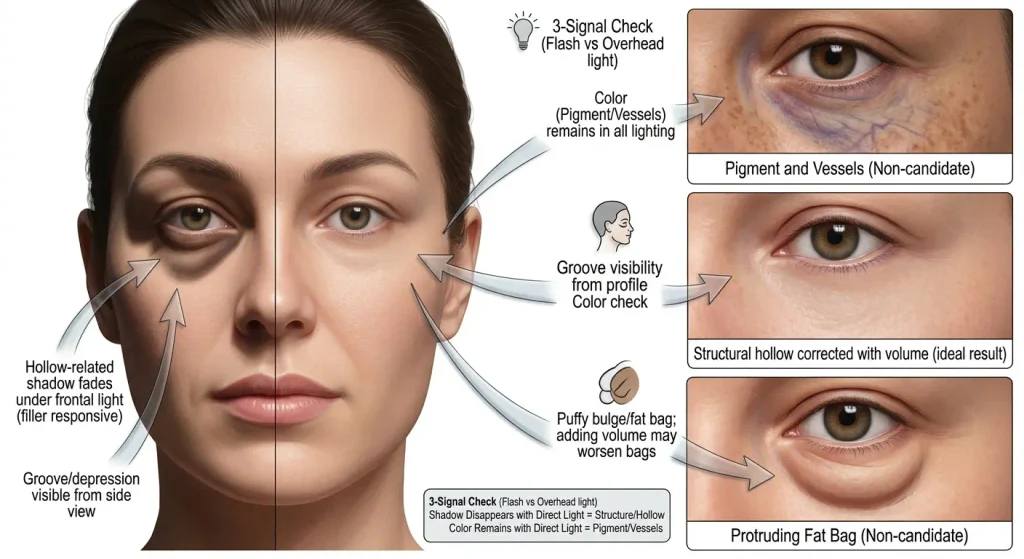
Try these checks in good light, ideally with photos so you can compare.
Does the darkness change with lighting?
Take one photo under overhead light and one with flash or straight-on light. A review in the Journal of Cutaneous and Aesthetic Surgery notes that tear-trough circles can be confirmed because they largely disappear under flash. If most of the darkness fades, a hollow is likely.
Is there a visible groove or depression?
Look from the side. A concave line running from the inner eye toward the cheek points to a tear trough hollow.
Does the color remain when the skin is gently repositioned?
Gently stretch or reposition the skin. Color that stays suggests pigment or vessels. Shadow that lifts suggests structure.
Is there brown pigmentation?
A brown tint across the lid and cheek, in every light, points to melanin.
Is there blue or purple discoloration?
A cooler tone, often with thin or translucent skin, suggests vessels showing through.
Is there a visible bulge or puffiness?
A soft mound above the groove suggests a fat bag or edema.
This self-check can help you understand possible contributors but cannot diagnose an individual condition. A qualified clinician should assess you in person.
When Under-Eye Filler Is Most Likely to Help
Tear-trough hollowing
A clear groove from the inner eye, with shadow that softens in direct light, is the classic target.
Structural shadowing
Darkness that fades with lighting is more likely to respond, because the cause is shadow, not color.
Mild-to-moderate volume loss
Subtle to moderate depression suits conservative HA filler better than severe deflation.
Under-eye contour transition problems
A harsh step between the lower lid and cheek can be smoothed. This answers the common question, what type of dark circles can filler treat? Hollow-related ones.
When Under-Eye Filler Won’t Fix Dark Circles
Pure pigmentation
Filler does not remove melanin. Pigment needs skin-directed care.
Prominent visible blood vessels
A blue or purple tint from vessels is not directly treated by volume.
Significant eye bags
Filler can emphasize a protruding fat pad.
Malar bags or festoons
Cheek-side swelling involves fluid and tissue changes. A review on tear-trough technique cautions against filler where festooning or fluid retention is present, since HA attracts water.
Significant skin laxity
Loose, crepey skin needs tightening, resurfacing or surgery, not volume.
Dark circles caused by multiple factors
Filler addresses only the hollow portion, so results may look partial.
Best Treatments for Under-Eye Dark Circles: Match the Treatment to the Cause
There is no single best treatment for every person with dark circles. The most appropriate option depends on whether the main issue is structural hollowing, pigmentation, vascular visibility, puffiness, fat protrusion, or loose skin.
| Main cause | Treatment direction | Is filler the main solution? |
|---|---|---|
| Structural hollowing and shadow | Assessment for tear-trough filler or other volume-restoring options | Potentially. Appropriate for carefully selected patients |
| Brown pigmentation | Sun protection and dermatologist-guided pigment-focused skincare or procedures | No. Filler does not remove melanin |
| Blue-purple vascular appearance | Assessment of skin thickness and vascular contribution; selected skin-directed or vascular treatments where appropriate | Usually not directly. Filler does not eliminate visible blood vessels |
| Prominent fat bags | Assessment for lower-eyelid surgery or other appropriate options | Usually not. Additional volume may worsen the contour in some patients |
| Festoons or persistent puffiness | Assessment of the cause and suitable management options | Often unsuitable without careful assessment. Filler may increase fullness |
| Significant skin laxity | Assessment for skin-directed procedures or surgery, depending on severity | Not usually as a standalone treatment |
| Mixed causes | Individualized combination of treatments, if appropriate | Sometimes, when a structural hollow is one of the causes |
A procedure that improves one component may leave another unchanged. For example, treating a tear-trough hollow may soften a shadow but will not necessarily correct brown pigmentation or prominent under-eye bags. An in-person assessment is needed to determine which treatment, if any, is appropriate.
What Procedure Gets Rid of Dark Circles?
There is no single procedure that reliably removes every type of dark circle. Treatment should be selected according to the cause:
- Hollows and structural shadows: selected patients may benefit from tear-trough filler or another volume-restoring approach.
- Pigmentation: a dermatologist may recommend sun protection, appropriate skincare, or selected pigment-directed procedures.
- Visible vessels or thin skin: assessment can help determine whether a skin-directed or vascular approach is suitable.
- Prominent fat bags or substantial lower-eyelid laxity: a consultation with a qualified oculoplastic or plastic surgeon may help determine whether lower blepharoplasty or another surgical option is appropriate.
- Mixed causes: a combination of approaches may be considered, with realistic expectations for each component.
Lower blepharoplasty may improve the appearance of under-eye bags or excess tissue in selected patients. It is not a universal treatment for dark circles, and it does not necessarily correct pigmentation or vascular discoloration.
The best next step is a professional assessment of the under-eye area, not automatically choosing an injection or surgery based on the appearance of darkness alone.
What Does Under-Eye Filler Actually Do?
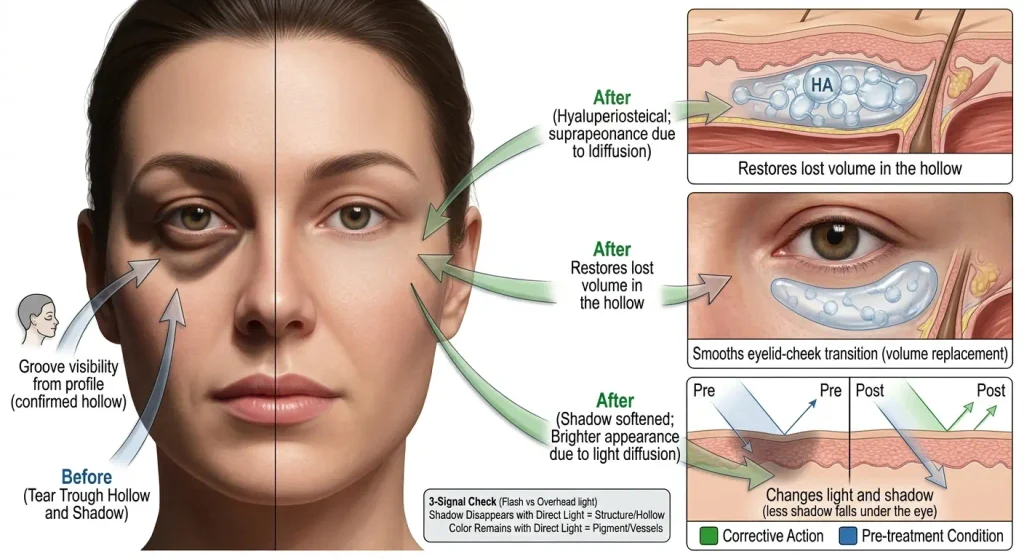
- Restores volume in the hollow where tissue was lost.
- Reduces the depression along the tear trough.
- Changes light and shadow so less shadow falls under the eye.
- Smooths the eyelid-cheek transition into a gentler contour.
- Can make the area look brighter because less shadow is visible.
That last point is about shadow, not skin color. Filler does not lift pigment. To get rid of dark circles caused by hollows, the goal is to reduce the hollow, not to bleach the skin.
Which Fillers Are Used for Dark Circles?
There is no single best filler for every under-eye. Product choice depends on anatomy, hollow depth, skin thickness, degree of correction, prior filler, edema tendency, provider experience, the product’s approved indication and clinician preference.
| Product | Under-eye status | Key point |
|---|---|---|
| Restylane Eyelight | FDA-approved (May 2023) for infraorbital hollowing, adults over 21 | Results may last up to 12 months per the FDA |
| JUVÉDERM VOLBELLA XC | FDA-approved (May 2021) for infraorbital hollowing, adults over 21 | FDA-required provider training; results may last up to 12 months |
| Belotero Balance (+) | Infraorbital hollow indication added in 2023, adults over 21 | Check current labeling |
| RHA Redensity Eye | Approved in 2026 (adults 22 and older) | Newest; up to 12 months in its study |
| Other HA fillers | Depends on product and indication | Not every filler is approved for the under-eye area |
The FDA describes JUVÉDERM VOLBELLA XC as improving the appearance of darkness or hollowness under the eyes by temporarily adding volume. Approvals change, so confirm current status with the FDA or manufacturer.
If a clinician recommends a product that is not indicated for the under-eye area, ask why and what the evidence is.
Restylane Eyelight vs JUVÉDERM Volbella XC
| Factor | Restylane Eyelight | JUVÉDERM VOLBELLA XC |
|---|---|---|
| FDA indication | Infraorbital hollowing, adults over 21 | Infraorbital hollowing (also lips), adults over 21 |
| Treatment area | Between the lower eyelid and cheekbone | Under-eye hollow |
| HA formulation | Crosslinked HA gel with 0.3% lidocaine, NASHA technology | Soft HA gel with low water affinity, per the manufacturer |
| Clinical evidence | FDA pivotal study randomized 287 subjects to treatment or none; FDA reports 64% had at least a 1-point improvement at 12 months | Manufacturer reports 90% satisfaction through 1 year |
| Duration per labeling | Up to 12 months per the FDA (the manufacturer cites up to 18 months with optimal treatment) | Up to 12 months |
| Treatment approach | Conservative placement; a follow-up session may be recommended | Provider must complete training; combined use with VOLUMA XC not studied |
| Patient selection | Not for people with certain allergies; caution with edema tendency | Not for people with certain allergies |
| Important limitations | Excessive swelling possible in people prone to edema | Evidence is mainly manufacturer-reported |
Neither is universally better. The right choice depends on your anatomy and your injector’s experience with the product.
JUVÉDERM and Restylane for Dark Circles: What Can They Actually Treat?
JUVÉDERM VOLBELLA XC and Restylane Eyelight are hyaluronic acid fillers with specific U.S. Food and Drug Administration (FDA) indications involving infraorbital hollowing. They are not general treatments for every cause of dark circles.
- JUVÉDERM VOLBELLA XC: Its FDA-approved under-eye indication is for improvement of infraorbital hollowing in adults over age 21.
- Restylane Eyelight: Its FDA-approved indication is for improvement of infraorbital hollowing in adults aged 21 and older.
These indications concern hollowing, not the direct removal of skin pigmentation or visible blood vessels. The right product depends on the patient’s anatomy, skin characteristics, medical history, and the treating clinician’s assessment. Neither product is universally best for every under-eye concern.
FDA approval establishes an approved use; it does not mean the treatment is risk-free or appropriate for every patient. Patients should ask the injector which exact product is proposed and whether its intended use matches their condition.
Does Botox Help Dark Circles Under the Eyes?
Botox is not a standard treatment for dark circles caused by pigmentation, visible blood vessels, or a tear-trough hollow. Botox and hyaluronic acid filler work differently: Botox temporarily reduces activity in selected muscles, while HA filler adds volume to a treated area.
Botulinum toxin may be used for certain expression-related lines around the eyes when clinically appropriate, but that is different from treating the underlying cause of dark circles. It does not remove melanin, eliminate visible blood vessels, or replace lost volume in a hollow.
If your main concern is under-eye darkness, a clinician should first determine whether it comes from hollowing, pigmentation, vascular visibility, bags, or a mixture. Choosing an injectable treatment before identifying the cause can lead to limited or disappointing results.
How Is Under-Eye Filler Injected?
This is for understanding only. Under-eye filler should only be injected by a qualified clinician, and DIY injection is dangerous.
Consultation and anatomy assessment
Your clinician reviews your history, previous filler, allergies, medications and your lower eyelid, upper cheek and midface anatomy.
Treatment planning
A plan decides whether cheek support or other treatments should come first.
Needle vs cannula
A fine needle or blunt cannula may be used. Reviews report that cannulas may cause less pain and swelling, but injector skill matters more than the tool.
Injection depth and placement
Small amounts are placed deep, close to the bone (supraperiosteal), to avoid a visible or bluish filler layer.
Conservative correction
Careful injectors undercorrect, because HA draws in water.
Follow-up and touch-up assessment
A review at about 2 to 4 weeks lets the clinician judge the settled result. The visit usually takes 15 to 30 minutes.
What Results Can You Expect?
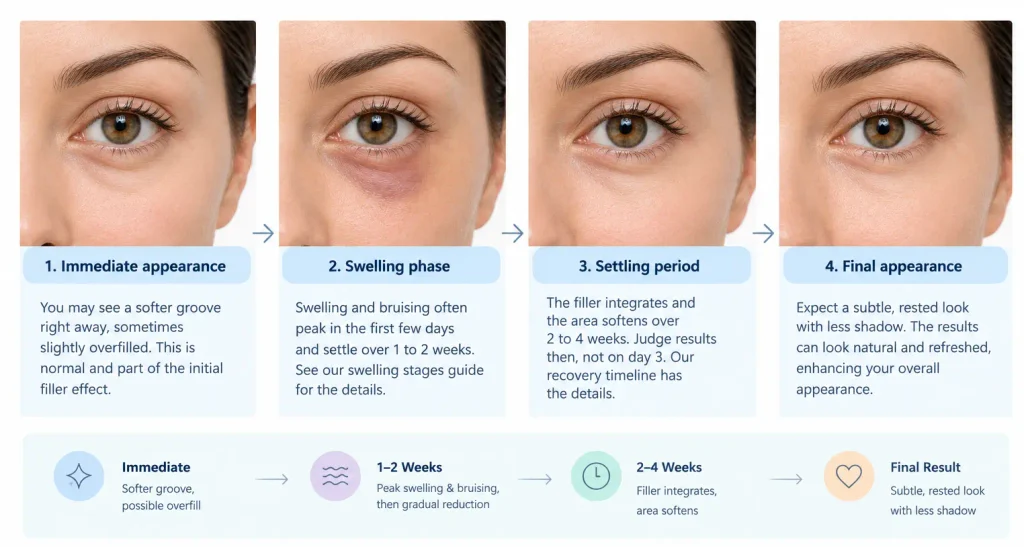
Immediate appearance
You may see a softer groove right away, sometimes slightly overfilled.
Swelling phase
Swelling and bruising often peak in the first days and settle over 1 to 2 weeks. See our swelling stages guide.
Settling period
The filler integrates and the area softens over 2 to 4 weeks. Judge results then, not on day 3. Our recovery timeline has the details.
Final appearance
Expect a subtle, rested look with less shadow.
How much can dark circles improve?
It depends on how much of your darkness is hollow. Filler rarely eliminates dark circles completely, and no clinician should promise that.
How Long Does Under-Eye Filler Last?
Most labeling and sources point to about 9 to 12 months, with some people reaching 18. Duration depends on:
- Product: FDA labeling for both Restylane Eyelight and VOLBELLA XC says up to 12 months.
- Anatomy and patient factors: metabolism and the depth of the hollow.
- Treatment amount: touch-ups at 2 to 4 weeks can affect the final volume.
- Maintenance: repeat treatment is needed when volume fades.
HA filler is temporary and can be broken down with hyaluronidase.
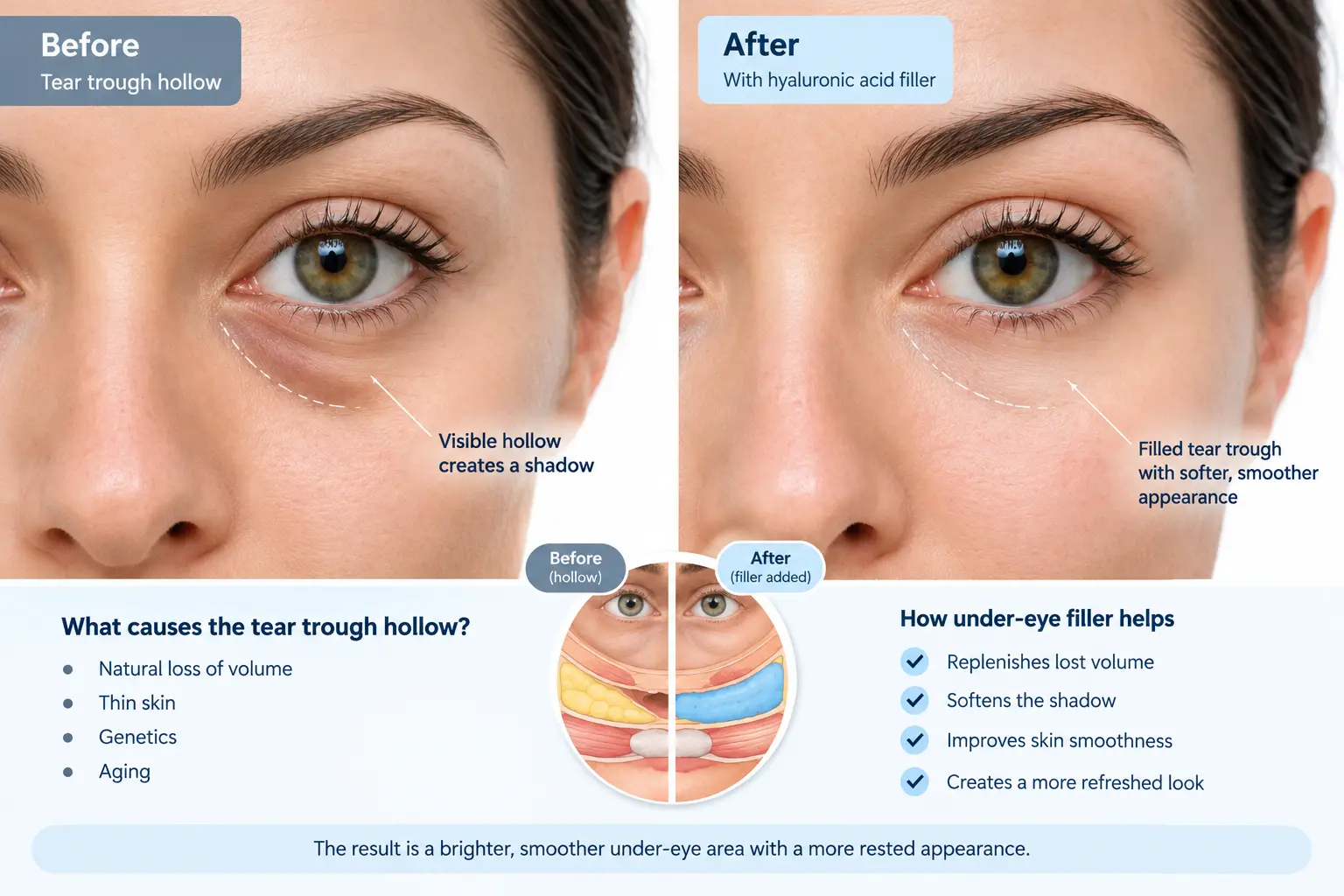
Under-Eye Filler Before and After: What Results Should You Expect?
Before-and-after photos can help illustrate what under-eye filler may change, but they should be interpreted carefully. In an appropriate candidate with structural hollowing, treatment may soften the tear-trough groove, reduce the shadow it creates, and improve the transition between the lower eyelid and cheek.
Filler should not be expected to erase every dark circle. Brown pigmentation, visible blood vessels, prominent fat bags, and significant skin laxity may remain after treatment. Swelling can also affect the early appearance, so an immediate post-treatment image may not represent the final result.
When comparing before-and-after photos, look for:
- Similar lighting, camera angle, facial expression, and image distance.
- A clear view of the under-eye contour rather than changes caused by makeup or shadows.
- Consistent image quality and no obvious smoothing or retouching.
- Follow-up photos that show how the result looks after initial swelling has settled.
- A realistic improvement in hollowing rather than a claim that all discoloration has disappeared.
Individual results vary. Ask the treating clinician what change is realistic for your specific anatomy and what concerns are unlikely to improve with filler.
Lighting matters enormously. Photos are not directly comparable unless the lighting, angle, camera distance, makeup and timing match. A photo taken at 3 days will look different from one at 4 weeks. See our full guide to under-eye filler before and after results.
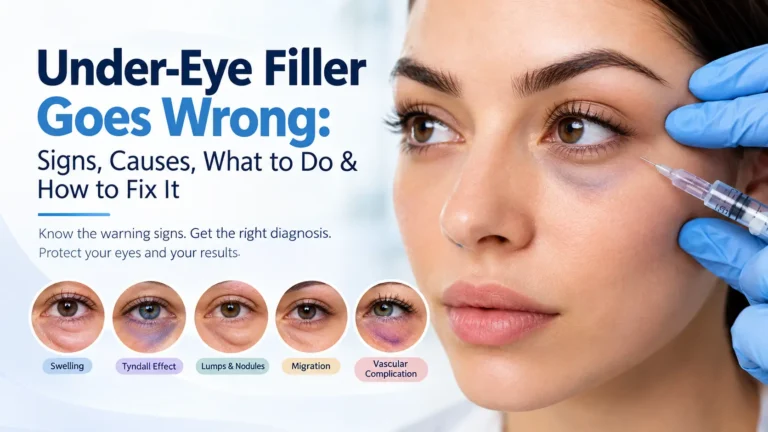
Risks and Complications of Under-Eye Filler
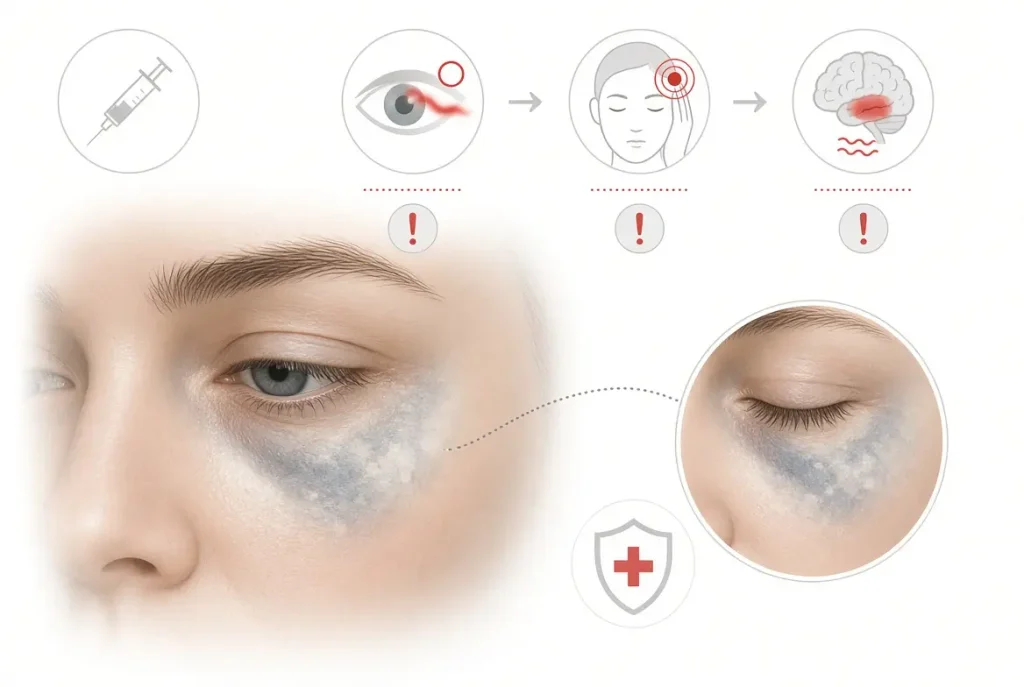
The tear trough is one of the more technically demanding areas to treat with filler. A tear-trough review cites a 2006 consensus describing it as the most challenging.
Common short-term effects
- Swelling
- Bruising
- Tenderness
- Redness
Aesthetic complications
- Overfilling and lumps or nodules
- Asymmetry
- Tyndall effect (a bluish tint when filler sits too superficially in thin skin)
- Prolonged puffiness and malar edema
- Migration
- A delayed inflammatory reaction
Rare but serious complications
- Vascular occlusion, which can cause tissue ischemia
- Vision-threatening complications, including vision loss
- Infection
The review calls blindness extremely rare but possibly under-reported. Restylane Eyelight labeling also warns that injecting into a vessel may lead to embolization or occlusion, and that people prone to edema may have excessive swelling. Read more in our risks and complications guide.
Get emergency care immediately for vision changes, severe or unusual pain, skin that turns white or blotchy, or stroke-like symptoms.
Can Under-Eye Filler Make Dark Circles Worse?
Yes, in some cases. Possible mechanisms:
- Swelling: early edema can look puffy or darker.
- Superficial filler: filler too close to the surface can give a bluish tint (Tyndall effect).
- Overcorrection: too much product can create a shelf or fullness that casts its own shadow.
- Persistent edema: HA attracts water, and some people retain it longer.
- Incorrect diagnosis: filler placed for a bag or pigment problem will not help and can worsen the look.
Why do I still have dark circles after filler?
The most common reason is that the darkness was never purely a hollow. Pigment, vessels or a bag may remain once the shadow is softened. Early swelling can also hide the result for 2 to 4 weeks.
What If I Don’t Like My Under-Eye Filler?
Observation during normal settling
Early swelling, minor lumps and asymmetry often change as the area settles, so don’t judge too early.
Follow-up assessment
Return to your injector at 2 to 4 weeks and describe what bothers you.
Hyaluronidase for appropriate HA filler complications and corrections
If HA filler is causing a problem, an enzyme called hyaluronidase can break it down. Juvéderm notes that removal effectiveness has not been formally studied.
When urgent medical assessment is needed
Vision changes, severe pain or skin color change need immediate care.
See our guide to dissolving under-eye filler.
Hollowness and Dark Circles: When Can Tear-Trough Filler Help?
A tear-trough hollow is a depression along the transition between the lower eyelid and upper cheek. Depending on facial anatomy, age-related changes, and lighting, this depression can cast a shadow that looks like a dark circle.
Tear-trough filler may help when the darkness is substantially caused by this structural hollow. By restoring some volume, a suitable hyaluronic acid filler may soften the groove and reduce the shadow.
Filler is less likely to address the main problem when the darkness comes primarily from:
- Brown pigmentation: excess melanin or other pigment-related changes in the skin.
- Blue or purple discoloration: visible blood vessels or thin, translucent skin.
- Prominent eye bags: bulging tissue that creates fullness and an adjacent shadow.
- Festoons or persistent puffiness: swelling or tissue changes that can become more noticeable with added volume.
- Significant skin laxity: loose skin that cannot be corrected simply by filling a hollow.
More than one cause can be present. Treating the hollow may reduce the shadow without eliminating pigmentation or vascular discoloration.
Under-Eye Filler vs PRP/PRF
PRP (platelet-rich plasma) and PRF (platelet-rich fibrin) are made from your own blood and are aimed at skin quality, not volume. Evidence for dark circles is still limited, so ask what supports its use for your type.
| Concern | Filler | PRP/PRF |
|---|---|---|
| Structural hollow | Stronger fit | Limited |
| Volume replacement | Yes | Limited |
| Skin quality | Limited | Potentially |
| Pigmentation | No direct treatment | Not a direct pigment treatment |
| Immediate structural correction | Yes | No |
Under-Eye Filler vs Laser
- Filler: structural shadow and hollow.
- Laser and skin treatments: selected pigment and texture concerns.
Not every dark circle should receive laser. Procedures that inflame skin can cause pigment changes in some skin types, so skin type and clinician experience matter. Other options, such as IPL, skin resurfacing and chemical peels, follow the same logic: they target skin, not hollows.
Under-Eye Filler vs Lower Blepharoplasty
| Situation | More likely consideration |
|---|---|
| Mild structural hollow | Filler |
| Significant fat protrusion | Lower blepharoplasty evaluation |
| Significant skin laxity | Surgical evaluation |
| Mixed hollow and bags | Individualized combination or structural plan (for example, fat transfer or fat repositioning) |
How Much Does Under-Eye Filler Cost?
Costs vary by provider, product and location, and insurance does not cover this cosmetic treatment. See our U.S. under-eye filler cost guide for details.
The American Society of Plastic Surgeons (ASPS) publishes an average for HA dermal fillers overall, and the figure has varied between updates. That is not an under-eye-specific price. ASPS notes that provider expertise, treatment type and location all affect cost.
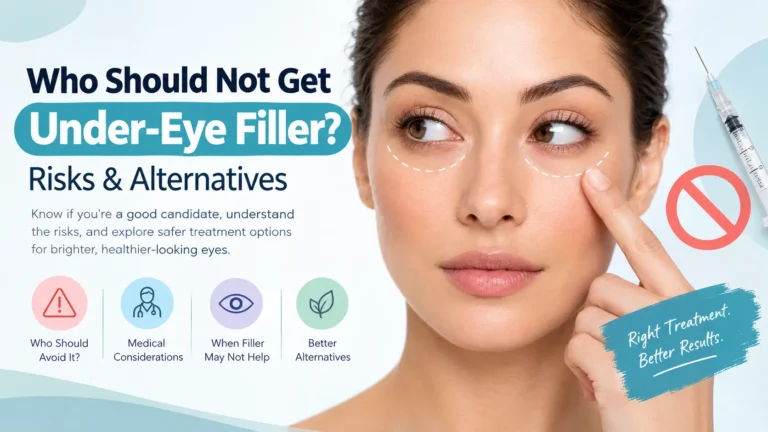
Who Is a Good Candidate for Under-Eye Filler?
Usually good candidates have:
- Structural hollowing
- Realistic expectations
- Appropriate anatomy and soft-tissue characteristics
- No active infection
- A suitable medical history
- Adult age within the product’s indication
May be poor candidates:
- Pure pigmentation or vascular darkness
- Significant bags, festoons or skin laxity
- Unrealistic expectations
- Allergy to HA products or lidocaine
- Active infection near the eyes
- Pregnancy or breastfeeding (safety has not been studied)
How to Choose a Qualified Under-Eye Filler Provider
ASPS stresses that a provider’s experience and board certification matter as much as cost. Use this checklist:
- Relevant credentials: board-certified dermatologist, plastic surgeon or oculoplastic surgeon, or an aesthetic physician or trained nurse practitioner under proper licensing
- Specific periorbital experience
- Understanding of eyelid and vascular anatomy
- Ability to manage complications, including a hyaluronidase supply
- Appropriate product selection and willingness to explain it
- A before-and-after portfolio with consent
- A transparent discussion of alternatives
- An emergency protocol
- A conservative approach
Frequently Asked Questions
Can filler remove dark circles permanently?
No. HA filler is temporary, and it only improves dark circles caused by hollows. Pigment and vessel-related darkness are not directly treated.
What is the best filler for dark circles?
No single product is best for everyone. Restylane Eyelight and JUVÉDERM VOLBELLA XC are FDA-approved for infraorbital hollowing, and others have since been added.
Does Restylane Eyelight help dark circles?
It can help dark circles caused by hollows by restoring volume. It does not treat pigment.
Does JUVÉDERM Volbella help dark circles?
The FDA describes it as improving darkness or hollowness under the eyes by adding volume. It works through the hollow, not the pigment.
Can filler fix pigmentation?
No. Pigment needs skin-directed treatment.
Can blepharoplasty get rid of dark circles?
Lower blepharoplasty may improve the appearance of prominent under-eye bags or excess tissue in selected patients. It does not necessarily correct pigmentation or visible blood vessels, and suitability should be assessed by a qualified surgeon.
Can filler make eye bags worse?
Yes. Filler adds volume, which can make a fat bag look heavier. A specialist can advise whether surgery fits better.
How long does under-eye filler last?
Most often about 9 to 12 months, with up to 12 months per FDA labeling of the approved products.
How much does under-eye filler cost?
Cost varies widely by provider and location. See our cost guide for current ranges.
Is under-eye filler safe?
It is generally well tolerated in trained hands, but the area is delicate and rare vascular complications can be serious.
Can under-eye filler be dissolved?
Yes, HA filler can be broken down with hyaluronidase, though removal effectiveness has not been formally studied.
Is PRF better than filler for dark circles?
It depends on the cause. Filler is a stronger fit for hollows, while PRF targets skin quality and has limited evidence for dark circles.
Is filler better than laser for dark circles?
Not universally. Filler suits hollows, and laser suits selected pigment or texture concerns.
Is under-eye filler worth it?
It can be for the right candidate, meaning a hollow-driven dark circle with realistic expectations. It is poor value when the cause is pigment, bags or loose skin.
Does under-eye filler help with dark circles?
It may help when dark circles are primarily caused by a structural tear-trough hollow and the shadow it creates. It is less likely to help pigmentation or visible blood vessels, and it may be unsuitable for prominent bags or persistent puffiness.
Reliable Sources
- FDA: Restylane Eyelight approval (P040024/S135)
- FDA: JUVÉDERM VOLBELLA XC approval (P110033/S053)
- Dermal Fillers for the Treatment of Tear Trough Deformity (J Cutan Aesthet Surg)
- Recommendations for tear trough treatment with HA filler (PubMed)
- ASPS: dermal filler cost
- Merz: Belotero Balance (+) treatment areas
This guide is educational and does not replace advice from a qualified clinician. Medical content is reviewed by [Reviewer name, credentials]. Prices change, so check current figures.

Sarah Mitchell is the founder and research editor of Under Eyes Filler, an independent patient-education resource. She is a researcher and writer, not a licensed medical professional. Her work is to read clinical studies and official FDA and ASPS guidance, then translate them into clear, honest explanations of under-eye filler results, recovery, risks, and realistic costs, so readers can prepare better questions for their own qualified provider.